Showing posts with label Automated Income Tax Form 10 E in Excel. Show all posts

Friday, 1 July 2022

Tax Savings tips for the F.Y.2022-23| With automated Income Tax Arrears Relief Calculator U/s 89(1) with Form 10E for the F.Y.2022-23

 Tax Savings tips for the F.Y.2022-23 | How to save tax or rather how to plan your investment is a

 question that bothers each one of us. While tax planning is crucial, taxes saving schemes are also

 essential. You can save tax and earn returns with the best tax-saving schemes in India. The ideal time to

 plan for tax-saving investments is the beginning of the financial year. This will ensure you don’t pay

 more taxes and save taxes in Indiaalong with year-long returns on tax-saving investments.


While we all aim to save taxes in Indiawhy do only a few of us succeed? The answer could be a lack of knowledge or struggles in fitting the best-suited choice in your investment planning. In this article, we have listed each of the best tax-saving investment options in Indiato help you compare and make a well-informed investment decision. 


While planning on how to save tax in India, you must also ensure that your goal is not just tax saving. The goal must be to invest in the best-suited investment option along with income tax savings. We have listed the best tax-saving scheme options for 2020-21 in this article.

You may also like- Automated Income Tax Form 16 Part B One by One Preparation software in Excel for the F.Y.2021-22

form 16 Part B

1. Unit Linked Insurance Plan (ULIP)

ULIP Life Insurance Plan is one of the most important investment plans in India. It ensures that one’s family is financially balanced in the case of an event of death. By purchasing a life insurance policy, the taxpayer can avail of the benefit under the income tax act.


Under section 80C of the income tax act 1961, the premium paid towards the purchase of a life insurance policy qualifies for deduction up to Rs. 1.5 lakh. Furthermore, as per section10(10D) income on the maturity of the policy is tax-free. The income is tax-free if the premium is not more than 10% of the sum assured. In the case wherein the money goes to the nominee of the person insured, the same remains as a tax exemption in the hands of the nominee.


In terms of the deduction under section 80C 1961, the taxpayer can claim 20% of a tax deduction on the premium paid. The following conditions also apply:

1. The taxpayer purchases a life insurance policy on or before 31st March 2012

2. The policy is in his own name or in the name of their spouse or child

If the life insurance policy is purchased after 1st April 2012, then the premium paid is eligible for tax deduction up to 10% of the sum assured.


2. ELSS Mutual Funds

Equity Linked Savings Schemes are mutual fund investment schemes that invest a large percentage of their portfolio in equity. Furthermore, the fund has a mandatory lock-in period of 3 years which is the shortest among all the investment products.


Investment in ELSS funds qualifies for deduction under section 80C of the income tax act up to a maximum of Rs. 1.5 lakh. Both lump sum investment and the amount invested through a systematic investment plan (SIP) qualify for the deduction. Since ELSS funds invest a large amount in equity, there is always some inherent risk.

ELSS funds provide the dual benefit of capital appreciation and tax savings. This makes it one of the most popular tax-saving schemes amongst investors.

You may also like- Automated Income Tax Form 16 Part A&B One by One Preparation software in Excel for the F.Y.2021-22 

Income Tax Form 16

In general, taxpayers who want to claim tax deductions of up to Rs 1.5 lakh under Section 80C provisions and are willing to take some risk should consider investing in ELSS. These mutual funds are equity-oriented, and they invest a minimum of 60% of their portfolio in equity and equity-linked instruments. This makes it crucial to be invested in the funds for a long period of time in order to reap the benefit of the returns.

Learn: How to Save Tax by Investing in Mutual Funds


3. Public Provident Fund (PPF)

The Public Provident Fund has always been a popular tax-saving scheme among the taxpayer. One of the major reasons for this popularity is the fact that PPF falls under the category of exempt tax status. You can open your PPF accounts with a bank or post office.


Taxpayers can claim a deduction under section 80C of the income tax act for the amount invested by them during the financial year. The maximum amount eligible for deduction is Rs. 1.5 lakhs. Since PPF falls under the exempt category, the interest and maturity amount are exempt from tax.


PPF account comes with a lock-in period of 15 years and it allows the investors the below options at the end of the maturity period:

Download Automated Excel Based Income Tax Salary Arrears Relief Calculator U/s 89(1)with Form 10E from the Financial Year 2000-01 to the Financial Year 2022-23 (Updated Version)

Tax Savings tips for the F.Y.2022-23

Tax Savings tips for the F.Y.2022-23

Tuesday, 19 April 2022

The five most important sections of income tax| With Automated Income Tax Arrears Relief Calculator U/s 89(1) with Form 10-E from the F.Y.2000-01 to 2022-23

 The five most important sections of income tax| Anyone who earns income in the state is responsible

 for paying income tax. The Income Tax Law consists of different articles that deal separately with

 various aspects of taxation in the country. In addition, this law also provides taxpayers with several

 income tax deductions that they can claim when filing their Income Tax Returns (ITR). Once the

 deductions have been made, the tax will be charged on the total tax base according to the rates of the

 taxpayer's income tax bracket.


Income Tax Act has 23 chapters in total and 298 sections, according to the official website of the Department of Income Tax. Although it is very tedious to review all the sections and chapters of the income tax, the Income Tax Administration encourages taxpayers to take advantage of the deductions and rebates provided for in the Income Tax Law, to reduce the amount subject to tax.


However, there are five sections in particular that every taxpayer should know, which will be especially useful when he decides to invest his group in one of the investment vehicles.

Download and Prepare at a time 50 Employees Form 16 Part B for the Financial Year 2021-22

Form 16 Part B


Section 80C - Tax deduction on investments

Section 80C of the Income Tax Act allows deductions for investments made in certain instruments. Two of the most popular are tax-saving mutual funds and tax-saving fixed deposits. Tax-saving mutual funds are equity-oriented; This means that at least 65% of its entities must invest in inequality.


The Equity Linked Savings Scheme (ELSS) comes with a 3-year lock-in period of a minimum of 80% of the group invested in the shares and is eligible for tax deductions of up to Rs. 1.5 lakhs under Section 80C of the Income Tax Act.


Similarly, a tax-saving fixed deposit system has a maturity of at least 5 years, with a maximum deduction of Rs. 1.5 lakhs an investor can claim. Tax on interest earned in excess of 10% will be based on the rates in the personal income tax bracket.


You can invest in time deposits with returns of up to 8.35% at Finserv Markets (with an additional 0.25% above current senior rates). You can choose between flexible tenures ranging from 12 months to 5 years and benefit from guaranteed returns.


Deduction 80CCC - Tax Deduction for Contribution to Pension Funds

As a result of an attempt to encourage taxpayers to begin investing in pension funds, Section 80CCC provides an income tax deduction for Chapter VI-A pension funds from the taxpayer's gross gross income for that tax year. . This provides a tax deduction for any amount paid or deposited in the annual premium plan of any insurance company (LIC or other). Also, the maximum deduction that can be claimed through Section 80CCC is Rs. 1.5 lakhs.

Download and Prepare at a time 50 Employees Form 16 Part A&B for the Financial Year 2021-22


The five most important sections of income tax

Section 80CCD - Tax Deduction for Contribution to the National Pension Scheme

Section 80CCD establishes income tax deductions for contributions to the National Pension System (NPS). Also, the maximum deduction that can be claimed from Section 80CCD (1) is 10% in the case of a salaried person (employee) from non-employees (self-employed).


Section 80CCD (1B) entitled to get an additional deduction of up to Rupees Fifty Thousand for the group deposited by the individual into their NPS account.


Section 80CCD(2) allows individuals to claim an additional deduction on their contribution to an employee's pension account of up to 10% of their salary.


Section 80TTA - Tax exemption for interest on a savings account

Under Section 80TTA of the Income Tax Act (Chapter VI-A), individuals can claim an exemption of up to Rs. 10,000 per year of interest earned on deposits in savings accounts held in banks, post offices or cooperatives.


Section 80TTB - Interest Income Tax Exemption for Seniors Citizen above 60 Years Age.

According to the 80 TTB section of the Income Tax Law, seniors (age 60 and over) can claim tax credits on the interest income from deposits they hold. The maximum allowable deduction in a financial year is Rs. 50000.

Download Automated Income Tax Arrears Relief Calculator U/s89 (1) with Form 10E from the F.Y.2000-01 to F.Y.2022-23(Updated Version)

The five most important sections of income tax

The five most important sections of income tax

Income Tax Form 10 E

Monday, 18 April 2022

See How Much Tax You Can Save in the Fiscal Year 2022-2023 | With automatic income tax filling for government and non-government employees for the fiscal year 2022-23

See How Much Tax You Can Save in the Fiscal Year 2022-2023| Chapter VI A of the Income Tax Act

 contains various subsections of section 80 that allow a taxpayer to claim deductions from total gross

 income.


There are taxpayers who have not yet invested in the financial products needed to save on taxes. If you are one of those who are still undecided on which financial product you can invest in to cut taxes this year, here are some options for you.


Chapter VI A of the Income Tax Act contains various subsections of section 80 that allow the taxpayer to request deductions from the total gross income of various investments that save on taxes, eligible expenses, donations, etc. These deductions allow the taxpayer to significantly reduce the tax payable.

Download Automatic Income Tax Preparation Excel Based Software All in One for the Non-Govt Employees for the Financial Year 2022-23 as per Budget2022

See How Much Tax You Can Save in the Fiscal Year 2022-2023

Feature of this Excel Utility:-


1) This Excel Utility Prepare Your Income Tax as per your option U/s 115BAC perfectly.


2) This Excel Utility has the all amended Income Tax Section as per Budget 2022


3) Automated Calculation Income Tax House Rent Exemption U/s 10(13A)


4) Individual Salary Structure as per the Non-Govt Concern’s Salary Pattern


6) Individual Salary Sheet


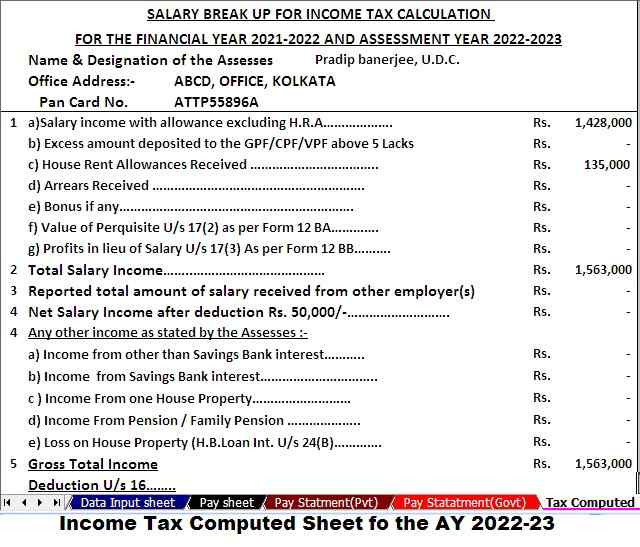
7) Individual Tax Computed Sheet


8) Automated Income Tax Revised Form 16 Part A&B for the F.Y.2022-23


9) Automated Income Tax Revised Form 16 Part B for the F.Y.2022-23


10) Automatic Convert the amount into the in-words without any Excel Formula


Chapter VI A of the Income Tax Act contains the following sections:


80C: Deduction in connection with LIC premium, deferred annuities, contributions to a Provident Fund (PF), subscription of certain shares or bonds, etc. The deduction limit is Rs 1,5 lakh together with section 80CCC and section 80CCD (1).

80CCC: Deduction for contributions to some pension funds. The deduction limit is Rs 1,5 lakh together with section 80C and section 80CCD (1).


80CCD (1): Deduction of the contribution to the central government pension scheme - in the case of an employee, 10 per cent of the salary (base + DA), and in all other cases, 20 per cent of his total gross income. in the exercise will not be taxed. The general limit is Rs 1.5 lakh along with 80C and 80CCC.


80CCD (1B): Deductible of up to Rs 50,000 against contributions to the central government pension scheme (NTS).


80CCD (2): employer deduction of central government pension contributions. A tax credit is available on an employer contribution of 14% if the central government contributes and if any other employer contributes, a tax credit on a contribution of 10% is granted.


80D: Deduction for the health insurance premium. A maximum limit of Rs 25,000 is under the age of 60 years for deduction for people other than the elderly. For seniors, the limit is 50,000 rupees and the total limit of 80D U / s is 1 million rupees.

80DD: Food deduction, including the treatment of a dependent person with a disability. The maximum deduction in this section is Rs 75,000.


80DDB: Deduction on expenses up to Rs 40,000 for the treatment of a specific disease by a neurologist, oncologist, urologist, haematologist, immunologist or other specialists possibly appointed.


80E: Deduction of interest on a university loan without the maximum limit.


80EE: Interest deduction of up to Rs 50,000 on a loan taken out to purchase a residential home.


80EEA: deduction of interest up to 1.5 lakh on a loan taken out for the purchase of a specific house (affordable housing).


80EEB: Deduction on interest up to 1.5 lakh on a loan taken out for the purchase of an electric car.


80G: Donations to certain foundations, charities, etc. Depending on the nature of the donee, the limit varies from 100 % of the total donation to 50 % of the total donation, or 50 % of the donation with a 10 % cap. Gross Income.


80GG: Deductions for rent paid by self-employed people who do not receive HRA benefits. The deduction limit is Rs 5,000 per month or 25 per cent of gross income per year, whichever is lower.


80GGA: Full deductions for some donations to research or rural development.


80GGC: Full deductions for donations to a political party, provided such donations are in kind.


80TTA: Deductions for interest on savings accounts up to Rs 10,000 if the taxpayers are not senior residents.


80 TTB: Deposit interest deductions up to Rs 50,000 for senior residents.


80U: Disability deduction. Depending on the type and degree of disability, the maximum allowable deduction in this section is Rs 1.25 million.


Download Automated IncomeTax Preparation Excel Based Software All in One for the Government andNon-Government (Private) Employees for the Financial Year 2022-23 and Assessment Year 2023-24 U/s 115BAC


Tax computed Sheet

Feature of this Excel Utility:-

1) This Excel Utility Prepare Your Income Tax as per

2) This Excel Utility has the all amended Income Tax Section as per Budget 2022 

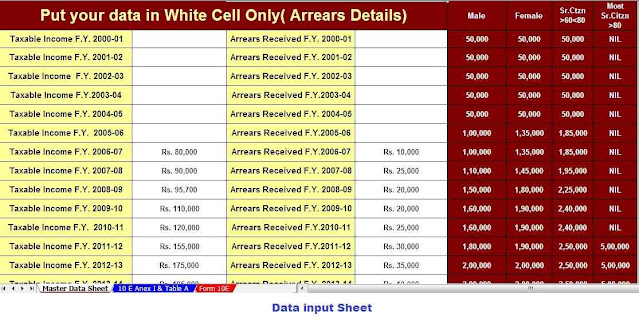
3) Automated Income Tax Arrears Relief Calculator U/s 89(1) with Form 10E from the F.Y.2000-01 to F.Y.2022-23 (Updated Version) 

4) Automated Calculation Income Tax House Rent Exemption U/s 10(13A) 

5) Individual Salary Structure as per the Govt and Private Concern Salary Pattern 

6) Individual Salary Sheet 

7) Individual Tax Computed Sheet 

8) Automated Income Tax Revised Form 16 Part A&B for the F.Y.2022-23 

9) Automated Income Tax Revised Form 16 Part B for the F.Y.2022-23 

10) Automatic Convert the amount into the in-words without any Excel Formula

Tuesday, 11 January 2022

Auto Calculate Income Tax Salary Arrears Relief Calculator U/s 89(1) with Form 10 E for the F.Y.2021-22

 In the case of a salaried person, there may be occasions when the company may delay payment of

 salary. If this happens, the tax burden for salaried employees may change or increase due to the

 understanding of past arrears paid in the current year. Acknowledging this hardship, the government

 has made provisions to provide relief to salaried employees in case of arrears of salary in a particular

 year. It also covers tax relief pay arrears and advances payments under section 89.


Section 89(1) calculates the tax relief available to a salaried employee. Here are some steps to calculate tax relief: 

Auto Calculate Income Tax Salary Arrears Relief Calculator U/s 89(1)

Step 1:

You will need to calculate the tax payable on the total salary amount, including any arrears or advance payment. The Form 16 that you will receive from your employer will contain details of any arrears or advance payments.


You will need to calculate the tax on salary considering standard deduction under section VI such as section 80C for investment deduction, section 80D for health insurance, section 80TTA for interest income, section 80G for grants and any other deduction applicable to the assessee. Taxes including cess must be calculated and based on the existing slab rate.


Step 2:

In Step 2, you need to calculate the total tax on your salary income without considering the salary arrears or advance. You will need to subtract this amount from your salary and calculate the tax after executing the deduction as per step 1 calculation.


Step 3:

You need to calculate the difference between the tax payable in step 1 and step 2. You will have to pay an extra tax burden due to arrears or salary advances.


Step 4:

You need to calculate the total tax payable based on the slabs and rules for the year in which the arrears are related. For example, if your company pays you your salary from 2015-16, you need to calculate your tax based on income from 2015-16 after adding the amount due. The deduction must give an effect for this calculation.


Step 5:

The amount of your tax for the year you are in arrears is already available based on past returns. In our example above, the tax paid for 2015-16 can be deducted from your past income tax return.


Step 6:

You need to calculate the difference between the actual tax payable from the year of arrears and the tax that will be payable, including the arrears.


If the tax difference due to arrears exceeds the tax difference from the salary arrears year, the additional sanction is given as relief under section 89. For example, if in 2019-20 there are additional taxes due to arrears of 5,000 and from 2017-18 there are additional taxes with arrears of money. 4,000, then relief of Rs. 1,000 will be paid to the taxpayer.


To get this relief, the taxpayer must fill out Form 10E

Know to abut Form 10 E

You can fill up Form 10E online by logging in to the Income Tax e-filing website and going to the Income Tax Forms section. The Income Tax website has rules and guidelines on how to fill out Form 10E. Details of the form are required such as:

Name and address of the employee

Pan

Residential status

• Salary arrears or advance received

Paying gratuity

Payment by the employer in case of termination of employment before the expiry of the notice

Commuted pension payment

It must be signed by the employee.

Detailed information on salary arrears or advances is also required to calculate relief.

Actual salary received  in arrears

Additional tax for the current financial year

Excess tax in arrears year

Differential tax or additional tax paid due to arrears or advance pay

Relief under section 89

In addition to salary arrears or advances, the form also deals with relief in the case of gratuity, termination compensation or commuted pension.

Form 10E income tax must be filled and submitted online. Salary employees will get relief only after filling the form. The process is fairly simple and can be easily done online to get tax relief.

Download Auto Calculate Income Tax Arrears Relief Calculator U/s 89(1)with Form 10 E from the F.Y.2000-01 to F.Y.2021-22(Updated Version as per Budget 2021)

Auto Calculate Income Tax Salary Arrears Relief Calculator U/s 89(1)

Income Tax Form 10 E
form 10 E


Tuesday, 7 December 2021

Tax benefits on home loans| With Automatic Salary Arrears Relief Calculator U/s 89(1) with Form 10 E from F.Y.2000-01 to F.Y.2021-22 (Up-to-date Version}

Tax benefits on home loans. Union Finance Minister Nirmala Sitharaman in her budget speech proposed to extend the deadline for getting additional concessions for repaying interest on home loans till March 31, 2022. This comes after the government extended the deadline to March 31, 2021, in the previous budget.

While a housing loan can help you get a home for yourself, it can also be a costly affair. But the various tax benefits that come with this type of loan help you save money every year. See how you can make the most of these benefits.

Tax Benefits on Home Loans (F.Y 2021-22)

The following table gives you tax benefits under the relevant sections of the Income-tax Act, 1961.

New Update (Union Budget 2021-2022)

Here is an update from the latest budget presented by Union Finance Minister Nirmala Sitharaman on 1 February 2021:

The eligibility period has been extended till March 31, 2022, to claim an additional deduction for the interest of Rs 1.5 lakh on a loan taken to buy an affordable home.

The eligibility to claim tax left for affordable housing projects has been extended for another year. The new deadline is March 31, 2022.

A new tax rebate was proposed for the advertised affordable rental housing projects to promote the provision of affordable rental housing for migrant workers. Home Loan Tax Benefit Under Section 80C - Main Deduction. Section 80C relates to the deduction of principal amount:

For both self-acquired and late-out properties, you can claim a maximum of Rs 1.5 lakh per annum from taxable income on basic payments.

Stamp duty and registration charges may be included. These benefits can avail only one time.

You may also, like- Automatic Income Tax Preparation Excel Based Software All in One for the Non-Govt Employees for the F.Y.2021-22.[This Excel Utility prepare at a time Tax Computed Sheet + Individual Salary Structure as per all Non-Govt employees salary pattern+ Automatic H.R.A. Exemption Calculation U/s 10(13A} + Automatic Form 12 BA + Automatic Form 16 Part A&B and Part B for F.Y.2021-22]

Income Tax input sheet

To claim this, you must first complete the construction of the property.

Your home should not be sold within 5 years of your possession to claim this deduction

If you sell your home within 5 years of occupancy, any deductions claimed will be refunded in the year you sell it. This amount will be added to your income for the year of sale.

Tax benefits under section 80EE

It has been proposed to increase the income tax benefit by Tk 1.5 lakh for paying interest

You can get discounts up to Rs.3.5 lakhs

The benefit can be availed on and above the existing exemption of Rs. 2 lakhs under Section 24 (b)

The value of the property must be less than Rs 45 lakh.

Deduction for a joint home loan

If two or more persons take a housing loan, then each of them is eligible to claim a deduction on interest paid up to Rs 2 lakh. Up to Rs 1.5 lakh, tax can also be deducted on the principal paid for each. However, all applicants must be co-owners of the property to claim this discount. Therefore, a joint home loan can give you more tax benefits.

Tax benefits on home loan for owning a second property.

Under the present provisions, the tax benefit is applicable on interest payable. It has been suggested that the second self-occupied home may also be claimed as a self-occupied one to help borrowers save more on taxes.

Download Automated Income Tax Arrears Relief Calculator U/s 89(1) along with Form 10E from the Financial Year 2000-01 to Financial Year 2021-22 (Up-to-date Version)

Tax benefits on home loans

Wednesday, 17 November 2021

Auto Calculate Income Tax Salary Arrears Relief Calculator U/s 89(1) with Form 10 E for the F.Y.2021-22

 Auto Calculate Income Tax Salary Arrears Relief Calculator U/s 89(1), In the case of a salaried person,

 there may be occasions when the company may delay payment of salary. If this happens, the tax

 burden for salaried employees may change or increase due to the understanding of past arrears paid in

 the current year. Acknowledging this hardship, the government has made provisions to provide relief to

 salaried employees in case of arrears of salary in a particular year. It also covers tax relief pay arrears

 and advances payments under section 89.


Section 89 1 calculates the tax relief available to a salaried employee. Here are some steps to calculate tax relief:


Step 1:

You will need to calculate the tax payable on the total salary amount, including any arrears or advance payment. The Form 16 that you will receive from your employer will contain details of any arrears or advance payments.


You will need to calculate the tax on salary considering standard deduction under section VI such as section 80C for investment deduction, section 80D for health insurance, section 80TTA for interest income, section 80G for grants and any other deduction applicable to the assessee. Taxes including cess must be calculated and based on the existing slab rate.


Step 2:

In Step 2, you need to calculate the total tax on your salary income without considering the salary arrears or advance. You will need to subtract this amount from your salary and calculate the tax after executing the deduction as per step 1 calculation.


Step 3:

You need to calculate the difference between the tax payable in step 1 and step 2. You will have to pay an extra tax burden due to arrears or salary advances.


Step 4:

You need to calculate the total tax payable based on the slabs and rules for the year in which the arrears are related. For example, if your company pays you your salary from 2015-16, you need to calculate your tax based on income from 2015-16 after adding the amount due. The deduction must give an effect for this calculation.


Step 5:

The amount of your tax for the year you are in arrears is already available based on past returns. In our example above, the tax paid for 2015-16 can be deducted from your past income tax return.


Step 6:

You need to calculate the difference between the actual tax payable from the year of arrears and the tax that will be payable, including the arrears.


If the tax difference due to arrears exceeds the tax difference from the salary arrears year, the additional sanction is given as relief under section 89. For example, if in 2019-20 there are additional taxes due to arrears of 5,000 and from 2017-18 there are additional taxes with arrears of money. 4,000, then the relief of Rs. 1,000 will be paid to the taxpayer.


To get this relief, the taxpayer must fill out Form 10E

Know to abut Form 10 E

You can fill up Form 10E online by logging in to the Income Tax e-filing website and going to the Income Tax Forms section. The Income Tax website has rules and guidelines on how to fill out Form 10E. Details of the form are required such as:

Name and address of the employee

Pan

Residential status

• Salary arrears or advance received

Paying gratuity

Payment by the employer in case of termination of employment before the expiry of the notice

Commuted pension payment

It must be signed by the employee.

Detailed information on salary arrears or advances is also required to calculate relief.

Actual salary received  in arrears

Additional tax for the current financial year

Excess tax in arrears year

Differential tax or additional tax paid due to arrears or advance pay

Relief under section 89

In addition to salary arrears or advances, the form also deals with relief in the case of gratuity, termination compensation or commuted pension.

Form 10E income tax must be filled and submitted online. Salary employees will get relief only after filling the form. The process is fairly simple and can be easily done online to get taxrelief.

Download Automated Income Tax Arrears Relief Calculator U/s 89(1) along with Form 10E from the Financial the Year 2000-01 to Financial Year 2021-22 (Up-to-date Version)

Auto Calculate Income Tax Salary Arrears Relief Calculator U/s 89(1)

Auto Calculate Income Tax Salary Arrears Relief Calculator U/s 89(1)

Auto Calculate Income Tax Salary Arrears Relief Calculator U/s 89(1)


Monday, 8 November 2021

Download Automated Income Tax Arrears Relief Calculator U/s 89(1) with Form 10 E for the F.Y.2021-22 with details of Section 80TTA of the Income Tax Act

Download automated income tax arrears relief calculator U/s 89(1)

Download Automated Income Tax Arrears Relief Calculator U/s 89(1) with Form 10 E for the

 F.Y.2021-22 with details of Section 80TTA of the Income Tax Act


Download Automated Income Tax Arrears Relief Calculator U/s 89(1) with Form 10 E for the F.Y.2021-22.What is Section 80TTA?


As per the Income Tax Act Under Section 80TTA  provides for an Exemption for interest income from Bank/Post Office. Discounts are available with a few limitations and limitations. In this article, we have covered everything about claiming a tax deduction because of the interest earned


Tax exemption on interest income


Where the total income of a taxpayer includes any income through interest on the deposit, such income is tax-free. The taxpayer must be an individual taxpayer, a member of a Hindu undivided family, or a member of a Hindu undivided family.


The way to earn interest should be from a deposit with a savings account:


A banking institution where the Banking Regulation Act, 1949 (10 of 1949), applies


A cooperative society is involved in the banking business.


The assessee can claim a tax deduction when calculating his total income


Tax deduction on the interest income from the time deposit is not available.


Therefore, the exemption is not allowed in the following cases:

Interest from fixed deposits

Interest from recurring deposits

No other time deposit


The amount of deduction under section 80TTA of the Income-tax Act


The maximum discount allowed under 8TTA for a financial year is Rs.


Actual interest is discounted if the total interest is less than Rs.


If the total interest is excess than Rupees Ten Thousand, only Rupees Ten Thousand is entitled as tax exemption


The assessee must consider his / her total interest from all savings bank accounts.

Eligibility to claim an exemption under 80TTA

Cutting approved under 80TTA


The below-given taxpayers can be entitled to get the benefits under Section 80TTA of the Income Tax Act:

Private Taxpayer or Hindu Undivided Family (HUF)

Indian residents


Non-Resident Indians (NRIs) own NRO Savings Accounts


Deduction under 80TTA is unauthorized

The following types of taxpayers are not eligible for deduction:

Interest income is received from any deposit in a savings account. The account is owned by or on behalf of:

A firm, or

An association of individuals, or

A body of individuals

Then no exemption will be given to any partner of the firm or any member of the association or any person of the body. These taxpayers will not be allowed to deduct against interest income when calculating total income.


Furthermore, even senior citizens cannot claim a waiver under the 80TTA. They can claim tax benefits under 80TTB.


How to claim Section 80 TTA exemption while filing an income tax return?


First, you add the interest income with your total income. You will then have to claim tax benefits under section 80 deduction under section 80TTA.


Income Tax Section 80TTB only for Senior Citizen above 60 years of age.


Where the total income of a taxpayer includes any income through interest on the deposit, such income is tax-free.

Ways to earn interest on deposits with:


A co-operative society is engaged in conducting banking business.


A post office under the Indian Post Office Act, 1898


The assessee can claim a tax deduction when calculating his total income


A maximum of Rs 50,000 was approved by 8TTB for a financial year.

If the total interest is less than Rs. 50,000, the actual interest is discounted.


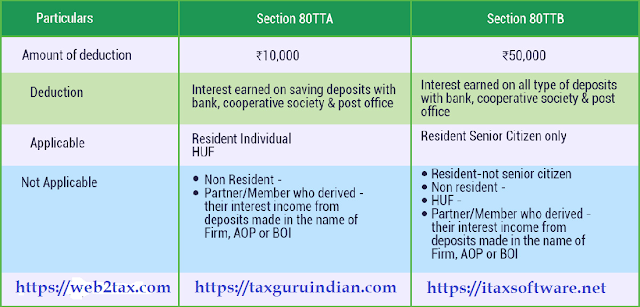
The difference between Section 80TTA and 80TTB

Section 80TTA  Section 80TTB

Individual Taxpayer and Hindu Undivided Family (HUF) only allowed for senior citizens above 60 years of age


Interest earned on deposits with savings account only: - Deposit with a savings account - Fixed deposit, term deposit or recurring deposit


Exemption limit under section 80TTA Rs.10,000 per annum Exemption limit under section 80TTB Rs.50,000 per annum


Download Automated Income Tax Arrears Relief Calculator U/s89(1) with Form 10 E for the F.Y.2021-22

Download Automated income tax arrears relief calculator U/s 89(1)

form 10 E

Monday, 11 October 2021

Under Section 80D Health Insurance Tax Benefit. With Auto Fill Income Tax Preparation Software All in One in Excel for the F.Y.2021-22


Income Tax Section 80 D health Insurance tax benefits

Under Section 80D Health Insurance Tax Benefit. Although people in their 20s and 30s now understand the importance of health insurance, many of them remain ignorant about it. They believe that health insurance is for the elderly and that it is an unnecessary investment.


But young people as young as 20 are now suffering from serious health problems like cholesterol and diabetes. It is therefore important that one should consider buying health insurance as soon as possible. To further encourage people, there are income tax exemptions for medical insurance premiums under Section 80D of the IT Act.


Under Section 80D Health Insurance Tax Benefit. Although the primary reason to buy a health insurance policy should always be to protect your health, tax exemption is an excellent additional benefit. Before claiming tax benefits on health insurance premiums, you need to clarify the following: Invest in the right health insurance policy and save tax


1. Who can claim a tax deduction on health insurance?

2. What is the maximum tax deduction limit?

3. How can this cut be claimed?

You may also, like-Auto Fill Income Tax Preparation Software All in One in Excel for the West Bengal Govt Employees for the F.Y.2021-22

State of West Bengal

Who is entitled to claim a reduction in taxes on health insurance?

Under section 80D, if you are eligible for a tax deduction on premiums paid for a health insurance policy-

You are a person who has purchased health insurance for you, your wife, dependent children or your parents.

Tax exemptions are available for health insurance

Here are some discounts you can claim if you have purchased health insurance for yourself and your parents.

Age below 60 years (Proposer and Guardian)

If you are purchasing a separate health plan for yourself and your age is below 60 years, then you have to pay Rs. Can claim tax benefits. twenty-five thousand in a year on your medical premium. If you are also buying health insurance for a dependent parent under the age of 60, you will get an extra money discount. 25,000.

60 over 60 years of age (parents)


If you have purchased a separate health plan for your dependent parents over the age of 60, the discount limit will be increased to Rs. 50,000 to 25,000.


So, if you are under 60 years of age and your dependent parents are above 60 years of age and you purchase a separate policy for yourself and your parents, then you have to claim tax exemptions. 75,000. Here, Rs. 25,000 is your health insurance premium and Rs. 50,000 for the premium paid for your senior parents.

You may also, like-Auto Fill Income Tax Preparation Software All in One in Excel for the Bihar StateGovt Employees for the F.Y.2021-22


State of Bihar

Above 60 years (Proposer and Guardian)

If both you and your old aged above 60 Years parents are over 60 years of age, the maximum medical premium tax-deductible limit will be Rs. One Lakh lakh.

Since you are above 60 years of age, you will get a discount of Rs. 50,000 and you can get the tax benefits to your dependent parents for whom you have bought a health insurance policy.

Insured

Premium paid for health insurance - Self (Rs)

Premium paid for health insurance - Parents (Rs)

Total deduction under 80D (Rs)

Self (including spouse, children) under 60, and parents also under 60

25,00

25,000

50,000

Self below 60, but parents above 60

25,000

50,000

75,000

Parents and individuals both above 60 years

50,000

50,000

1,00,000


How to claim tax exemption on health insurance premium?

Tax benefits on health insurance can be claimed at the time of filing an income tax return. Given below the manners you need to follow

1. At the time of filing your income tax, there have an option as  'Deductions' column you can select '80D' to claim an exemption  for health insurance premium


2. A drop-down menu will now be available so that you can select the conditions under which you are claiming the cut. There will be seven options and you can choose the one under which you are claiming the cut. The options are as follows-

⮚ yourself and family

⮚ Self (over 60 years) and family

⮚ Parents

Parents (over 60 years)

Self and family with parents

Own and family with parents over 60 years of age

Self (above 60 years) and family with parents over 60 years


You can now attach helpful evidence and documents so that the IT department can verify your cuts. Remember that deduction in medical insurance premium can be claimed only if you pay the premium through net banking, credit/debit card, a check or draft. Cash premiums are not tax-deductible. Also, you must have supporting documents and evidence to claim a successful cut.


When can you claim a health insurance tax deduction?

Tax deductions on health insurance premiums can only be claimed for a certain financial year. For example, if you pay a premium for the fiscal year 2018/19, a tax deduction may be claimed when filing an ITR for 2018/19.


No deduction can be claimed for the premium you have already paid in the last financial year or will pay in the next financial year.


Taking advantage of tax cuts on health insurance

You are entitled to claim tax benefits in accordance with the limits and conditions discussed above.

Download Automated Income Tax Preparation Excel Based Software All in One for the Government & Non-Government (Private) Employees for the F.Y.2021-22 and A.Y.2022-23


under section 80D

Income Tax Section 80D

Form 16

Income Tax Form 10 E

Feature of this Excel Utility:-


1) This Excel utility prepares and calculates your income tax as per the New Section115 BAC (New and Old Tax Regime)


2) This Excel Utility has an option where you can choose your option as New or Old Tax Regime


3) This Excel Utility has a unique Salary Structure for Government and Non-Government Employee’s Salary Structure.


4) Automated Income Tax Arrears Relief Calculator U/s 89(1) with Form 10E from the F.Y.2000-01 to F.Y.2021-22 (Update Version)


5) Automated Income Tax Revised Form 16 Part A&B for the F.Y.2021-22


6) Automated Income Tax Revised Form 16 Part B for the F.Y.2021-22