Showing posts with label Arrears of Salary and Relief U/s 89 (1) and Form 10 E for the F.Y.2021-22. Show all posts

Friday, 15 October 2021

Income Tax Planning Salaried Persons for F.Y.2021-22.With Automated Income Tax Preparation Software All in One in Excel for the Govt and Non-Govt Employees for F.Y.2021-22

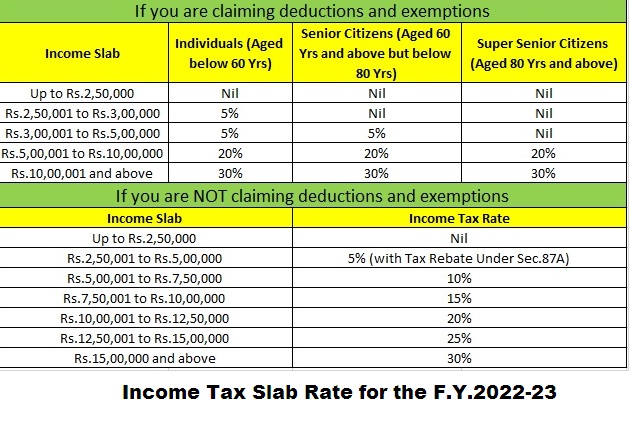
 Income Tax Planning Salaried Persons for F.Y.2021-22.No change in income tax slab or rate has been

 proposed. Also, no additional tax exemptions or exemptions were introduced. The standard deduction

 for U/s 16(ia) salaried and pensioners remains the same.


Without any change in income tax slab and rate and basic exemption limit. An individual taxpayer will continue to pay taxes at the same rate as in the fiscal year 2020-21. Read more at: 
Income Tax Planning for salaried person

In addition, to 80C, there are many ways to save tax, which gives exemptions and tax benefits-

1. Section 80D: Medical Insurance Premium Section 80D of the Income Tax Act Helps to claim a tax deduction from total taxable income Payment of medical insurance premium.

You can get a maximum discount of Rs. 25,000 per year you pay for medical purposes for yourself, your wife or your children. The max limit for senior citizens is Rs. 50,000. Also, if you spend money on behalf of your parents, you will get a maximum tax deduction of up to Rs 10,000. 25,000

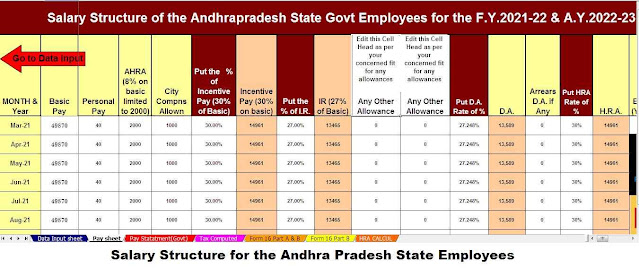
You may also, like- Automated Income Tax Preparation Excel Based Software All in One for the Andhra Pradesh State Employees for the F.Y.2021-22
 

State of Andhra Pradesh


2. Section 80G: Charitable Donations You can claim 50% or 100% of the amount, which is donated to a charitable trust. To claim a deduction you need to save the receipt of the organization after the financial year.


Income Tax Planning Salaried Persons for F.Y.2021-22.Make sure that whenever you donate, charities and trusts will be registered under the Section 12A post that they are eligible for the 80G Certificate.


3. Section 80GG: Rent towards housing Individuals living in a rented house can claim a tax exemption under section 80GG. However, this deduction is eligible for those who are not salaried and employees who do not receive House Rent Allowance (HRA) from their employers.


4. Section 80D: Health Insurance Nowadays, medical services are skyrocketing and buying health insurance has become a necessity for everyone. Because it helps you with your medical expenses in case of emergency. For example, if you pay a premium for your health insurance, you can save up to Rs 15,000 - Rs 20,000 under Section 80D.

You may also, like- Automated Income Tax Preparation Excel Based Software All in One for the Jharkhand  State Employees for the F.Y.2021-22
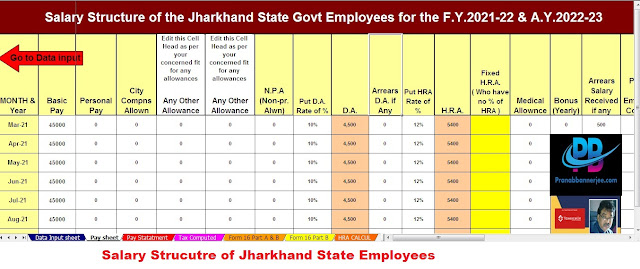
 

State of Jharkhand

5. Section 80EEE: Education Under section E0E, interest on loans for higher education is tax-free for oneself, wife and children. An individual can claim the amount of interest discount not paid but the amount paid.


Section: 80EE: Home loan is one of the best ways to save tax in India. Under the new regime, home loans have helped reduce taxable income. Section 80 EE, for the first time home buyers can claim the maximum deduction. Fifty Thousand in a fiscal year.


7. Section 80TTA: Interest can be claimed as a deduction under 80TTA of Rs. 10,000/-.


Save income tax under section 80C. Read more at:


Under Section 80C you can find various options and ways to save income tax-


1. Life insurance not only provides full life coverage, but it is also the best way to save tax. In a life insurance policy, one has to pay a certain amount of money every year, which is instead refunded in a healthy single amount.


Endowment, ULIP, Term Life Life Insurance, an annual approved for tax savings. The maximum exemption eligible under section 80C is up to Rs.1,50,000.


2. ULIP's Unit Link Insurance Plan aka ULIP is a market-linked insurance plan. The advantages of this plan are that it provides flexibility, long-term goals, financial security after retirement and income tax benefits. Investments made in this scheme are tax-deductible under Income Tax Act 80C. In addition, it gives you the opportunity to grow your money.

You may also, like- Automated Income Tax Preparation Excel Based Software All in One for the West Bengal State Employees for the F.Y.2021-22


State of West Bengal

3. Mutual Funds, you can go for ELSS (Equity Linked Savings Scheme) where you can get a discount of up to Rs 1,50,000 under Section 80C. Being a combination of equity and tax savings, ELSS is an optimal gateway to equity. This means that with tax savings, your money grows as the stock market grows. Thus, the profit in ELSS is higher. This facility can be a minimum lock-in period of 3 years.


4. Tax Savings Fixed Deposit Provides tax exemption on investments up to Rs. 1,50,000 under section 80C.


5. SCSS or Senior Citizen Savings Scheme This scheme is formulated only for senior citizens who have retired at the age of 60 years or above 55 years. Under Section 80C, the maximum SCSS investment is liable for tax exemption. 1,50,000


6. Future funds (PF) are helping to create a goal with long-term returns. Deposits made in PF are Rs. Till the claimant of tax deduction. 1,50,000 under section 80C.


7. National Savings Certificate (NSC) starts with a minimum deposit of Rs.1000. 100. The term of investment of NSC is 5 years. Upon maturity, you can claim a full refund to their account. However, if not claimed, the entire amount will be reinvested in the scheme. You may get a tax exemption of Rs.. 1,50,000 under Section 80C of the Income Tax Act
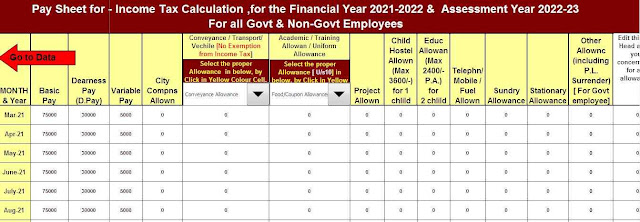
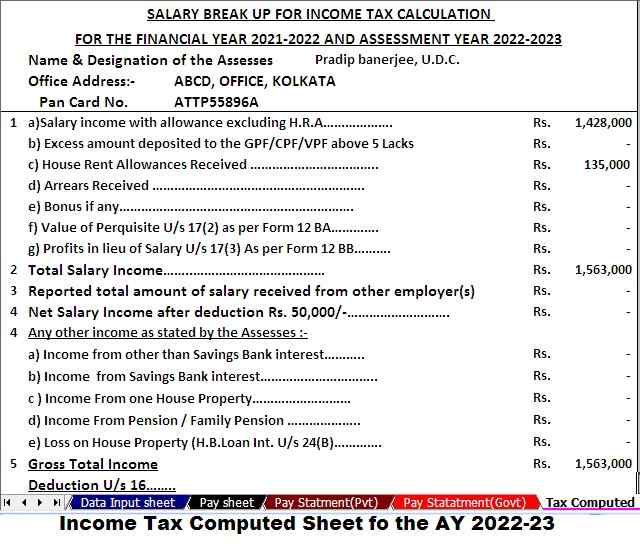
Automated Income Tax Preparation Excel Based Software All in One for the Government & Non-Government (Private) Employees for the F.Y.2021-22

Income Tax Planning Salaried Persons

Income Tax Planning

Income Tax Form 16
Income Tax Relief Form 10 E

Feature of this Excel Utility:- 

1) This Excel utility prepares and calculates your income tax as per the New Section 115 BAC (New and Old Tax Regime)


2) This Excel Utility has an option where you can choose your option as New or Old Tax Regime


3) This Excel Utility has a unique Salary Structure for Government and Non-Government Employee’s Salary Structure.


4) Automated Income Tax Exemption from House Rent U/s 10(13A)


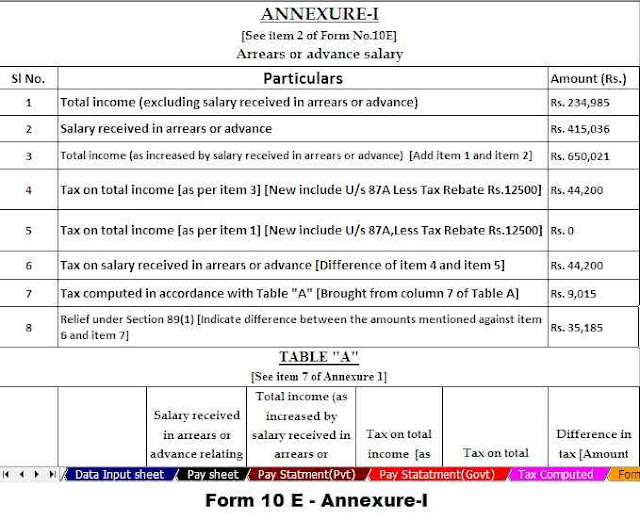
5) Automated Income Tax Arrears Relief Calculator U/s 89(1) with Form 10E from the F.Y.2000-01 to F.Y.2021-22 (Update Version)


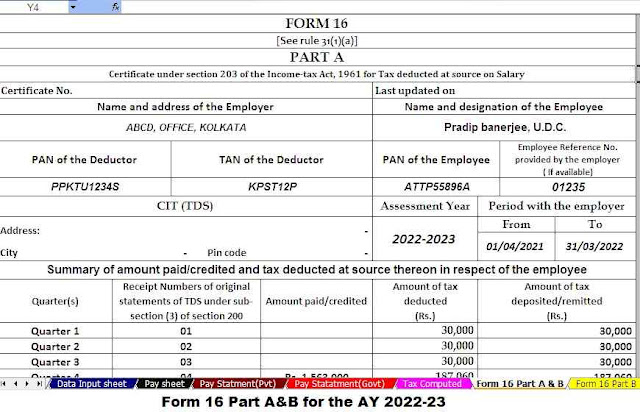
6) Automated Income Tax Revised Form 16 Part A&B for the F.Y.2021-22


7) Automated Income Tax Revised Form 16 Part B for the F.Y.2021-22


Tuesday, 12 October 2021

Arrears Relief Calculator for the F.Y.2021-22 with Form 10 E as per Rule 21 A and U/s 89(1)

 Arrears Relief Calculator for the F.Y.2021-22 with Form 10 E as per Rule 21 A and U/s 89(1) In this

 post, you need to find relief if arrears or payments are made in advance:


There are many instances where an employee may receive salary arrears for the current year for the correction of any leftovers of the previous year. If other arrears are added to the current year's income, the tax payable for the current year is much higher. This is due to the shift from the income tax slab rate to a higher tax slab. 

Arrears Relief Calculator for the F.Y.2021-22

Thus section 89 has been included by the government under the Income-tax Act which comes as an advantage in this context as the Act allows a tax deduction for employees who are in arrears of salary to understand other taxes.


Pursuant to Section 89 (1), the tax deduction/relief is provided by recalculation of the tax for the year in which the arrears are collected and the year in which the arrears are collected and the year in which these arrears are collected Either before. Moreover, if the designated person needs to pay more tax for the year of receipt, “if the money he was supposed to receive in the year he was supposed to receive, the additional tax may be deducted from what he actually paid. Payable. "

What is the method of calculation of tax relief in salary arrears U / S 89 (1)?

You can follow the below-given steps for mediation


Step 1: We have to calculate the tax liability on the total income, where is the salary arrears of the year received.


Step 2: Calculate tax liability on total income which does not include salary arrears for the year received. If no arrears are collected in the current year, the measure provides us with the amount of tax payable.


Step 3: Calculates the difference between tax liability as step 1 and step 2. It will be taxed on the extra salary associated with the total income.


Step 4: Calculates the tax liability on the total amount of arrears received for the arrears concerned.


Step 5: Calculate the tax liability on total income which does not include the amount due for receipt of arrears.


Step 6: Calculate the difference between the calculation amount according to step 4 and step 5. This gives us the original tax liability of the previous year which is due for the current year.


• Step:: Exemption of additional amount of tax in the amount of step at under section 89 which is allowed under the Act. In this case, there is no additional that if the tax calculated under step 3 is less than in the calculation of step 6, relief is not required for the employee under section 89 as no relief is allowed.


You can go to the income tax website for calculating relief under section 89, there is a link- https://www.incometaxindia.gov.in/Pages/tools/relief-under-section-89.aspx


Which section applies to section 89?

Relief is available under section 89 (1) in the following cases: 

Salary arrears or advance available [Rule 21A (2)]

Gratuity received for previous service [Rule 21A (3)]

Compensation after the termination of employment [Rule 21A (4)]

Payment of pension conversion [Rule 21A (5)]; 


Procedure for claiming tax relief under section 89

To get relief under the paragraph, 89 people have to "submit Form 10E available for Income Tax Portal within the new e-filing portal, log in and go to Dashboard, e-File> Income Tax Form> File Income Tax Form). Submit Form 10E. “Just essential. In case of non-submission of Form 10E, ITR will be processed but relief sought under 89 will not be allowed which will be allowed only if it is dependent under Income Tax Act 89 if the 10E form is available equipped before ITR.


Let us know the calculation with the help of examples though 

Sl No.

Particulars

Amount

1

“Tax payable on the total income for FY 2020-21, including the arrears”

1,54,440

2

“Tax payable on the total income for FY 2020-21, excluding the arrears”

1,10,760

3

“Difference between Step 1, Step 2”

43,680

4

“Tax payable on the total income for FY 2019-20, including the arrears”

1,06,600

5

“Tax payable on the total income for FY 2019-20, excluding the arrears”

75,400

6

“Difference between Step 3, Step 4

31,200

7

“Amount of relief = Step 3 – Step 6

12,480″


Let us know that Mr Arun has received Rs. Under normal circumstances, he has paid "Rs. 1,10,70 tax on his income of Rs. 9,70,000 / - for the financial year 2020-21". But, after adding the arrears of Rs 1.5 lakh, his tax liability increased to Rs. 1,54,440.

Moreover, towards the financial year 2019-20, he paid Rs 5,400,000 tax on his income, which was lakhs of rupees. Did he get arrears of Rs 1.5 lakh that the tax liability would be Rs 1,06,600 as they have arrears for the year? 

This information calculates the tax relief available to Mr Arun:

Note: If the tax payable under step 3 (arranged in the year of receipt) is less than the tax payable under step 6, it indicates that no relief is given if there is no additional tax.

Download Auto Calculate Income Tax Salary Arrears ReliefCalculator U/s 89(1) with Form 10 E from the F.Y.2000-01 to F.Y.2021-22 (Updated Version)

Arrears Relief Calculator U/s 89(1)

Income Tax Form 10 E


Wednesday, 4 August 2021

Arrears of Salary and Relief U/s 89 (1) and Form 10 E for the F.Y.2021-22

 Arrears of Salary and Relief Under Section 89 (1) and Form 10 E. In the section on salary, we discuss

 Section 89 (1) which provides relief in tax for those receiving salary for earlier years. In cases where

 this happens, the Government has provided relief if there is an increase in your tax liability in this year

 due to such arrears.


Relief under this section 89(1) can be claimed where a person has received arrears of salary. Remember, salary is taxable only upon receipt by the individual. The amount of arrears will be mentioned in Form 16. 

Arrears Relief with Form 16

Calculating Relief under 89 (1) is complicated and involves the following steps:


First – calculate the tax payable for the current year in which arrears are received including arrears less the tax payable including arrears.


Second – calculate the tax payable for the current year in which arrears are received excluding arrears less the tax payable including arrears.


Third – Calculate the Difference between the taxes payable in the year of receipt.


Fourth – calculate the tax payable for the year to which arrears relate excluding arrears less the tax payable including arrears.


Fifth – Calculate the tax payable for the year to which arrears relate excluding arrears less the tax payable including arrears.


And lastly, calculate the difference between the taxes payable in the year to which arrears relate.


The excess of difference in tax payable in the year of receipt versus the year to which arrears relate will give the amount of relief under 89 (1).


Also, Form 10 E needs to be filed if arrears are to be claimed.


Form 10E 

Income Tax Salary Arrears Relief U/s 89(1)

Form 10E is an important form to save tax on income generated through arrears by applying the provision of Section 89(1). 


It is mandatory for an assessee to file Form 10E for claiming relief under section 89(1).


An assessee who fails to file Form 10E, will not be allowed the relief under Section 89(1). If the Income-Tax Return is filed without filing Form 10E and it is showing defective, the ITR should be revised after filing Form 10E. The ITR can be revised before the end of the assessment year, i.e. 31 March 2021 for the financial year ended 2020-21

Download Automated Income TaxSalary Arrears Relief Calculator U/s 89(1) with Form 10 E from the F.Y.2000-01to F.Y.2021-22(Updated Version)

Data Input Sheet

Income Tax Arrears Relief Calculator U/s 89(1)

Income Tax