Showing posts with label Income Tax Section 80TTA. Show all posts

Thursday, 8 December 2022

Deduction u/s 80TTA vs . 80TTB| With Auto Fill All in One Income Tax Preparation Software for Govt. and Non-Government Employees for F.Y.2022-23

 Deduction u/s 80TTA vs . 80TTB|Currently section 80TTA provides Rs 10,000/- deduction to all

 individual/HUF taxpayers.


Section 80TTA of the Income Tax Act, 1961 states:


Deduction of interest on deposits and savings accounts.


80TTA.


(a) As per the Banking Regulation Act, 1949 (10 of 1949) a banking company covered by the Banking Regulation Act,  (including any bank or banking organization referred to in section 51 of that Act);


(b) A cooperative society engaged in banking (including a cooperative land mortgage bank or cooperative land development bank); either


(c) A post office as defined in clause (k) of section 2 of the Indian Postal Act, 1898 (6 of 1898),


The deduction shall be allowed, in accordance with and in accordance with the provisions of this section, upon the computation of the total income of the assessee as set forth below, viz.


(i) If the amount of such expenditure does not exceed ten thousand rupees in the aggregate, the whole amount; and


(ii) Rs.10, 000/- in any other case.


(2) Where an income referred to in this section arises from a deposit in a savings account held by or on behalf of a company, association, or group of persons, no deduction is allowed under this section for such income when computing the total income of a corporate partner or member of an association or person of a body.

You may also like- Automated Income Tax Preparation Software All in One in Excel for the West Bengal Govt Employees for the F.Y.2022-23

Salary Structure

Description. For purposes of this section, "long-term deposits" means deposits due at the expiration of specified periods.


It is now proposed to add a new section 80TTB to the Income Tax Act 1961 which will fix the age deduction for interest up to Rs. 50,000/- in cash.


The proposed 80TTB section reads as follows:


80TTB, (1) Where is the collector's total income? Being old includes any income you earn in the form of interest on deposits with:

(a) As per the Banking Regulation Act, 1949 applies (including any bank or banking institution referred to in section 51 of that Act);


(b) A cooperative society carrying on the business of banking (including a cooperative land mortgage bank or cooperative land development bank); either


(c) A post office as defined in clause (k) of section 2 of the Indian Postal Act, 1898,

Shall, in accordance with and in accordance with the provisions of this section. It is permissible, in computing the total income of the assessee, to deduct—


(i) If the amount is not excessive. The total sum of fifty thousand rupees, the whole of such amount; and


(ii) In any other case, Rs.50,000/-.


(2) Where the income referred to in subsection (1) comes from income held by or on behalf of a company, association, or private association, no deduction shall be allowed under this Article in respect of the income when calculating the total income of a business partner or an association member or a person of a body.


Description. For the purposes of this section, "older person" means a person resident in India who has attained the age of sixty years or more at any time during the relevant previous year.


The question arises whether Rs, 50,000/- deduction. It is even an interest allowance in FDR Bank which was not available under Section 80TTA. Another question arises whether senior citizens can claim deductions under Section 80TTA and 80TTB.


Let’s try to understand.


Section 80TTA provides for the deduction of interest excluding interest on term deposits. FDR is a term deposit. This means that there is no deduction of 80TTA in the bank’s FDR interest.


However, there is no restriction in u/s 80TTB. That is, Rs. 50,000/- for a senior citizen deduction is also available on the Bank’s FDR interest.


Also, Finance Bill 2018 does not propose repealing 80TTA. It is available for senior citizens from F.Y 2018-19 as a deduction is suggested under section 80TTB. Seniors can claim an 80TTB deduction. Only when other persons / HUF taxpayers would be eligible for deduction u/s 80TTA.

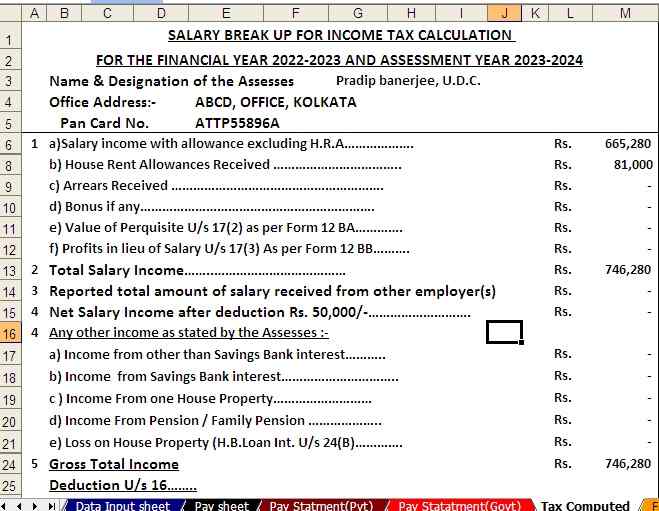
Download Automated Income Tax Preparation Excel-Based Software All in One for the Government & Non-Government (Private) Employees for the F.Y.2022-23 and A.Y.2023-24 

Deduction u/s 80TTA vs . 80TTB

Deduction u/s 80TTA vs . 80TTB

Deduction u/s 80TTA vs . 80TTB

Feature of this Excel Utility:-


1) This Excel utility prepares and calculates your income tax as per the New Section 115 BAC (New and Old Tax Regime)


2) This Excel Utility has an option where you can choose your option as a New or Old Tax Regime


3) This Excel Utility has a unique Salary Structure for Government and Non-Government Employees Salary Structure.


4) Automated Income Tax Arrears Relief Calculator U/s 89(1) with Form 10E from the F.Y.2000-01 to F.Y.2022-23 (Update Version)


5) Automated Income Tax Revised Form 16 Part A&B for the F.Y.2022-23


6) Automated Income Tax Revised Form 16 Part B for the F.Y.2022-23

Monday, 21 November 2022

Income Tax Section 80TTA| With Auto fill Income Tax Arrears Relief Calculator U/s 89(1) with Form 10E from the F.Y.2000-01 to F.Y.2022-23

Income Tax Section 80TTA| Under the Indian Income Tax Act, various deductions are provided to the

 Indian taxpayers to reduce their income tax liability and thereby reduce their tax expenses. These

 deductions can be based on salary, investment, or payment.


U/s 80TTA of the Income Tax Act, tax exemption is eligible to taxpayers on interest earned in a savings account. The savings account in question may be held at a bank, cooperative, or post office.


Section 80TTA was included in the Finance Act in 2013 and has since exempted many taxpayers.


Let us examine the terms and conditions involved in availing the benefits of Section 80TTA.


This exemption is provided U/s 80TTA- Terms and Conditions


1) The conditions applicable for tax deductions under Section 80TTA are listed below:


2) A maximum of Rs.10,000 per annum can be deducted from the interest of savings accounts

You may also like- Autofill Income Tax Preparation Software All in One in Excel for the West Bengal State Employees for the Financial Year 2022-23


Income Tax Section 80TTA

Income Tax Section 80TTA

Deductions can be claimed by individuals and Hindu Unified Families (HUFs).


3) If an entity has more than one savings account with multiple banks, the combined interest income of all the accounts must be below INR 10,000 to avail of the benefit of deductions


4) In the above case, if the cumulative interest income exceeds the limit of INR 10,000, tax exemption can be claimed for INR 10,000 and the remaining amount will be taxable.

Eligibility to claim deductions under 80TTA


Under the Income Tax Act, Section 80TTA deductions can be claimed against:


(a) Taxpayers belonging to the category of natural persons or Hindu Undivided Family (HUF).


b) Indian residents


c) Non-resident Indians (NRIs) holding NRO savings accounts


(d) An organization holding savings accounts with institutions such as banks, post offices, or cooperative societies


Claiming 80TTA Tax Deductions


Under Section 80TTA, tax deductions of up to INR 10,000 can be claimed for an eligible assessor above the limit of INR 1.5 Lac of Section 80C. Be sure to include the interest on savings accounts under the Income from other sources section when filing income taxes.

Exemption under Section 80TTA


1) If the total income of the company is less than the minimum taxable income, a person cannot claim tax exemption under section 80TTA


2) Senior citizens cannot avail of tax deductions under Section 80TTA


3) Tax exemption 80TTA does not apply to:


• Long Term Deposits


• Fixed deposits


• Recurring Deposits


• Deposits from NBFC (non-banking finance companies).


• NRA holders of NRE accounts cannot claim tax deductions under Section 80TTA as NRE accounts are tax-exempt.


Conclusion


Many savings account holders are unaware of the taxes on savings account interest. Section 80TTA of the Income Tax Act 1961 covers the income tax exemption granted on interest earned on savings accounts, with a maximum exemption of INR 10,000 per annum.


This exemption applies to Hindu undivided individuals or families (HUF).

Download Automated IncomeTax Arrears Relief Calculator U/s 89(1) along with Form 10E from the Financial Year 2000-01 to Financial Year 2022-23 (Up-to-date Version)

Income Tax Section 80TTA

Income Tax Section 80TTA

Form 10E


Monday, 30 May 2022

Exemption from bank savings interest U/s 80TTA| With Automated Income Tax Preparation Software in Excel for the Non-Govt Employees for the F.Y.2022-23

 Section 80TTA of the Information Technology Act provides a tax deduction for interest income from

 personal savings. To help you claim your Section 80TTA Income Tax Act deductions, we will discuss

 your eligibility, threshold, inclusions, and exclusions in detail.


What is a section 80TTA deduction?

Section 80TTA deduction was established in 1961 and provides for a deduction of up to Rs. 10,000. This law applies to individual savings in banks and individual savings groups under the HUF (Hindu Undivided Family). However, it is ineffective with respect to income from interest on term or term deposits.

Interest Income Deductible under Section 80TTA

Savings income from the following institutions is tax-deductible under section 80TTA of the Income Tax Act:

Bank

Banking cooperative society

Post Office

You may also like- Automated Income TaxForm 16 Part B for the F.Y. 2021-22[This Excel Utility can prepare at a time 50 Employees Form 16 Part B]

Form 16 Part B

What is the maximum allowable deduction under section 80TTA?

The maximum applicable deduction of 80TTA is Rs. 10,000 per year, i.e. any excess of the amount of savings income will be taxable. Here, the calculation is based on the amount of interest accrued from one or more savings accounts of different banks.


Interest income is treated as income from other sources. Taxpayers can claim a maximum deduction of Rs. 10,000 of your total gross income and receive taxable income. The applicable tax percentage will then be calculated based on the taxpayer's taxable income.


What interest is non-deductible under Section 80TTA?

Interests from the following sources are not allowed in this section -

Fixed deposit.

Duplicate account.

Term deposit.

Savings in non-bank financial companies.

Companies, LLPs and partner firms are not permitted to receive interest payments under section 80TTA.


Who is eligible to claim tax credits under Section 80TTA?

The most important factors for compliance with the requirements of Section 80TTA are:

Taxpayers residing in India

Group of persons in HUF

NRI with NRO Savings Account

Age under 60 (Section 80TTA does not apply to older people, they can apply for section 80TTB)

You may also like- Automated Income Tax Form 16 Part A&B for the F.Y.2021-22[This Excel Utility can prepare at a time 50 Employees Form 16 Part A&B]


Exemption from bank savings interest U/s 80TTA

The deduction under section 80TTA applies to persons whose total income exceeds the taxable base. For example, if your income is Rs. 2,00,000 and your specific interest income is Rs. 50,000 in the reporting year. In this case, you are not eligible to apply for section 80TTA because your total income is below the taxable level.


How much tax will you save?

This is a viable question on the internet, what is 80TTA in income tax and how much can you save on it? The maximum amount of tax that can be saved with 80TTA depends on the tax rate that the taxpayer is subject to.


If your total income falls under the 20 % tax rate, the maximum amount of tax you can save is Rs. 2000 thousand minus 20,000 thousand 10,000 below 80TTA. Likewise, if you qualify for the 30 % tax rate, the maximum amount you can save is Rs. 3000.

Section 80TTA of the Income Tax Act aims to improve financial management. Thus, it helps people avoid paying taxes on income earned by small savings and large investors, without bothering them to include small amounts of interest in the income tax return process.

You may also like- Automated Income TaxForm 16 Part B for the F.Y.2021-22[This Excel Utility can prepare at a time 100 Employees Form 16 Part B]


Exemption from bank savings interest U/s 80TTA

General issues

How do I get Section 80TTA deductions?

To claim a deduction under Section 80TTA, you must show savings interest income as income from other sources on your ITR file. You should mention this both in the chapters under other sources and in the chapters of deduction.


How is 80TTA different from 80TTB?

Both acts are in accordance with section 80 of income tax. Section 80TTA is for a tax deduction on personal savings income and HUFS under the age of 60, whereas; 80TTB applies to the retiree tax deduction.

In addition, 80TTA excludes savings from fixed deposits, while 80TTB includes savings from all sources.


Do I need to mention the interest accruing on a savings account balance to receive Section 80TTA benefits?

Yes, it is mandatory to indicate all sources of income from savings interest.

Download Automated IncomeTax Preparation Excel Based Software All in One for the Non-Government (Private) Employees for the Financial Year 2021-22 and Assessment Year 2022-23U/s 115BAC


Exemption from bank savings interest U/s 80TTA

Exemption from bank savings interest U/s 80TTA

Feature of this Excel Utility:-


1) This Excel Utility Prepare Your Income Tax as per your option U/s 115BAC perfectly.


2) This Excel Utility has the all amended Income Tax Section as per Budget 2022


3) Automated Income Tax Form 12 BA


4) Automated Calculation Income Tax House Rent Exemption U/s 10(13A)


5) Individual Salary Structure as per the Non-Govt(Private) Concern’s Salary Pattern


6) Individual Salary Sheet


7) Individual Tax Computed Sheet


8) Automated Income Tax Revised Form 16 Part A&B for the F.Y.2022-23


9) Automated Income Tax Revised Form 16 Part B for the F.Y.2022-23


10) Automatic Convert the amount into the in-words without any Excel Formula

Monday, 9 May 2022

Section 80 TTA - Exemption for Savings Interest | With Automated Income Tax Arrears Relief Calculator U/s 89(1) with Form 10 E for the F.Y.2022-23(Updated Version)

 Section 80 TTA - Exemption for Savings Interest | 80TTA Complete Guide: Definitions, Limits,

 Eligibility, Exceptions for the Fiscal Year 2022-23 (A..Y 2023-24


A savings bank account is like a digital piggy bank where interest is earned. Most people have savings bank accounts, but most of them are not aware of the taxation of accrued interest on savings accounts. Interest earned from savings accounts is taxed based on income from other sources and interest deduction u/s 80TTA is also allowed.


What is the 80TTA section?

Section 80TTA of the 1961 Income Tax Act provides for the deduction of interest earned from savings accounts in banks, cooperatives or post offices, up to Rs 10,000/-. No FD interest discount available u/s 80TTA. This deduction is allowed for all individuals and HUFs other than super seniors (aged 60 and over) as they have a separate 80TTB Part deduction for themselves.


Section 80TTA was introduced in 2013 as part of the Finance Act which was passed that year and came into effect from the 2012-13 fiscal year onwards and remains in effect.

Download and Prepare at a time 50 Employees Form 16 Part A&B for the F.Y. 2021-22 in Excel

Section 80 TTA - Exemption for Savings Interest


Who can take advantage of the discount under the 80TTA section?


Undivided Hindu individuals or households (HUF) can claim a deduction of less than 80 TTA on interest earned on all their bank and postal accounts.


Can an NRI request a deduction of fewer than 80 TTA?

Like Indian residents, non-resident Indians (NRIs) are also eligible for a reduction of up to 80 TTA.


The 80TTA benefit is only available in NRO savings accounts. Please note that no deductions are allowed on NRO time deposits.


How much is the reduction amount of 80TTA u/s?

A deduction of Rs 10,000 u/s 80TTA on interest earned from savings accounts is allowed. If one has several savings accounts with different banks, the maximum deduction that can be claimed for all savings accounts combined is Rs 10,000/-.

The reduction under the 80TTA section is higher than the 1.5 lakh limit of the 80C section.

Download and Prepare at a time 50 Employees Form 16 Part B fort he F.Y. 2021-22 in Excel


Section 80 TTA - Exemption for Savings Interest

What organizational savings accounts does Section 80TTA cover?

Savings accounts with the following institutions fall under Section 80TTA:


Banks: Banking companies established under the provisions of the Banking Regulations Act, 1949. This includes all banks and banking institutions established under Section 51 of the same law.


Post Office: All Indian government post offices that have a savings account.


Cooperatives: Cooperatives that are registered by the government and are eligible to have a savings account as a feature of their banking system.


What are the exceptions to 80TTA?


The exceptions to 80TTA are:


Deposits in non-bank financial companies


Fixed deposit interest (FD)


Interest from Recurring Deposit (RD)

Download and Prepare at a time 100 Employees Form 16 Part B for the F.Y. 2021-22 in Excel


Section 80 TTA - Exemption for Savings Interest

 Frequently asked questions 


Q- If I have a savings account with the Cooperative, am I entitled to a tax deduction under Section 80TTA?


Yes, you are eligible for tax deductions under Section 80TTA if you have a savings bank account with a registered Cooperative.


Q- My annual income is below the minimum annual tax threshold, do I have to pay tax on interest earned from my savings account?


No, as long as your total annual income is not below the lower tax threshold. You do not have to pay tax on interest earned from your savings account even if it exceeds Rs.10,000/- as there is no taxable income.


Q- If the appraiser has earned capital gains or income from homeownership, etc, can 80 TTA be claimed?


80 TTA can only be requested if the appraiser has earned interest income on the savings account.


Q- Can seniors apply for 80TTA?


No, deductions can be claimed by seniors up to Rs.50,000 under 80 TTB share.


Q- Can 80TTA be claimed by NRI?


Yes, Section 80TTA can be claimed by NRIs like Indian residents.


Q- How many bank accounts can I request for a deduction under the 80TTA section?


In the 80TTA section, the limit is on the interest amount and not on your account amount. Therefore, tax benefits can be claimed for a number of accounts up to an aggregate interest amount of Rs 10,000.


Q- Will TDS be deducted from my interest income?


Ans. No, there is no provision under the Income Tax Act to deduct the TDS on interest income received from savings accounts.

Download Automated Income Tax Arrears Relief Calculator U/s 89(1) with Form 10 E from the F.Y.2000-01 to F.Y.2022-23(Up-to-date Version)

Section 80 TTA - Exemption for Savings Interest