Showing posts with label Income Tax Arrears Relief Calculator U/s 89(1). Show all posts

Monday, 21 November 2022

Income Tax Section 80TTA| With Auto fill Income Tax Arrears Relief Calculator U/s 89(1) with Form 10E from the F.Y.2000-01 to F.Y.2022-23

Income Tax Section 80TTA| Under the Indian Income Tax Act, various deductions are provided to the

 Indian taxpayers to reduce their income tax liability and thereby reduce their tax expenses. These

 deductions can be based on salary, investment, or payment.


U/s 80TTA of the Income Tax Act, tax exemption is eligible to taxpayers on interest earned in a savings account. The savings account in question may be held at a bank, cooperative, or post office.


Section 80TTA was included in the Finance Act in 2013 and has since exempted many taxpayers.


Let us examine the terms and conditions involved in availing the benefits of Section 80TTA.


This exemption is provided U/s 80TTA- Terms and Conditions


1) The conditions applicable for tax deductions under Section 80TTA are listed below:


2) A maximum of Rs.10,000 per annum can be deducted from the interest of savings accounts

You may also like- Autofill Income Tax Preparation Software All in One in Excel for the West Bengal State Employees for the Financial Year 2022-23


Income Tax Section 80TTA

Income Tax Section 80TTA

Deductions can be claimed by individuals and Hindu Unified Families (HUFs).


3) If an entity has more than one savings account with multiple banks, the combined interest income of all the accounts must be below INR 10,000 to avail of the benefit of deductions


4) In the above case, if the cumulative interest income exceeds the limit of INR 10,000, tax exemption can be claimed for INR 10,000 and the remaining amount will be taxable.

Eligibility to claim deductions under 80TTA


Under the Income Tax Act, Section 80TTA deductions can be claimed against:


(a) Taxpayers belonging to the category of natural persons or Hindu Undivided Family (HUF).


b) Indian residents


c) Non-resident Indians (NRIs) holding NRO savings accounts


(d) An organization holding savings accounts with institutions such as banks, post offices, or cooperative societies


Claiming 80TTA Tax Deductions


Under Section 80TTA, tax deductions of up to INR 10,000 can be claimed for an eligible assessor above the limit of INR 1.5 Lac of Section 80C. Be sure to include the interest on savings accounts under the Income from other sources section when filing income taxes.

Exemption under Section 80TTA


1) If the total income of the company is less than the minimum taxable income, a person cannot claim tax exemption under section 80TTA


2) Senior citizens cannot avail of tax deductions under Section 80TTA


3) Tax exemption 80TTA does not apply to:


• Long Term Deposits


• Fixed deposits


• Recurring Deposits


• Deposits from NBFC (non-banking finance companies).


• NRA holders of NRE accounts cannot claim tax deductions under Section 80TTA as NRE accounts are tax-exempt.


Conclusion


Many savings account holders are unaware of the taxes on savings account interest. Section 80TTA of the Income Tax Act 1961 covers the income tax exemption granted on interest earned on savings accounts, with a maximum exemption of INR 10,000 per annum.


This exemption applies to Hindu undivided individuals or families (HUF).

Download Automated IncomeTax Arrears Relief Calculator U/s 89(1) along with Form 10E from the Financial Year 2000-01 to Financial Year 2022-23 (Up-to-date Version)

Income Tax Section 80TTA

Income Tax Section 80TTA

Form 10E


Monday, 10 October 2022

Income Tax Arrears Relief Calculator U/s 89(1) With Form 10E for the F.Y.2022-23

 Income Tax Arrears ReliefCalculator U/s 89(1) With Form 10E | What if they pay you late? If really,

 you may be worried about the tax consequences of it. Do you have to pay taxes on the total tax base?

 Shouldn't something be said about last year's tax checks and such? For taxpayers with these requests in

 mind here's everything you need to know.


Now, you would have recently resolved that income tax is calculated on a taxpayer's total income for a given year. Income can be a salary or family annuity or various sources of income. Regardless, there may be circumstances where you received back family benefits or future wages during the current tax year. It may happen that a taxpayer receives part of his advantage or salary early or late in any year related to cash, which increases his total income in a similar way by increasing the taxes to be paid. In that case, an application can be filed and the reviewing authority can allow relief to the taxpayer. In short, the Income Tax Law guarantees equity in income tax rates, so that when part of the income obtained is not identified with the current year, a tax exemption is granted with the aim that the taxable income does not increase.

Download Automated Income Tax Preparation Software All in One in Excel for the West Bengal Government Employees for the F.Y.2022-23

Income Tax Arrears Relief Calculator U/s 89(1)

Income Tax Arrears Relief Calculator U/s 89(1)
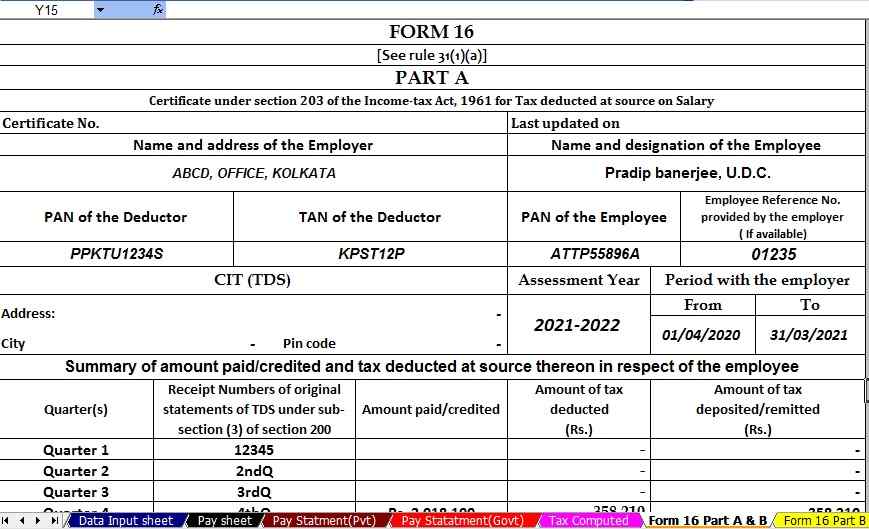
Income Tax Form 16

To make sure you are not mistaken for paying additional taxes, the U/s 89(1) Relief is issued by the income tax office. If you receive any annuities or dues from the previous year, you will not pay taxes on the full amount for the current year. Essentially, you're far from paying additional taxes considering the way there was a deferral of the instalment.


To benefit from Section 89(1) preferences, you must file Form 10E. The nuances of Form 10E, how and why to enter the comparable, are detailed below.


What is relief under section 89(1)?


Exactly when the taxpayer receives:


1. Delay in salary payment or


2. Salary in advance or


3. Delay of family annuity


Until then, said amount is taxable in the Monetary Year in which it is obtained.


However, the exemption under section 89(1) is provided to lessen the additional tax burden due to the deferral of receipt of such income.


How to calculate relief under section 89(1)?


Here is how to calculate relief under section 89(1) of the Income Tax Act of 1961:


1. Calculate the tax to be paid on the total overdue income for the year in which it is earned.


2. Calculate the tax to be paid on the total income, except the arrears of the year in which it is accrued.


3. Compute the differentiation somewhere in the range of (1) and (2).


4. Tax to be paid on the total tax base for the year to which the delays refer, including delays.


5. Compute the differentiation somewhere in the range of (4) and (5).


6. The amount of relief will be the amount in excess of (3) more than (6). No relief will be allowed if the value of (6) is greater than the value of (3).


What is Form 10E?


To secure relief under section 89(1) for back wages received, it is necessary to file Form 10E with the Income Tax Division. In the event Form, 10E is not filed and relief is granted, then the taxpayer is on their way to getting a notice from the Income Tax office for not filing Form 10E.

Download Automated Income Tax Arrears Relief Calculator U/s 89(1) along with Form 10E from the Financial the Year 2000-01 to Financial Year 2022-23 (Up-to-date Version)

Income Tax Arrears Relief Calculator U/s 89(1)

Income Tax Arrears Relief Calculator U/s 89(1)

Income Tax Form 10E


Sunday, 9 October 2022

Housing Loan Interest Deduction - Section 24B | With Automated Income Tax Arrears Relief Calculator U/s 89(1) with Form 10E for the F.Y.2022-23

 Housing Loan Interest Deduction - Section 24B| Section 24b of the Income Tax Act allows for the

 deduction of interest on mortgage loans from taxable income. The said loan must be taken for the

 purchase or construction or repair or reconstruction of residential property.


This deduction is allowed on an accrual basis, not the payment. In other words, interest due for the year is allowed as a deduction whether or not it is paid.


The deduction may be claimed for two or more home loans. The deduction may also be claimed for two or more households.


To claim the deduction under this section, a person must own the house and the loan must also be in his or her name.


Interest inclusions/exclusions


Interest includes service fees, brokerage, commission, prepayment fees, etc.

Interest/fines on unpaid interest will not be allowed as a deduction.


Type of loan for which the deduction is allowed


The deduction will be allowed regardless of the nature of the loan, whether it is a home loan or a personal loan from any person/institution. The loan must be used for the construction, purchase or repair/reconstruction of the house.


If a person, instead of taking out a loan from a third party, pays the sale price to the seller in instalments with interest, then that interest is also allowed.


Maximum deduction limit


These deduction limits apply per appraised and not per property. Therefore, if a person owns two or more homes, the total deduction for that person remains the same.


1) On rented property / Considered leased - Rs. 2 million


2) Self-Occupied House (SOP) - Rs. 2 million


Interest in the pre-construction/acquisition period


Pre-construction/acquisition period interest is allowed in five equal instalments from the year of completion of home ownership. This deduction is not allowed if the loan is used for repairs, renovations or reconstruction.


The pre-construction/acquisition period begins on the loan date and ends on the last day of the previous fiscal year in which construction is completed.


Deduction in case of co-borrower


If the mortgage loan is taken together, the deduction is allowed to each co-borrower in proportion to his share of the loan. To make such a deduction it is necessary that the said co-borrower is also co-owner of that property. If the beneficiary is a co-owner but is paying off the entire loan, he or she can claim the deduction of the entire interest paid by the beneficiary.


The deduction limit in the case of Autonomous Property is applied individually to each co-borrower. In other words, each co-borrower can claim a deduction of up to Rs. 2 lakhs/Rs. 30,000. No limits apply to the leased property.


Interest deduction with HRA


The HRA pursuant to section 10(13A) and the interest deduction may be used simultaneously, even if the home owner is in the same city where you reside in a rental property.


Form 12BB must be filed with the employer if you want your employer to consider a deduction under this section and therefore deduct lower TDS

Download Automated Income Tax Arrears Relief Calculator U/s 89(1) along with Form 10E from the Financial the Year 2000-01 to Financial Year 2022-23 (Up-to-date Version)

Housing Loan Interest Deduction - Section 24B

Housing Loan Interest Deduction - Section 24B

Income Tax Form 10E


Friday, 7 October 2022

LTA – Tax benefits| With Automated Income Tax Arrears Relief Calculator U/s 89(1) with Form 10E for the F.Y.2022-23

 LTA – Tax benefits| Leave Travel Allowance is one of the best tax-saving tools available to an

 employee. It’s a tax exemption that employers offer their employees. Leave Travel Allowance, as the

 name suggests, is an allowance paid by an employer to an employee when the primary travel with the

 family or on their own. The amount paid as Leave Travel Allowance is tax-free.


What is a leave travel allowance?


Leave Travel Allowance or LTA is a form of subsidy provided by employers to an employee to travel. Covers domestic travel expenses while on sick leave.


Section 10(5) of the Income Tax Act 1961 in Rule 2B guarantees tax deduction and also details the items to be deducted from tax. There are certain provisions relating to a tax deduction which are expressly mentioned in Section 10(5) of the Income Tax Act, 1961.


Latest Update:-


The travel license subsidy does not apply to Taxpayers who elect the New Tax Slab.


Below is a list of expenses excluded from the Leave Travel Allowance


Air Travel- Economy flight fare will be deducted for the shortest route or cost incurred which is less.


Travel by Rail: First Class A.C. for a shorter route or travel expenses shall be exempt, whichever is less.


The place of origin and destination of the journey is connected by rail but the journey is made by other modes of transport


The place of origin and destination is not connected by rail (partially/fully) but are connected by another approved public transportation system


The place of origin and destination is not connected by rail (partially/wholly) and is not connected to any other recognized public transportation system as well.

Download Automated Income Tax Preparation Excel-Based Software All in One for the Non-Government (Private)Employees for the Financial Year 2022-23 and Assessment Year 2023-24 U/s 115 BAC


LTA – Tax benefits

LTA – Tax benefits

Income Tax Form 16

Feature of this Excel Utility:-


1) This Excel Utility Prepare Your Income Tax as per your option U/s 115BAC perfectly.


2) This Excel Utility has the all amended Income Tax Section as per Budget 2022


3) Automated Income Tax Form 12 BA


4) Automated Calculation Income Tax House Rent Exemption U/s 10(13A)


5) Individual Salary Structure as per the Non-Govt(Private) Concern’s Salary Pattern


6) Individual Salary Sheet


7) Individual Tax Computed Sheet


8) Automated Income Tax Revised Form 16 Part A&B for the F.Y.2022-23


9) Automated Income Tax Revised Form 16 Part B for the F.Y.2022-23


10) Automatic Convert the amount into the in-words without any Excel Formula


Calculation of Vacation Travel Allowance


An employee can claim LTA for two trips in a block of four years. These block years are different from financial years and are prepared by the Income Tax Department. Currently, we have a block year from January 1, 2014, to December 31, 2017. In this block year, an employee can claim LTA for two trips made during 2014-17, however, if the employee does not make any claim, then the exemption carries over for the next year and not to the next block. Only travel or ticket expenses are considered for exemption, all expenses incurred for stay, meals, sightseeing, etc. are excluded. is not eligible for LTA.


LTA deductions applied


Depending on the salary structure, you can claim LTA exemption only up to a certain point. LTA can be claimed in the following cases:


Air Travel - When the destination is booked by air, an exemption is allowed for domestic airline economy class ticket rates.


Travel by rail: when the destination is also connected by rail, exemption of AC first class tickets is allowed


Travel by Other Mode of Transportation: If the destination is not covered by air or rail, an amount equivalent to the fare of First Class, Premium or AC 1st Class, whichever is less, may be claimed for the departure of the LTA.


LTA deductions will only be considered for the shortest round trip. If an employee is entitled to an LTA amount of Rs 30,000 but claims only Rs 20,000, the deduction applicable to LTA will be Rs 20,000 and the remaining Rs 10,000 will be added to his income, which will be payable for the obligation. tax.


LTA tax refund


In cases where you are unable to make an LTA claim within the year, you can roll it over to the following year. However, the LTA exemption is not included in the filing of the income tax returns. Your employer will issue an acknowledgement of your LTA claim and attach it to Form 16.


LTA restrictions


There are certain restrictions when it comes to travel allowance by license. Key restrictions applicable to the Holiday Travel Allowance are detailed below.


Vacation Travel Allowance applies only to travel expenses.


The individual can travel as far as Indiaalone.


The individual must retain the proof of travel as may be required for tax purposes.


The exemption from the holiday travel allowance is not available for more than two children born after 1st October 1998.


One employee claim LTA only twice in a block of four years


If no LTA is claimed in a particular block, it can be carried over to the next block and used in the first year of the next block.


The LTA waiver also provides protection for the individual’s family. Family, under the LTA, includes the immediate family consisting of parents, siblings, spouse and children.


limitations of travel


Below are the travel limits applicable under the Holiday Travel Allowance.

The holiday travel allowance only covers domestic travel and does not cover international travel


The type of travel must be travel by air, train or public transport.


Documents required for applying for LTA


To apply for LTA, the employee has to submit the LTA form along with the travel bills. While the IT Department or the service provider is not required to verify tickets or invoices, it is recommended that you retain the tickets, boarding pass and other documents, so that they can be handed over to the LTA Claims Officer if required

Download Automated Income Tax Arrears Relief Calculator U/s 89(1) along with Form 10E from the Financial the Year 2000-01 to Financial Year 2022-23 (Up-to-date Version)

LTA – Tax benefits

LTA – Tax benefits

Income Tax Form 10E

Share this

Wednesday, 5 October 2022

Fixed-term deposits: the best investment or not| With Automated Income Tax Arrears Relief Calculator U/s 89(1) for the Financial Year 2022-23

 Fixed-term deposits: the best investment or not| Fixed deposit basically means depositing a certain

 amount of money for a specific period. You can earn interest on the principal amount over the entire

 term cumulatively. Earned interest is added to the principal amount after each specified time period.


Where do you open an FD account?

You can open a time deposit account at a bank where you already have a savings account. Apart from this, there are many banks that allow you to open an FD account even if you don't have a savings account with them after going through the KYC process where you need to provide the relevant documents including proof of identity, proof of address and size photos. passport, among others.


Types of Fixed Deposit Accounts

There are different types of fixed deposits depending on the goals behind them


1) Standard Fixed Deposit: It is the standard FD scheme available in all banks where a certain amount of money is deposited for a specified period and the interest rate is predetermined by the bank. The term of these deposits can vary from 7 days to 10 years and the interest rates are higher than a savings account


2) Fixed Tax Savings Deposits: These types of deposits are useful for tax savings as you can claim tax exemption of up to Rs. 1.5 lakhs per year These FDs have a 5-year lock-in period during which you cannot withdraw the amount and only a single deposit is allowed in this type of fixed deposit.


3) Special Fixed Deposits: These are like standard deposit contracts where funds are invested for specific time periods. The only difference is that if you don't withdraw funds during the specified period, you will earn higher interest than in standard FD contracts.


4) Senior Fixed Deposit: The Senior Fixed Deposit system provides benefits to citizens over 60 years of age. These FD schemes offer an additional interest rate of around 0.50% on top of regular interest rates with flexible periods


5) Flexible Fixed Deposit – These are the FD types linked to your savings account where you can start with an initial deposit of your choice and link it to your savings account.


Fixed deposit interest

Guaranteed Return (FD) Fixed Deposit Accounts are relatively risk-free compared to other forms of investment where investors earn a fixed rate of interest on the amount invested.

Fixed deposits with high-interest rates: These deposit schemes offer a relatively higher interest rate than other forms of traditional investments, such as savings accounts and recurring deposits.


Tax benefits

Time deposits may also provide tax benefits under Section 80c of the Income Tax Act. Investors can avail of up to Rs. 1.5 lakh, as stipulated in Section 80c of the Income Tax Act 1961.

Download Automated Income Tax Arrears Relief Calculator U/s 89(1) along with Form 10E from the Financial the Year 2000-01 to Financial Year 2022-23 (Up-to-date Version)

Fixed-term deposits: the best investment or not


Fixed-term deposits: the best investment or not

Income Tax Form 10E
Share

Thursday, 22 September 2022

Section 80E deduction of study loan interest | With Automated Income Tax Arrears Relief Calculator U/s 89(1) with Form 10E from the F.Y.2000-01 to F.Y.2022-23

 Section 80E deduction of study loan interest | Section 80E gives you a tax deduction on an "interest

 item" charged on a loan taken out for the higher education of an individual valued. Educational credits

 earned for higher studies in India or abroad are both eligible for deduction under this section.


What is Section 80E of Income Tax?


Section 80E is an income tax exemption that applies to the deduction of an "interest item" paid by higher education borrowers to notified financial or charitable organisations. Interest paid on student loans taken out for higher education from yourself, a spouse or children (including for which you are a legal guardian) can be claimed as a deduction from taxable income.


Who can claim taxes on interest paid on student loans?


This student loan repayment deduction can be claimed by an individual for themselves, spouse, children and anyone who is a legal guardian for them. Whoever repays the loan for the above-mentioned individuals can avail of the 80E exemption.

If your parents share the EMI payments, the extent to which the parents pay part of the EMI interest can be charged to them and the rest to you.


What is the deductible amount u/s 80E?


There is no maximum or minimum exemption limit specified in Section 80E. The amount of the deduction from the deduction of interest payments is not affected by the interest rate charged by the financial institution or charity, the amount of the loan or any other factor. In this section, you will find the deduction from the interest actually paid during the financial year.


To avail of the benefit u/s 80E, where should I apply for a loan?


If you want to claim the 80E benefit, you must borrow from:

The financial institution, or

A charitable institution.


Which financial institutions are notified under section 80E?

Section 80E states that interest paid on a student loan must be collected from a charitable organization or a recognized financial institution. Any other organization from which the loan was collected is not entitled to the deduction. These parameters can be determined as follows:

Financial Institution - Under the Banking Regulation Act, of 1949, a financial institution is defined as any bank operating under the rules specified in the Banking Regulation Act.

Charity - A charity may be defined as an authoritative body as defined in Section 23C of the Act.


What are the supporting documents required to claim an exemption under Section 80E?


Exemption under section 80E is required while filing income tax returns and supporting documents need not be attached. The documents below should still be kept safe, if they need to be forwarded to the Department of Financial Taxation in case of future investigation.

Loan penalty documents.

Return documents of a financial institution or charitable organization. Such statements must include a clear breakdown of the amount of principal and interest paid.


What is the term/s for claiming the deduction?


Exemption under Section 80E can be claimed for less than 8 years of assessment. But if you take out a loan account first, the income tax deduction will be available for the relatively short period that the loan was active.

For example,

You took a student loan in A.Y 2019-20 and started paying interest in that same year.

In this case, you can claim a deduction u/s 80E for A.Y 2019-20 to A.Y 2026-27 (8 tax years).

Now imagine another situation where you pay off the entire loan in just 5 years.

In this case, you can claim an 80E deduction for A.Y 2019-20 to A.Y 2023-24 (i.e. till the time you complete the loan)

Download Automated Excel Based Income Tax Salary Arrears Relief Calculator U/s 89(1)with Form 10E from the Financial Year 2000-01 to the Financial Year 2022-23 (Updated Version)

Data input sheet
Section 80E deduction of study loan interest

Tuesday, 23 August 2022

Home loan in case of joint ownership | With Automated Income Tax Arrears Relief Calculator U/s 89(1) with Form 10 E for the F.Y.2022-23

 Home loan in case of joint ownership:

If the mortgage is taken out for the purpose of buying, building, renovating, renovating, or renovating, interest is allowed under section 24 of the Income Tax Act of 1961.


However, if the property is owned by a co-owner, the Home Loan Interest deduction is allowed if the property is jointly owned with each of the co-owners.


Income Tax Regulation:

Under section 24 of the Income Tax Law, the maximum amount of interest allowed in the case of own property is Rs 2,00,000 per co-owner, subject to actual payment of interest if the following conditions are met;


1. A housing loan is issued from April 1, 1999, for the purchase or construction of real estate.


2. A loan taken before April 1, 1999, is eligible for a maximum interest deduction up to Rs 30,000 only.


3. The acquisition/construction must be completed within three years after the end of the financial year in which the borrowed capital. For example. the loan was taken on July 2, 2015, so the acquisition or construction must be completed before March 31, 2019, i.e. three years from March 31, 2016


4. The person must certify that the loan was taken for the purchase or construction of a house, or to repay the principal of a loan previously taken for the purchase or construction.


5. However, a maximum deduction of Rs 30,000 and not Rs 200,000 is allowed for repairs, renovations or renovations.

Deduction in case of joint ownership:

For example, if a man and his wife are co-owners of a house, the mortgage interest deduction in case of joint ownership will be Rs. 2,000,000 allowed for husband and wife. Pay attention to the following points in this regard;


1. Ceiling Rs. 2,000,000 installed for own housing.


2. The persons must be co-owners of the property, and their names must be indicated in the registered deed of sale.


3. Your share of the property must be indicated in the act of sale, in the absence of such information, the property is considered equal between all co-owners.


4. To claim a mortgage interest deduction, each co-owner must take out a joint loan.

5. If people took a loan from more than one bank, but for the same property, a deduction is also allowed.


In addition to the home loan interest deduction, people can claim a deduction of U/s 80C to repay the principal of the home loan, up to a general limit of Rs 1,50,000 per person. You can check the latest Mortgage Loan Interest Rates at Money Control from the link below:

Latest home loan rates.

I hope this post has given you a clear idea of ​​the home loan interest deduction in the case of co-ownership.


Start financial planning today if you want to invest in fixed-income real estate with capital gains. The first step is to learn how to manage money in the best possible way.


Download Automated Excel Based Income Tax Salary Arrears Relief Calculator U/s 89(1) with Form 10E from the Financial Year 2000-01 to the Financial Year 2022-23 (Updated Version)

Home loan in case of joint ownership

Home loan in case of joint ownership

form 10E

Monday, 8 August 2022

Know you’re Tax Burden for the F.Y.2022-23 and A.Y.2023-24 by the Excel Based Automated Tax Calculator All in One for the Govt and Non-Govt Employees for the F.Y.2022-23


Know you’re Tax Burden for the F.Y.2022-23 and A.Y.2023-24 | As the Financial Year 2021-22 has already gone and the New Financial Year 2022-23 has started from the 1st April 2022 which will end on the month of 31st March 2023. So we called the Financial Year 2022-23 and Assessment Year 2023-24.


Now it is indispensable as well as necessary to calculate your Income Tax liability for the Financial Year 2022-23 as per the Finance Budget 2022. The New and Old Tax Regime U/s 115 has continued for this present financial year. You can change your opinion from Old to New or New to Old Tax Regime this year. Hope all of the Tax Payers are well known about this New and Old Tax Regime U/s 115 BAC.


Know you’re Tax Burden for the F.Y.2022-23

However, we prepare an Excel Based Software for calculating your Income Tax liability for the Financial Year 2022-23 and Assessment Year 2023-24 as per the Finance Budget 2022. This Excel Based software can use by both Government and Private Employees or Concerned also. This Excel Utility is easy to generate just like an Excel File. No need for any calculation of tax which will calculate automatically as per the Income Tax Law. No need to calculate for House Rent Exemption U/s 10(13A as the software can calculate it automatically.


Most of the advantage of this Excel Software All in One is that the Salary Arrears Received from the previous years, you can calculate the Arrears Relief by this software as the Automated Income Tax Arrears Relief Calculator has built in this software U/s 89(1) along with Form 10 E.


Download Automated Income Tax Preparation Excel-Based Software All in One for the Government & Non-Government (Private) Employees for the F.Y.2022-23 and A.Y.2023-24

Know you’re Tax Burden for the F.Y.2022-23 and A.Y.2023-24
 
Know you’re Tax Burden for the F.Y.2022-23 and A.Y.2023-24

Income Tax Form 10 E

Feature of this Excel Utility:-


1) This Excel utility prepares and calculates your income tax as per the New Section 115 BAC (New and Old Tax Regime)


2) This Excel Utility has an option where you can choose your option as New or Old Tax Regime


3) This Excel Utility has a unique Salary Structure for Government and Non-Government employees Salary Structure.


4) Automated Income Tax Arrears Relief Calculator U/s 89(1) with Form 10E from the F.Y.2000-01 to F.Y.2022-23 (Update Version)


5) Automated Income Tax Revised Form 16 Part A&B for the F.Y.2022-23


6) Automated Income Tax Revised Form 16 Part B for the F.Y.2022-23

Thursday, 4 August 2022

All-in-one Excel Income Tax Preparation Software for Tax Year 2022-23

 The article contains a program for automatic adjustment of income tax in Excel. This Excel utility can

 prepare times for Govt and Private employees in various formats for the tax year 2022-23 (tax year

 22-23), i.e. income tax estimate for the year 2023-24. Income tax calculation software is useful for

 employees in the government and private sector.


“Let all be subject to the governing authorities, for there is no other authority but that which God has established. Give to each his due: if you owe tribute, pay tribute; if tribute, pay tribute; if you respect, respect." if honor, honor.


I wish you a life without financial stress and competent tax planning! Good luck and God bless you.


A common question employees ask is: what factors should be considered when preparing a financial and financial plan?


Tax-related financial planning is important for employees as they invest their limited and hard-earned resources to save on taxes and increase their wealth. There are a few simple things to keep in mind when preparing a detailed tax plan.


How much to invest in tax-saving for the F.Y.2022-23?


Review your current liabilities, such as Employee Provident Fund contributions, tuition payments, premiums paid on life insurance policies, mortgage payments, etc., that qualify for tax investment under section 80C. There is no need to invest in suitable tax-saving tools if the total payments in the list above are more than 1.5 lac per year, or if you only need to invest in tax-saving options to the extent that remains after accounting for all over. - Said payments. So, to keep things very simple and straightforward, don't spend too much to save on taxes. The rest of the money you have can be invested in a growth/wealth fund other than a tax savings fund, give the following ideas.

Download Automated Income Tax Preparation Excel-Based Software All in One for the Government & Non-Government (Private) Employees for the F.Y.2022-23 and A.Y.2023-24 

All-in-one Excel Income Tax Preparation Software

All-in-one Excel Income Tax Preparation Software

Income Tax Form 10E

Feature of this Excel Utility:-


1) This Excel utility prepares and calculates your income tax as per the New Section 115 BAC (New and Old Tax Regime)


2) This Excel Utility has an option where you can choose your option as New or Old Tax Regime


3) This Excel Utility has a unique Salary Structure for Government and Non-Government employees Salary Structure.


4) Automated Income Tax Arrears Relief Calculator U/s 89(1) with Form 10E from the F.Y.2000-01 to F.Y.2022-23 (Update Version)


5) Automated Income Tax Revised Form 16 Part A&B for the F.Y.2022-23


6) Automated Income Tax Revised Form 16 Part B for the F.Y.2022-23

Tuesday, 26 July 2022

Deduction U/s 80D, 80DD and 80DDB | With Automated Income Tax Preparation Software All in One in Excel for the Government and Non-Government Employees for the F.Y.2022-23

 Deduction U/s 80D, 80DD and 80DDB | Section 80D of the Information Technology Law provide for a

 deduction of Rs 25,000 from the insurance premium paid for health insurance for self, spouse and

 dependent children.


Section 80D of the Information Technology Law provides for a deduction of Rs 25,000 from the insurance premium paid for health insurance for self, spouse and dependent children.


The Income Tax Act rewards people for purchasing health insurance by allowing a deduction when paying premiums on their insurance policies. Section 80D of the Information Technology Law provides for a deduction of Rs 25,000 from the insurance premium paid for health insurance for self, spouse and dependent children. The section also allows you to deduct up to Rs 25,000 for the premium paid for the health insurance policy for the parents of the person being assessed. It doesn't matter if the parents are dependent or not.

Download One by One Preparation Form 16 Part A&B in Excel for the F.Y.2021-22

Deduction U/s 80D, 80DD and 80DDB

Section 80D of the Income Act provides for an increased deduction of Rs.50,000 if either parent of the person being assessed is elderly. A person residing in Indiaat the age of 60 or over at any time during the previous relevant year is considered to be senior.


Deductions for preventive examinations

Section 80D of the Information Technology Law allows a deduction of up to Rs 5,000 in respect of payments for preventive medical examinations of self, spouse, dependent children or parents made during the previous year. Payment for preventive medical examinations can be made in cash.

A deduction of Rs 5,000 counts against the total limit of Rs 25,000 or Rs 50,000, as the case may be.

Download One by One Preparation Form 16 Part Bin Excel for the F.Y.2021-22


Deduction U/s 80D, 80DD and 80DDB

Deduction of expenses for treatment

Section 80DDB allows for a tax deduction for expenses incurred by an individual for himself or for a dependent for the treatment of specific medical conditions, as specified by law. The deduction amount can be used for the amount actually paid or Rs 40,000, whichever is less.


The maximum deduction for an elderly person is Rs 1 Lakh.

The amount of the deduction will be reduced by the amount paid by the insurance company or reimbursed by the employer.


Deduction for the treatment of a dependent with a disability

Section 80DD of the Income Tax Act deals with the deduction of medical expenses incurred by you or a dependent. A dependent may be the spouse, children, parents, or siblings of the respondent.

A deduction up to a maximum amount of Rs 75,000 will be allowed under section. The maximum deduction limit is increased to Rs 1.25 lakh in case of severe disability. Severe deficiency means that the deficiency percentage is 80% or more.

Download Automated Income Tax Preparation Excel-Based Software All in One for the Government & Non-Government (Private) Employees for the F.Y.2022-23 and A.Y.2023-24


Salary Structure

Deduction U/s 80D, 80DD and 80DDB

Deduction U/s 80D, 80DD and 80DDB

Feature of this Excel Utility:-


1) This Excel utility prepares and calculates your income tax as per the New Section 115 BAC (New and Old Tax Regime)


2) This Excel Utility has an option where you can choose your option as New or Old Tax Regime


3) This Excel Utility has a unique Salary Structure for Government and Non-Government employees Salary Structure.


4) Automated Income Tax Arrears Relief Calculator U/s 89(1) with Form 10E from the F.Y.2000-01 to F.Y.2022-23 (Update Version)


5) Automated Income Tax Revised Form 16 Part A&B for the F.Y.2022-23


6) Automated Income Tax Revised Form 16 Part B for the F.Y.2022-23