Showing posts with label Form 10E. Show all posts

Friday, 30 September 2022

What is Section 80TTA? With Automated Income Tax Preparation Software in Excel for the Government and Non-Government Employees for the F.Y.2022-23


Under the Indian Income Tax Act, several deductions are provided to the Indian taxpayer to reduce his tax liability and thus reduce his tax bill. These deductions can be through salary, investment or payment.


Under Section 80TTA of the Income Tax Act, tax exemption is provided to eligible taxpayers on interest earned in a savings account. The savings account in question may be held in a bank, a cooperative society or a post office.


Section 80TTA became part of the Finance Act in 2013 and has provided relief too many taxpayers since then.


Let us examine the terms and conditions for availing the benefits of Section 80TTA.


This exemption is made under Section 80TTA- Terms and Conditions


The terms and conditions regarding tax deduction under Section 80TTA are given below:


Up to INR 10,000 can be deducted in a year from interest earned in savings accounts


Deductions can be claimed by Hindu Non-Sharing Individuals and Families (HUF) .


If an entity has more than one savings account with multiple banks, the combined interest income from all the accounts must be below INR 10,000 to avail the deductions.


If the accrued interest income in the above case exceeds the limit of INR 10,000, tax exemption of INR 10,000 can be claimed and the remaining amount will be subject to tax.


To be eligible to claim deductions under 80TTA


According to the Income Tax Act, deductions under Section 80TTA can be claimed for:


Taxpayers belonging to the category of Hindu Undivided Individuals or Families (HUF) .

Indian inhabitants


Non-resident Indians (NRIs) holding NRO savings accounts


This entity holds savings accounts with institutions such as banks, post offices or co-operative societies


Claim of tax deductions 80TTA


Under Section 80TTA, tax deduction of up to INR 10,000 can be claimed for an eligible beneficiary exceeding the Section 80C limit of INR 1.5 Lac. Be sure to include interest from bank savings accounts in the Income from other sources section when filing your income tax return.


Exceptions under Section 80TTA


If the total gross income of an entity is below the slab of minimum taxable income, it cannot claim tax deduction under Section 80TTA


Senior citizens cannot avail tax deduction under Section 80TTA


The 80TTA tax exemption does not apply to the following:


Time deposits


Fixed deposits


Recurring deposits


NBFC (Non-Banking Financial Companies) deposits .


NRI holders of NRE account cannot claim tax deductions under Section 80TTA as NRE accounts are tax free.


Conclusion

Many savings account holders are unaware of the tax liability on interest earned on savings accounts. Section 80TTA of the Income Tax Act 1961 talks about the income tax exemption provided for interest earned on savings accounts, with a maximum deduction of INR 10,000 per annum.


Deduction applicable to Hindu Undivided Individuals or Families (HUF).

Download Automated Income Tax Preparation Excel Based Software All in One for the Government & Non-Government (Private) Employees for the F.Y.2022-23 and A.Y.2023-24

What is Section 80TTA

What is Section 80TTA

Feature of this Excel Utility:-


1) This Excel utility prepares and calculates your income tax as per the New Section 115 BAC (New and Old Tax Regime)


2) This Excel Utility has an option where you can choose your option as New or Old Tax Regime


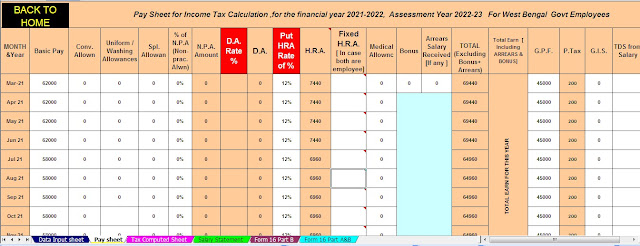
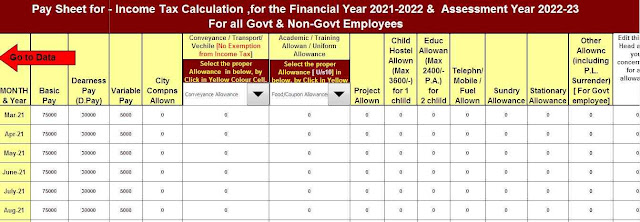
3) This Excel Utility has a unique Salary Structure for Government and Non-Government Employee’s Salary Structure.


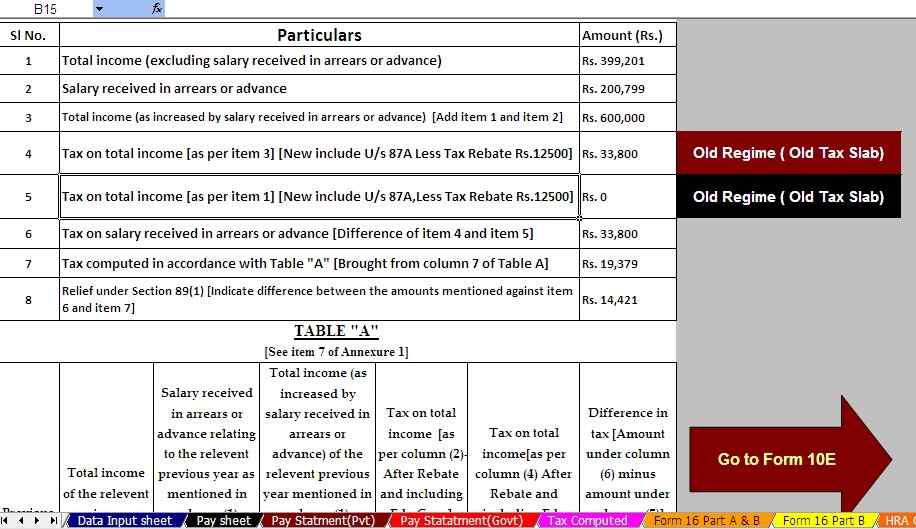
4) Automated Income Tax Arrears Relief Calculator U/s 89(1) with Form 10E from the F.Y.2000-01 to F.Y.2022-23 (Update Version)


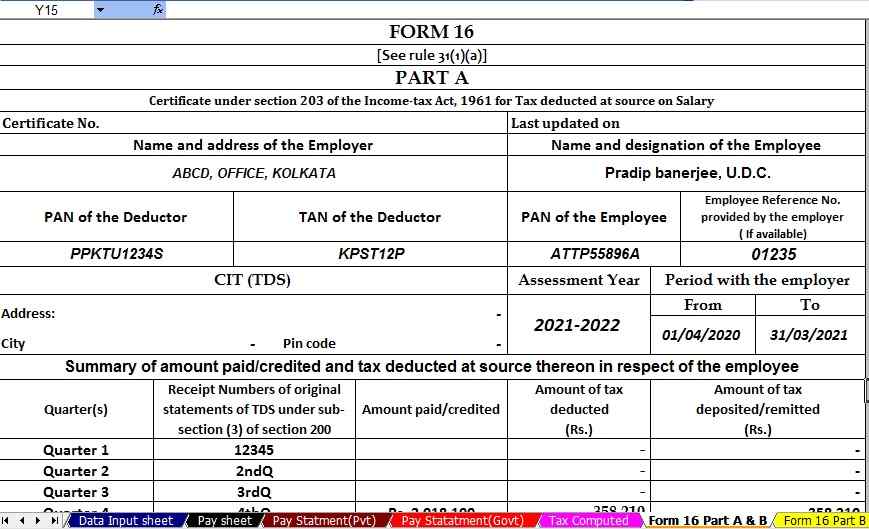
5) Automated Income Tax Revised Form 16 Part A&B for the F.Y.2022-23


6) Automated Income Tax Revised Form 16 Part B for the F.Y.2022-23

Wednesday, 14 September 2022

80GG – deduction on house rent paid| With Automated Income Tax Preparation Software All in One in Excel for the Govt and Non-Govt Employees for the F.Y.2022-23

80GG – deduction on rent paid | 80GG is a deduction under Chapter VI-A of the Income-tax Act, 1961. It was introduced to accommodate persons who do not receive housing assistance, but who pay rent for their accommodation. For example, a person can claim a rent deduction, even if they have not received a mortgage.


80GG – deduction on house rent paid

A person wishing to claim deductions under this section must be a self-employed person or employee. 80GG allows people to claim a deduction relating to rent paid. The rent paid is for personal occupancy.


Exclusion under Section 80GG

To request an exemption under this section, the following conditions must be met:

The person cannot receive housing benefits from their employer.

The person has filed a petition in Form no. 10BA.


The assessee or his spouse or minor or a member of HUF cannot own a house in the place where he usually resides or performs his office functions or carries on his business or profession.


The assessee cannot own a flat in his own profession, or in any other place, the value of which is to be ascertained in accordance with Sec 23(2)(a) or Sec 23(4)(a).

In other words, if Mr A is claiming on his income tax return an exemption for personal use and he pays rent for a place where he ordinarily lives, but does not own, he cannot claim an exemption under section 80GG :


The quantum of the deduction is the least of the following:

Rent actually paid less than 10% of the adjusted total income.

5,000/- per month.

25% of the total adjusted cost.


Exceptions under Article 80GG:

- An individual cannot claim a rental deduction if the premises is the place where he works or carries on business.

An individual cannot claim a deduction of rent by claiming payment of landlord-owned property as landlord-occupied property elsewhere. If the person lives in one city and owns a home in another city or town, they are considered tenants.


If a person lives in a household with his father and mother, he can apply for eviction under Article 80GG. She will have to sign a lease with her parents to get the rent deduction. However, the mother and father, who own the property, will have to report the rent as income on their tax return. If the house is jointly owned by a son/daughter, they cannot claim rent deduction from their taxable income.

Download Automated IncomeTax Preparation Excel-Based Software All in One for the Government and Non-Government (Private) Employees for the Financial Year 2022-23 and Assessment Year 2023-24 U/s 115BAC


80GG – deduction on house rent paid

Feature of this Excel Utility:-


1) This Excel Utility Prepare Your Income Tax as per your option U/s 115BAC perfectly.


2) This Excel Utility has the all amended Income Tax Section as per Budget 2022


3) Automated Income Tax Arrears Relief Calculator U/s 89(1) with Form 10E from the F.Y.2000-01 to F.Y.2022-23 (Updated Version)


4) Automated Calculation Income Tax House Rent Exemption U/s 10(13A)


5) Individual Salary Structure as per the Govt and Private Concern Salary Pattern


6) Individual Salary Sheet


7) Individual Tax Computed Sheet


8) Automated Income Tax Revised Form 16 Part A&B for the F.Y.2022-23


9) Automated Income Tax Revised Form 16 Part B for the F.Y.2022-23


10) Automatic Convert the amount into the in-words without any Excel Formula

Monday, 12 September 2022

Income Preparation Software in Excel for the Gov and Non-Govt employees for the F.Y.2022-23 with Exemption Chapter VI A as per the Income Tax Act

 Chapter VI A of the Income Tax Act contains several subsections of Section 80 that allow a valuer to

 claim deductions from total gross income due to various tax savings investments, allowable expenses,

 donations, etc. Such deductions enable a valuer to recover the amount due to reducing tax.


Chapter VI A of the Income Tax Act contains the following articles:

80C: Deduction related to the life insurance premium, deferred annuity, contributions to the pension fund (PF), subscription of certain stocks or bonds, etc. The deduction limit is Rs 1.5 lakh along with section 80CCC and section 80CCD (1).

80CCC: Deduction for a premium from some pension funds. The exemption limit is Rs 1.5 lakh including section 80C and section 80CCD (1).


80CCD (1): Withholding as Contribution to Central Administrations Pension Plan - in the case of an employee, 10 % of salary (Base + DA) and in any other case 20 % of his total gross income in an exercise will be tax-free to be. The Maximum limit is Rs 1.5 lakh Including 80C and 80CCC.


80CCD (1B): Deduction of up to Rs 50,000 related to the contribution to the Central Government Pension Scheme (NPS).


80CCD (2): Deduction in connection with the employer's contribution to the pension scheme of the Central Government. The tax benefit is granted on the employer's contribution of 14 %, where that premium is paid by the central government and where the premium is paid by another employer, the tax benefit of 10 % is granted.


80D: Deduction from the health insurance premium. The premium paid up to Rs 25,000 is eligible for deduction for persons other than the elderly. For seniors, the limit is Rs 50,000 and the general u/s 80D limit is Rs 1 lakh.


80DD: Deduction for alimony, including medical care of a dependent who is a person with a disability. The maximum exemption limit is Rs 75,000.


80DDB: Deduction related to the cost of up to Rs 40,000 for the medical treatment of a specific disease by a neurologist, oncologist, urologist, haematologist, immunologist or another specialist, as prescribed.


80E: Deduction for interest on the loan granted for higher education with no upper limit.


80EE: Interest deduction up to Rs 50,000 on the loan taken out for owning a residential house.


80EEA: Interest deduction of up to Rs 1.5 lakh on the loan taken out for a particular home property (on affordable housing).


80EEB: Deduction for interest up to Rs 1.5 lakh on the loan taken out for the purchase of an electric vehicle.


80G: Donations to certain funds, charities, etc. Depending on the nature of the donee, the limit varies from 100 % of the total donation to 50 %of the total donation or 50 % of the donation with a ceiling of 10 % of the total donation. Gross Income.


80GG: Deductions from rent paid by non-salaried subjects who are not receiving HRA benefits. The deduction limit is Rs 5,000 per month or 25 % of total income in a year, whichever is lower.


80TTA: Deductions for interest on savings accounts up to Rs 10,000 in the case of experts other than senior residents.


80TTB: Deduction of interest on deposits up to Rs 50,000 in case of older residents.


80U: Deduction for a person with a disability. Depending on the type and size of the maximum disability allowance allowed in this section is Rs 1.25 lakh.

Download Automated Income Tax Preparation Excel-Based Software All in One for the Government & Non-Government (Private) Employees for the F.Y.2022-23 and A.Y.2023-24

Income Preparation Software in Excel
 
Income Preparation Software in Excel

Income Preparation Software in Excel

Feature of this Excel Utility:-


1) This Excel utility prepares and calculates your income tax as per the New Section 115 BAC (New and Old Tax Regime)


2) This Excel Utility has an option where you can choose your option as New or Old Tax Regime


3) This Excel Utility has a unique Salary Structure for Government and Non-Government employees Salary Structure.


4) Automated Income Tax Arrears Relief Calculator U/s 89(1) with Form 10E from the F.Y.2000-01 to F.Y.2022-23 (Update Version)


5) Automated Income Tax Revised Form 16 Part A&B for the F.Y.2022-23


6) Automated Income Tax Revised Form 16 Part B for the F.Y.2022-23

Wednesday, 7 September 2022

Income Tax Preparation software in Excel for the Govt and Non-Govt Employees for the F.Y.2022-23 with Refund of tax under Section 87A

 Income Tax Preparation software in Excel with Discount u/s 87A was introduced by the Government of

 India in the year 2013-14. 87A discount benefits your tax liability. Rebates under Section 87A can be

 claimed if your taxable income does not exceed the predetermined limit for the relevant financial year.

You can claim a maximum deduction of Rs 12,500 under Section 87A of the Income Tax Act for the financial year 2022-23.


The maximum reduction amount of 87A is adjusted from time to time. Initially, the maximum tax refund under Section 87A of the Income Tax Act was Rs 2,000. In the Union Budget 2016, it was increased to Rs 5,000. In the Union Budget 2017, it has been increased to Rs 2,500, for people with net taxable income up to Rs 3,50,000. After the Union Budget 2019, the government increased the net taxable income by ₹5 Lakhs. The maximum discount limit of 87A has also been increased to Rs 12,500.


What is Income Tax Rebate?

An income tax refund can simply be understood as a form of tax refund that you receive from the tax authorities in certain circumstances. A person is liable for a tax credit if he or she pays more tax in a financial year than they have to pay to the government. To take advantage of the tax break, make sure you calculate your tax liability correctly and file your income tax return within the designated period.


What is a deduction of income tax u/s 87A?

Rebate u/s 87A provides a tax benefit to an individual taxpayer provided his total taxable income does not exceed the threshold of Rs. 5,000,000 for a particular financial year. That is, if the total taxable income exceeds Rs. 500,000, he will not be eligible for the benefit of tax relief under section 87A.


When did Section 87A come into force?

The Section 87A deduction was first offered in the year 2013 and has been in force for many years, only reinstated in 2019. According to the new provisions of Section 87A, any person with taxable annual income up to Rs 5 lakhs is eligible for an income tax refund of Rs.12,500. This actually translates into the fact that people with an annual income of less than Rs 5 lakhs are effectively exempt from income tax and can actually save income tax in India.


Section 87A- Then and Now

It is interesting to note that the income tax refund provided under Section 87A has undergone many changes since its introduction in 2013. It was only in the financial year 2018-2019 that the income tax refund provided under Section 87A ended with much less Rs. 2500. So, if your total taxable income was above Rs 3.5 lakhs and your tax liability was above Rs 2,500, Section 87A could no longer be a tax relief target for you.

How can you claim a tax refund under Section 87A?

Under Income Tax Section 87A, you can claim a refund of Rs 12,500 from your tax liability. Here are the steps to claim this 87A reduction:

Step 1. First calculate your gross total income for the previous financial year


Step 2. Subtract from this any deductions you claimed for tax-saving investments


Step 3. Now you arrive at your Gross Total Income after taxes. This is your taxable income for the fiscal year (or previous year) .


Step 4. Estimates your gross tax liability on any income, but does not add any deductions to that amount


Step 5. You can claim an 87A reduction on your gross tax liability prior to delivery and arrive at the net tax liability.

Download Automated Income Tax Preparation Excel-Based Software All in One for the Government & Non-Government (Private) Employees for the F.Y.2022-23 and A.Y.2023-24


Feature of this Excel Utility:-


1) This Excel utility prepares and calculates your income tax as per the New Section 115 BAC (New and Old Tax Regime)


2) This Excel Utility has an option where you can choose your option as New or Old Tax Regime


3) This Excel Utility has a unique Salary Structure for Government and Non-Government employees Salary Structure.


4) Automated Income Tax Arrears Relief Calculator U/s 89(1) with Form 10E from the F.Y.2000-01 to F.Y.2022-23 (Update Version)


5) Automated Income Tax Revised Form 16 Part A&B for the F.Y.2022-23


6) Automated Income Tax Revised Form 16 Part B for the F.Y.2022-23

Wednesday, 27 July 2022

Section 80 CCD(IB) Deductions| With Automated Income Tax Preparation Software All in One for the Government and Non-Government Employees for the F.Y.2022-23

 Section 80CCD(1B) Deduction: National Pension Scheme (NPS) tax credits

The income tax law prescribes various forms of deductions that help reduce your tax liability. There are a number of prescribed investments and expenses that you pay from your income that are allowed as investments or deductible expenses. Since these investments and expenses are deducted from your income, your taxable income is reduced. As your taxable income decreases, you pay less taxes.


What is Section 80 CCD(1B)?

In terms of deductions, some of the most popular deductions are found in Chapter VIA of the Income Tax Act. This chapter contains Section 80 deductions. Section 80C is a very popular section that allows you to deduct up to INR 1.5 Lakh for various types of investments and expenses. There is another section, Section 80 CCD (1B), which allows an additional deduction of INR 50,000 in addition to the deduction available in Section 80C for INR 1.5 lakh. A deduction under Section 80 CCD (1B) is allowed if you invest in the National Pension Scheme (NPS) offered by the Government of India.

Do you know what NPS investing is? Let's figure it out soon

Download and Prepare at a time 50 Employees Form 16 Part B for the Financial Year 2021-22

What is an NPS scheme?

The National Pension Scheme is a public investment scheme that helps plan for retirement. You can invest in the scheme while you are working, and then the scheme will create housing for your pension. The corpus can then be used to provide a regular income in the form of annuities.


Eligibility to invest in the NPS scheme

The investor must be between 18 and 60 years of age. However, in the case of an NRI, if the NRI's nationality changes after the NRI invests in the scheme, the scheme will be terminated.


Invest in NPS

Investments in NPS can be made through a financial institution acting as a Point of Presence (POP). Almost all banks and non-bank financial companies are authorized to act as POPs. POP has specialized agencies that collect NPS deposits from investors. These agencies are called Point of Presence Service Providers or POP-SPs. The POP-SP list can be found online at the scheme's official website https://www.npscra.nsdl.co.in/pop-sp.php - no application form, ID, or proof of age. and proof of residence.


Section 80 CCD(IB) Deductions


Section 80CCD(1B) Deduction: National Pension Scheme (NPS) tax credits

The income tax law prescribes various forms of deductions that help reduce your tax liability. There are a number of prescribed investments and expenses that you pay from your income that are allowed as investments or deductible expenses. Since these investments and expenses are deducted from your income, your taxable income is reduced. As your taxable income decreases, you pay less taxes.

Download and Prepare at a time 50 Employees Form 16 Part A&B for the Financial Year 2021-22


What is Section 80 CCD(1B)?

In terms of deductions, some of the most popular deductions are found in Chapter VIA of the Income Tax Act. This chapter contains Section 80 deductions. Section 80C is a very popular section that allows you to deduct up to INR 1.5 million for various types of investments and expenses. There is another section, Section 80 CCD (1B), which allows an additional deduction of INR 50,000 in addition to the deduction available in Section 80C for INR 1.5 lakh. A deduction under Section 80 CCD (1B) is allowed if you invest in the National Pension Scheme (NPS) offered by the Government of India.

Do you know what NPS investing is? Let's figure it out soon


What is an NPS scheme?

The National Pension Scheme is a public investment scheme that helps plan for retirement. You can invest in the scheme while you are working, and then the scheme will create housing for your pension. The corpus can then be used to provide a regular income in the form of annuities.


Eligibility to invest in the NPS scheme

The investor must be between 18 and 60 years of age. However, in the case of an NRI, if the NRI's nationality changes after the NRI invests in the scheme, the scheme will be terminated.


Invest in NPS

Investments in NPS can be made through a financial institution acting as a Point of Presence (POP). Almost all banks and non-bank financial companies are authorized to act as POPs. POP has specialized agencies that collect NPS deposits from investors. These agencies are called Point of Presence Service Providers or POP-SPs. The POP-SP list can be found online at the scheme's official website https://www.npscra.nsdl.co.in/pop-sp.php - no application form, ID, or proof of age. and proof of residence.


Download and Prepare at a time 100 Employees Form 16 Part B for the Financial Year 2021-22


NPS account type

When you invest in the National Pension Scheme, you will have two accounts to choose from. These accounts are:

Level I account

A Tier I account is a mandatory account that you would have to invest in if you were to invest in the National Pension Scheme. The minimum investment required for this account is INR 500 at one time and INR 1000 for one year.

Tier II account

A Tier II Account is a voluntary account that you can invest in after you invest in a Tier I Account. The minimum investment amount for a Tier II Account is INR 250 at any given time. No minimum investment per year is required. A minimum deposit of INR 1,000 is required to open an account.

Download Automated Income Tax Preparation Excel-Based Software All in One for the Government & Non-Government (Private) Employees for the F.Y.2022-23 and A.Y.2023-24


Section 80 CCD(IB) Deductions

Section 80 CCD(IB) Deductions

Income Tax Form 10 E

Feature of this Excel Utility:-


1) This Excel utility prepares and calculates your income tax as per the New Section 115 BAC (New and Old Tax Regime)


2) This Excel Utility has an option where you can choose your option as New or Old Tax Regime


3) This Excel Utility has a unique Salary Structure for Government and Non-Government employees Salary Structure.


4) Automated Income Tax Arrears Relief Calculator U/s 89(1) with Form 10E from the F.Y.2000-01 to F.Y.2022-23 (Update Version)


5) Automated Income Tax Revised Form 16 Part A&B for the F.Y.2022-23


6) Automated Income Tax Revised Form 16 Part B for the F.Y.2022-23

Tuesday, 26 July 2022

Deduction U/s 80D, 80DD and 80DDB | With Automated Income Tax Preparation Software All in One in Excel for the Government and Non-Government Employees for the F.Y.2022-23

 Deduction U/s 80D, 80DD and 80DDB | Section 80D of the Information Technology Law provide for a

 deduction of Rs 25,000 from the insurance premium paid for health insurance for self, spouse and

 dependent children.


Section 80D of the Information Technology Law provides for a deduction of Rs 25,000 from the insurance premium paid for health insurance for self, spouse and dependent children.


The Income Tax Act rewards people for purchasing health insurance by allowing a deduction when paying premiums on their insurance policies. Section 80D of the Information Technology Law provides for a deduction of Rs 25,000 from the insurance premium paid for health insurance for self, spouse and dependent children. The section also allows you to deduct up to Rs 25,000 for the premium paid for the health insurance policy for the parents of the person being assessed. It doesn't matter if the parents are dependent or not.

Download One by One Preparation Form 16 Part A&B in Excel for the F.Y.2021-22

Deduction U/s 80D, 80DD and 80DDB

Section 80D of the Income Act provides for an increased deduction of Rs.50,000 if either parent of the person being assessed is elderly. A person residing in Indiaat the age of 60 or over at any time during the previous relevant year is considered to be senior.


Deductions for preventive examinations

Section 80D of the Information Technology Law allows a deduction of up to Rs 5,000 in respect of payments for preventive medical examinations of self, spouse, dependent children or parents made during the previous year. Payment for preventive medical examinations can be made in cash.

A deduction of Rs 5,000 counts against the total limit of Rs 25,000 or Rs 50,000, as the case may be.

Download One by One Preparation Form 16 Part Bin Excel for the F.Y.2021-22


Deduction U/s 80D, 80DD and 80DDB

Deduction of expenses for treatment

Section 80DDB allows for a tax deduction for expenses incurred by an individual for himself or for a dependent for the treatment of specific medical conditions, as specified by law. The deduction amount can be used for the amount actually paid or Rs 40,000, whichever is less.


The maximum deduction for an elderly person is Rs 1 Lakh.

The amount of the deduction will be reduced by the amount paid by the insurance company or reimbursed by the employer.


Deduction for the treatment of a dependent with a disability

Section 80DD of the Income Tax Act deals with the deduction of medical expenses incurred by you or a dependent. A dependent may be the spouse, children, parents, or siblings of the respondent.

A deduction up to a maximum amount of Rs 75,000 will be allowed under section. The maximum deduction limit is increased to Rs 1.25 lakh in case of severe disability. Severe deficiency means that the deficiency percentage is 80% or more.

Download Automated Income Tax Preparation Excel-Based Software All in One for the Government & Non-Government (Private) Employees for the F.Y.2022-23 and A.Y.2023-24


Salary Structure

Deduction U/s 80D, 80DD and 80DDB

Deduction U/s 80D, 80DD and 80DDB

Feature of this Excel Utility:-


1) This Excel utility prepares and calculates your income tax as per the New Section 115 BAC (New and Old Tax Regime)


2) This Excel Utility has an option where you can choose your option as New or Old Tax Regime


3) This Excel Utility has a unique Salary Structure for Government and Non-Government employees Salary Structure.


4) Automated Income Tax Arrears Relief Calculator U/s 89(1) with Form 10E from the F.Y.2000-01 to F.Y.2022-23 (Update Version)


5) Automated Income Tax Revised Form 16 Part A&B for the F.Y.2022-23


6) Automated Income Tax Revised Form 16 Part B for the F.Y.2022-23

Tuesday, 12 July 2022

Tips to save on taxes| With Automated Income Tax Preparation Software in Excel for the Govt and Non-Govt Employees for the F.Y.2022-23

 1. Rent paid but HRA not received:


You typically receive an HRA as part of your paycheck and treat the HRA as a primary tax-saving plan while you file taxes. However, there may also be a situation where it is not part of the employee's salary. In such a situation, the standard HRA deduction cannot be claimed and the taxpayer will not be able to claim benefits even if they are paying rent. Also, in such cases, the taxpayer must claim a tax benefit under Section 80GG.


To provide taxpayer benefits even when they did not receive an HRA, Section 80GG was introduced. Under this section, a taxpayer can claim a rent deduction even if they have not received an HRA. As per the following conditions:


That the individual is self-employed or receives a salary.

The HRA was not received at any time during the year for which the Section 80GG deduction was claimed.

You may also like- One by One Preparation Form 16 Part A&B and Part B for the F.Y.2021-22

You, your spouse, or the HUF of which you are a member do not own any accommodation where you currently reside.


To claim the deduction under Section 80GG, you must file a 10BA form for the rent payment. Less of the following will be considered a deduction under this section:

rupee. 5000 per month.


25% of total income (excluding long-term capital gains and short-term capital gains under Section 111A and income under Section 115A or 115D and deductions under 80°C at 80 units).

 Real income is less than 10% of income


2. Interest paid on the mortgage loan

To claim the interest component of a home loan as a tax deduction, you must meet the following conditions:

You must obtain a loan to buy or build a house.

The construction of the house must be completed within 5 years after the end of the financial year in which the loan was taken.


The interest component paid as part of the loan can be claimed as a deduction under section 24 up to Rs. 2 lakhs This applies in the case of self-occupied properties. In the case of rental property, there is no maximum limit for claiming interest.

In the event that interest is paid on a mortgage loan obtained during the pre-construction period, the pre-construction interest paid may be claimed as a deduction. The discount is available in five equal instalments beginning with the year the property was purchased or construction was completed. However, the maximum is Rs. 2 lakhs

You may also like- One by One PreparationForm 16 Part B for the F.Y.2021-22


3- Bank Savings Account Benefits:

The Income Tax Act of 1961 provides for deductions in respect of interest earned on bank savings accounts. Undivided Hindu individuals and families can claim a tax deduction under Section 80TTA on interest earned. This deduction applies to non-senior taxpayers. In the case of the elderly, article 80 TTB applies.

The maximum limit u/s 80TTA is Rs. 10,000. Limit Rs. 10,000 is applied to the total interest earned on the savings bank account held by the resident. No interest above and above Rs. 10,000 is taxed under the heading “Income from other sources”. The tax rate will correspond to the applicable tax bracket. For example, the total interest Amit earned from his savings bank account was Rs. 15,000. But allowed under Section 80TTA will be Rs. 10,000/-


On April 1, 2018, Section 80TTB for the elderly appeared. Under the 80TB section, seniors can claim discounts of up to Rs. 50,000 or a specified amount of gross gross receipts.


4- Medical expenses for disabled dependents:

Under the provisions of Section 80DD, a taxpayer can claim a deduction if they are caring for disabled dependents. This tax benefit will help reduce the tax liability of a person caring for a disabled person in their dependent family.

Download Automated Income Tax Preparation Excel-Based Software All in One for the Government & Non-Government (Private) Employees for the F.Y.2022-23 and A.Y.2023-24

Tips to save on taxes
 

Feature of this Excel Utility:-


1) This Excel utility prepares and calculates your income tax as per the New Section 115 BAC (New and Old Tax Regime)


2) This Excel Utility has an option where you can choose your option as New or Old Tax Regime


3) This Excel Utility has a unique Salary Structure for Government and Non-Government employees Salary Structure.


4) Automated Income Tax Arrears Relief Calculator U/s 89(1) with Form 10E from the F.Y.2000-01 to F.Y.2022-23 (Update Version)


5) Automated Income Tax Revised Form 16 Part A&B for the F.Y.2022-23


6) Automated Income Tax Revised Form 16 Part B for the F.Y.2022-23

Thursday, 5 May 2022

Section 10 Income Tax Act | With Automatic Income Tax Arrears Relief Calculator U/s 89(1) with Form 10 E from the F.Y.2000-01 to F.Y.2022-23

 Section 10 Income Tax Act | Under the Income Tax Act, 1961, any citizen of India whose income

 exceeds a certain threshold is liable to pay taxes. Therefore, when collecting each fiscal year, taxpayers

 look for ways to minimize their tax liability.


To ease the burden on taxpayers by encouraging them to save, invest, and pay taxes, the law listed some income as tax-exempt.

Download and prepare at a time 50 Employees Form 16 Part B for the F.Y.2021-22

Section 10 Income Tax Act

Deduction under Section 10 of the Income Tax Law

Exemption from the category of sections and subsections

10 (1) Agricultural income of the self-employed No tax

10 (2) Income of a Hindu family member is indivisible Without tax

10 (10C) Voluntary Retirement Benefit Exempt up to Rs. 5 lakh

10 (10D) Life insurance claims including bonus No tax

10 (11) (12) Amount withdrawn from the pension fund Without tax

10 (10BC) State Disaster Damage Compensation No tax

Download and prepare One by One Income Tax Form 16 Part A&B and Part B for the F.Y.2021-22 in Excel

Section 10 Income Tax Act

10 (13A) Rental Housing Benefit (HRA) At a minimum, the following are exempt: Actual HRA 40% of salary or 50% of salary if you live in metropolitan areas Rent paid less than 10% of salary

10 (15) Income from securities not taxed not taxed

Other exclusions under section 10

Employees receive a number of benefits in addition to their regular income. Most of these benefits are considered part of general income, and some are exempt under Section 10.

Download and prepare at a time 50 Employees Form 16 Part A&B for the F.Y.2021-22


Section 10 Income Tax Act

1. Special compensation under section 10 (14):

Some allowances are classified as special benefits under Section 10 and are tax-free. The exception depends on the amount allowed or the money actually used for a particular purpose, whichever is less.

Grants under subsection (14) of section 10 of the Income Tax Act include:

2. Per diem: includes per diem provided to cover expenses incurred during a business trip or when moving/moving to a new job.

3. Travel Allowance: Provided to employees to cover travel expenses during official travel or when moving to another job. Including expenses incurred in connection with the transfer of personal belongings, etc.

Download and prepare at a time 100 Employees Form 16 Part B for the F.Y.2021-22


Section 10 Income Tax Act

4. Adjutant's allowance: This exemption applies to the salary of an assistant assigned to assist in the performance of official duties.

5. Uniform allowance: Where the office requires you to wear a uniform while on duty, an allowance is offered to cover the cost of purchasing and maintaining a uniform.

6. Travel expenses: This subsidy is provided to cover expenses related to official travel. It does not cover travel expenses from home to work.

7. Research or Academic Scholarship: This exception is provided by educational and research institutions to encourage research or academic training, education, etc.

8. U/S 10(14)(i) exemption: -

A) Per Diem

B) Travel allowance

9. Specific compensation under Article 10(14)(ii):

Compensation excluded pursuant to paragraph (14)(ii) of Section 10 of the Income Tax Act

• Weather benefits: including compensation for work in the highlands or hills.

• Up to 800 for the hills of Himachal Pradesh, Uttar Pradesh Jammu and Kashmir and the northeast.

• Discount up to 7000 per month for Siachen.

• Discount up to 300 for other high altitude locations.

• Tribal Areas Allowance: 200 grants for those working in tribal areas, registered or pre-classified agencies such as Karnataka, West Bengal, Madhya Pradesh, Assam, Orissa, Tamil Nadu, Bihar, Uttar Pradesh and Tripura.

• Border Area Benefits: Pursuant to section 10(14)(ii) 2BB, military personnel serving in border areas, remote areas, or disturbed areas receive benefits ranging from 200 to 1,300 per month.

Download and prepare at a time 100 Employees Form 16 Part A&B for the F.Y.2021-22


Section 10 Income Tax Act

• Compensation in the field: a grant of 2600 per month is permitted under section 10(14)(ii) provided that it is given to individuals for tasks in unusual areas.

• Children's Education Fund: Exceptions to Section 10(14)(ii) are available for a benefit of Rs.100 per child for up to 2 children. Boarding allowance can also be claimed in the amount of 300 / month/child up to 2 children.

• Counterinsurgency allowance: The Section 10(14)(ii) allowance of $3,900 per month is for those who work in the armed forces in counterinsurgency.

• Island Service Allowance: An exemption under Section 10(14)(ii) of 3250 per month for military personnel serving in the Andaman and Nicobar Islands or the Lakshadweep Island Group.

• Other benefits under paragraph (14) (ii) of Section 10 of the Income Tax Act include:

• 800/month for underground miners.

• 4,200 per month for employees in high activity areas.

• 1000 per month for workers in certain modification areas.

• 3,200 per month in travel allowance for employees travelling between home and work

Download Automated Income Tax Arrears Relief Calculator U/s89 (1) with Form 10 E from the F.Y.2000-01 to F.Y.2022-23(Up-to-date Version)

Data input sheet
form 10 E


Monday, 6 December 2021

Income tax deduction for salaried employees| With Automatic Income Tax Preparation Excel Based Software in Excel All in One for the Govt and Non-Govt Employees for F.Y.2021-22

 When the overall taxpayers in the country are assessed, the salaried individuals make up a significant

 portion of it. And, their contribution to tax collection is considerable. With this in mind, the rules of the

 income tax deduction for salaried employees provide various opportunities for tax protection.


With these discounts and deductions, you can easily reduce your taxes significantly. Thus, if you are a salaried person, it is very important to know every little detail about the cuts. Let's learn more about it


Standard Income Tax (Deduction & Exemption) on Employees When presenting the Union Budget 2018, the Indian Finance Minister has proposed Rs. 40,000 is deducted in lieu of medical compensation (Rs. 15,000) and transport allowance (Rs. 19,200).


As a result, salaried individuals now earn Rs.9600/- You can get additional income tax exemption 5800 as per F.Y 2018-19. However, in the 2019 interim budget, the amount of Rs. 40,000 has been increased. 50,000 ..


Sections 80C, 80CCC, and 80CCD (1)

Undoubtedly, Section 80C is the most used option for salaried employees to get income tax exemption. Under this section, if an individual or a Hindu Undivided Family (HUF) spends or invests in a specific tax saving way, they can get up to Rs. 1.5 lakh.


The government also supports certain tax-saving instruments, such as NPS, PPF, and more, to allow individuals to invest and save for their retirement. Investments or expenditures under section 80C are not permitted as deductions for income from capital gains


This simply means that if you have a capital gain on your income, you will not be eligible to avail of the benefits of Section 80C. Some investments up to the amount eligible for rebate under Sections 80C, 80CCC, and 80CCD (1). 1.5 lakh is: -

Life insurance premium

Employees Provident Fund (EPF)

Equity Linked Savings Scheme (ELSS)

Pension / Annual Scheme

Home Loan Principal Payment

Children's tuition fees

PPF account

Contribute Sukanya Samridhi Account

NSC (National Savings Certificate)

Fixed Deposit (Tax Savings)

National pension scheme deposited during post office

Home Rent Allowance Discount (HRA)

If you are a salaried person, living in rented accommodation, it may be easier to get the benefits of HRA.


The amount can be partially or completely exempt from your income tax. However, if you do not live in rented accommodation and are still receiving HRA benefits, it will be considered taxable.

You may also, like- Automatic Income Tax Preparation Excel Based Software all in one for the West Bengal state Employees for the F.Y.2021-22

Income Tax deduction for salaried Persons
 

HolidayTravel Allowance (LTA)

The Income Tax Act also provides an LTA exemption to limit the travel expenses of salaried persons during the period of absence in the workplace.

However, you should keep in mind that this discount does not include the cost of the entire trip, such as food, shopping, leisure, entertainment and more.


Also, the allowance only covers domestic travel and not international. The mode of travel must also be airway, railway or public transport


Section 80D: Medical insurance


Deduction Section 80D is a deduction that you can claim for your medical expenses. That way, you can easily save tax on health insurance premiums that you are paying for yourself, your family or your dependent parents.


The limit under this section for deduction is money. 25,000 for insurance premium. If you pay insurance premiums for senior citizens, you can claim a discount of up to Rs. 50,000


Moreover, health check-up to money. Also covered in the overall range of 5,000. If your employer pays the premium on your behalf and deducts it from your salary, you can claim a deduction under section 80D.


Section 24(b):  home loan Interest Max Rs. 2 Lakh


Another primary tax-saving tool is home loan interest. You can claim a discount of up to 7 2 lakh for interest on the loan for self-acquired property


Article 80TTA: Deduction on interest earned from a savings account.


Under section 80TTA of the Income-tax Act, if you earn income from savings account interest, the deduction available for salaried employees in this regard will be Rs. 10,000


However, keep in mind that it is only available to individuals and HUFs.


If the income from interest is less than Rs. 10,000, the whole amount can be deducted.


Conclusion

The above-mentioned components can facilitate savings by accepting large tax breaks and rebates.


So, make sure that you are making the most of these income tax deductions for salaried employees. Also, structure your salary so that you can save more on your taxes.

Download Automated Income Tax Preparation Excel Based Software All in One for the Government & Non-Government (Private) Employees for the F.Y.2021-22 and A.Y.2022-23

Income Tax deduction for the salaried persons
 
Income Tax Form 10 E

Feature of this Excel Utility:-


1) This Excel utility prepares and calculates your income tax as per the New Section 115 BAC (New and Old Tax Regime)


2) This Excel Utility has an option where you can choose your option as New or Old Tax Regime


3) This Excel Utility has a unique Salary Structure for Government and Non-Government Employee’s Salary Structure.


4) Automated Income Tax Arrears Relief Calculator U/s 89(1) with Form 10E from the F.Y.2000-01 to F.Y.2021-22 (Update Version)


5) Automated Income Tax Revised Form 16 Part A&B for the F.Y.2021-22


6) Automated Income Tax Revised Form 16 Part B for the F.Y.2021-22