Showing posts with label Income Tax Calculator. Show all posts

Monday, 12 September 2022

Income Preparation Software in Excel for the Gov and Non-Govt employees for the F.Y.2022-23 with Exemption Chapter VI A as per the Income Tax Act

 Chapter VI A of the Income Tax Act contains several subsections of Section 80 that allow a valuer to

 claim deductions from total gross income due to various tax savings investments, allowable expenses,

 donations, etc. Such deductions enable a valuer to recover the amount due to reducing tax.


Chapter VI A of the Income Tax Act contains the following articles:

80C: Deduction related to the life insurance premium, deferred annuity, contributions to the pension fund (PF), subscription of certain stocks or bonds, etc. The deduction limit is Rs 1.5 lakh along with section 80CCC and section 80CCD (1).

80CCC: Deduction for a premium from some pension funds. The exemption limit is Rs 1.5 lakh including section 80C and section 80CCD (1).


80CCD (1): Withholding as Contribution to Central Administrations Pension Plan - in the case of an employee, 10 % of salary (Base + DA) and in any other case 20 % of his total gross income in an exercise will be tax-free to be. The Maximum limit is Rs 1.5 lakh Including 80C and 80CCC.


80CCD (1B): Deduction of up to Rs 50,000 related to the contribution to the Central Government Pension Scheme (NPS).


80CCD (2): Deduction in connection with the employer's contribution to the pension scheme of the Central Government. The tax benefit is granted on the employer's contribution of 14 %, where that premium is paid by the central government and where the premium is paid by another employer, the tax benefit of 10 % is granted.


80D: Deduction from the health insurance premium. The premium paid up to Rs 25,000 is eligible for deduction for persons other than the elderly. For seniors, the limit is Rs 50,000 and the general u/s 80D limit is Rs 1 lakh.


80DD: Deduction for alimony, including medical care of a dependent who is a person with a disability. The maximum exemption limit is Rs 75,000.


80DDB: Deduction related to the cost of up to Rs 40,000 for the medical treatment of a specific disease by a neurologist, oncologist, urologist, haematologist, immunologist or another specialist, as prescribed.


80E: Deduction for interest on the loan granted for higher education with no upper limit.


80EE: Interest deduction up to Rs 50,000 on the loan taken out for owning a residential house.


80EEA: Interest deduction of up to Rs 1.5 lakh on the loan taken out for a particular home property (on affordable housing).


80EEB: Deduction for interest up to Rs 1.5 lakh on the loan taken out for the purchase of an electric vehicle.


80G: Donations to certain funds, charities, etc. Depending on the nature of the donee, the limit varies from 100 % of the total donation to 50 %of the total donation or 50 % of the donation with a ceiling of 10 % of the total donation. Gross Income.


80GG: Deductions from rent paid by non-salaried subjects who are not receiving HRA benefits. The deduction limit is Rs 5,000 per month or 25 % of total income in a year, whichever is lower.


80TTA: Deductions for interest on savings accounts up to Rs 10,000 in the case of experts other than senior residents.


80TTB: Deduction of interest on deposits up to Rs 50,000 in case of older residents.


80U: Deduction for a person with a disability. Depending on the type and size of the maximum disability allowance allowed in this section is Rs 1.25 lakh.

Download Automated Income Tax Preparation Excel-Based Software All in One for the Government & Non-Government (Private) Employees for the F.Y.2022-23 and A.Y.2023-24

Income Preparation Software in Excel
 
Income Preparation Software in Excel

Income Preparation Software in Excel

Feature of this Excel Utility:-


1) This Excel utility prepares and calculates your income tax as per the New Section 115 BAC (New and Old Tax Regime)


2) This Excel Utility has an option where you can choose your option as New or Old Tax Regime


3) This Excel Utility has a unique Salary Structure for Government and Non-Government employees Salary Structure.


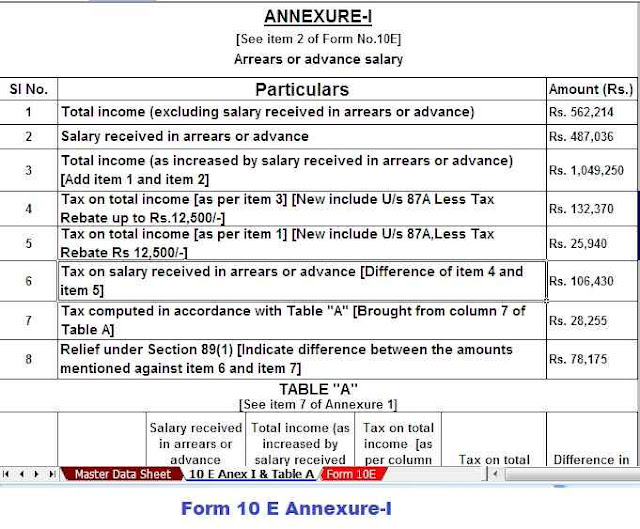
4) Automated Income Tax Arrears Relief Calculator U/s 89(1) with Form 10E from the F.Y.2000-01 to F.Y.2022-23 (Update Version)


5) Automated Income Tax Revised Form 16 Part A&B for the F.Y.2022-23


6) Automated Income Tax Revised Form 16 Part B for the F.Y.2022-23

Thursday, 16 December 2021

How to save tax through NPS| With Automatic Income Tax Preparation Excel Based Software All in One for the West Bengal Govt Employees for the F.Y.2021-22

How to save tax through NPS| With Automatic Income Tax Preparation Excel Based Software All in

 One for the West Bengal Govt Employees for the F.Y.2021-22


How to save tax by NPS investing an additional Rs 50, 000,.Investment in the National Pension System (NPS) is a hot topic of discussion from the perspective of tax protection for individual taxpayers considering various changes in the Income Tax Act in recent years. The NPS Tier 1 account provides tax benefits to the employer as well as the employee / self-employed person for their contribution to the NPS.


The tax benefits at the contribution stage are summarized below:


A person who has deposited any amount in his NPS account in a financial year can claim a rebate from his total income which is limited to 10% of the basic salary of salaried persons and 20% of the total income of self-employed persons. . This discount is for contributions made directly or in person by the employer.


Section 80CCE specifies the total amount of exemption permitted under sections 80C and 80 CCD (1) of the Income-tax Act., However, deposit in Section 80C baskets (EPF, PPF contributions, etc.),80CCD (1) also.

You may also, like-Automatic Income Tax Salary Arrears Relief Calculator U/s 89(1) with Form 10 E from the F.Y.2000-01 to F.Y.2021-22

how to save tax through NPS

How to save tax through NPS

Recently, U/s 80CCE permitted a person to an exemption up to Rs 1.5 lakh from the gross income if this Rs 1.5 lakh is invested in a specific way (including NPS). Certain expenditures are also eligible for exemption under the limit of Rs 1.5 lakh U/s  80CCE.


The maximum amount that can be deposited in NPS to claim deduction under section 80CCD (1) does not exceed 10% of a person's basic salary. After that, if 10% of the basic salary is below Rs. 1.5 lakhs, say Rs 1.40. deposit such as P.F., Tax-Saving F.D etc. Rs. 50,000 / - can be deposited in NPS in addition to Rs. 90,000 mentioned under 80CCD (1b). This rebate of Rs.50,000/-


Additional discount on NPS

To encourage investment in NPS, Section 80CCD (1B) of the Income-tax Act allows an additional rebate of Rs 1.5 lakh and above Rs 50,000 available under Section 80CCE.


Thus, where the individual taxpayer has exceeded the limit of Rs. 50,000 under Section 80CCD (1B) can be used to claim an additional rebate.


Employer's contribution

Employer's Contributions to the NPS account it is going to 80CCD(2)of an employee are governed by Section 17 (1) (viii) of the Income Tax Act applicable).


In Conclusion, Section 1 ((2) (vii) of the Finance Act, 2020 has been amended

Further, under section 17 (2) (viia), any interest, dividends, etc. earned by the employer on contributions above Rs. 7.5 lakhs and above will be taxable. The provision states that annual contributions will be calculated "in the prescribed manner" due to additional contributions. However, calculation guidelines are still pending.

Download Automated IncomeTax Preparation Excel Based Software All in One for the West Bengal Government Employees for the Financial Year 2021-22 and Assessment Year 2022-23 U/s 115BAC


Salary Structure

Feature of this Excel Utility:-


1) This Excel Utility Prepare Your Income Tax as per your option U/s 115BAC perfectly.


2) This Excel Utility has all amended Income Tax Section as per Budget 2021


3) Automated Calculation Income Tax House Rent Exemption U/s 10(13A)


5) Individual Salary Structure as per the West Bengal State Govt Employees Salary Pattern


6) Individual Salary Sheet


7) Individual Tax Computed Sheet


8) Automated Income Tax Revised Form 16 Part A&B for the F.Y.2021-22


9) Automated Income Tax Revised Form 16 Part B for the F.Y.2021-22


10) Automatic Convert the amount in to the in-words without any Excel Formula

Wednesday, 12 February 2020

Every big transaction you make, the Income Tax Department will be watching you With Automated Income Tax Arrears Relief Calculator U/s 89(1) with Form 10e from the F.Y. 2000-01 to F.Y.2019-20 (Updated Version)


HIGHLIGHTS

  • CBDT says it will make greater use of technology, data analysis and AI to comb through large transactions
  • The CBDT chief said scaling up information gathering will enable I-T dept to offer pre-filled returns of income
New Delhi: The income tax department will track more high-value transactions of individuals to ensure that these get reflected in their income tax returns, Central Board of Direct Taxes (CBDT) chairman P.C. Mody said in an interview.

Greater use of technology, data analysis and artificial intelligence to comb through large transactions taking place in the market will also help in tracking people who do not file their returns despite entering into many high-value transactions. By correlating the spending and investments made by people with their known sources of income, the department wants to make sure that people do not evade taxes. The emphasis on efficiency in tax collection and on adding more taxpayers come at a time when a slowing economy has made it harder for the tax department to achieve the 12.7% growth in direct tax collections in FY 21 while nominal GDP growth is expected to be only 10%.

“We are increasing our information mechanism to a newer level and the reporting entities (third-party financial institutions) are being increased. Once we have this information available with us along with the data of the taxpayers, we will be in a position to compare almost on a real-time basis as to what high-value financial transactions a tax payer is doing and how is he filing the returns of income,” said Mody. He, however, said it was not correct to call it surveillance. “It is totally non-intrusive and absolutely non-adversarial. It is a subtle persuasion,” said the chairman, adding that it was akin to telling taxpayers that the authorities are aware of the value transactions made by them, which should get reflected in their tax returns.

At present, the department collects information about certain high-value transactions which along with details of tax deducted and collected at source in the case of individuals is available for viewing in the tax department’s portal in the form 26 AS statement. The information collected for this includes savings bank deposits, credit card bill payments and investments in instruments like mutual funds above a specified threshold. Mody said that scaling up information gathering will also enable the department to offer pre-filled returns of income. “We are looking at (enhancing) tax collections as well as offering tax payer service,” he said.


Mody also rejected fears that certain steps proposed in the budget—introducing a monetary limit for tax-free contribution by employers to the retirement savings of employees and taxation of dividend in the hands of shareholders—could alienate high income earners. “For us, every taxpayer is important. We have adopted the classical system of taxation. Dividend is taxed in the hands of the recipient. As far as personal income tax rate is concerned, India is comparable to other countries. So, there is no concern of flight of persons to other countries. Besides, we are offering more services and convenience. We are offering a taxpayer charter,” he said. Taxation of dividend in the hands of shareholders and limiting the tax-free contribution of employers to the retirement savings of employees had displeased many high-income earners. The Narendra Modi administration has shown an inclination to increase the tax on the well-off to raise resources for welfare measures. Last year, the government increased the surcharge on income in two slabs. Accordingly, a person earning more than Rs.5 crore annually has to pay 42.74% on the income exceeding Rs. 5 crore.

Mody rejected criticism that increasing the number of slabs in the proposed lower personal income tax scheme complicates the tax structure. He said having multiple slabs suggests that the tax system is more progressive.

Another budget proposal aimed at checking abuse of certain tax provisions was to modify the concept of residence, which raised fears of global income of NRIs working in countries like the UAE, where there is no income tax liability, might be taxed in India. The finance ministry clarified that only the India income of such people will be taxed. Mody said that the department has to balance revenue considerations and recommendations from stake holders while framing budget proposals.

Sunday, 26 January 2020

One can claim Tax Benefit on both HRA & Home Loan? With Automated Income Tax Preparation Excel Based Master of Form 16 Part B for F.Y. 2019-20


Would I able to guarantee Tax Benefit for both HRA and Home Loan? – An inquiry which is frequently posed by many citizens. This is for the most part on the grounds that numerous businesses don't permit both tax cuts together in specific circumstances. Tragically this isn't the correct activity.

Both HRA and Home Loan Interest charge segments are irrelevant. You guarantee tax cut on HRA (House Rent Allowance) under segment 10(13A) while the tax break on the instalment of enthusiasm on home advance goes under area 24(b). Anyway, there can be issues if both sections are utilized together with the purpose of tax avoidance.

We can have four circumstances for individuals guaranteeing HRA and Home Loan tax cut.

1.         Rented house instead of business and claim house in various city

2.         Own level in the city of work and remain in a leased house in the same city

3.         Own level in the city of business and remain with guardians/kin in a similar city and pay them lease

4.         Rented house in various city and possess a house at work environment

1. Leased house instead of business and claim house in various city

This is extremely simple to deal with. You can undoubtedly guarantee tax break on both and NO business has an issue with this game plan.

2. Possess level in the city of work and remain in a leased house in the same city

This is a precarious circumstance. The principal sensible inquiry which rings a bell is a reason would any individual owning house in a similar city remains on the lease? Most managers have an issue with this course of action and may not give tax cut on both HRA and Home Loan.
Be that as it may, lawfully you can guarantee tax reduction on both on the off chance that you can give a substantial purpose behind this course of action. The reasons can be it's progressively advantageous to remain. For example, your level is on the edges with the practically immaterial open vehicle, you might not have any desire to live there and rather remain near your work environment. The other explanation could be the claimed house is littler for the size of the family. There are misguided judgments that there ought to be the least separation between two houses. This is a fantasy! All you need real motivation to remain on the lease.

Additionally in the event that you move to your new possessed house in a monetary year, its a real activity and you can guarantee HRA for the period you remained on lease and house credit advantage for the whole year. In the event that your boss isn't prepared to give tax cut on both – you can guarantee HRA tax break from the boss and guarantee tax cut on Home Loan while recording your Income Tax return.

 The other inquiry is should the claimed house be expected to have a notional lease? The appropriate response is No. In the event that you get a real lease, at that point appear, at exactly that point you have to pay the charge on that.

3. Possess level in the city of business and remain with guardians/kin in a similar city and pay them lease

The circumstance is comparable as talked about above with the distinction being your landowner or landlord is your nearby relative like guardians/kin. Any such rental exchange is full with doubt thus you ought to be cautious on the off chance that you utilize this for charge sparing. You should do the accompanying:

1.         Actually, compensation the lease through Check/ECS and so on and beneficiary should give lease receipt for the equivalent.

2.         The proprietor/woman should show this lease as "salary from house property" and pay charges on the equivalent.

There have been situations where lease paid to close family members have been denied tax break by personal assessment office as there was NO proof of real exchange. So remain cautious.

4. Leased house in various city and claim house at work environment

There might be a situation where you have leased a spot where your companion/guardians remain (in an alternate city) while you claim a house at the city of your work and remain there. For this situation, you can't guarantee HRA tax cut as HRA is paid for remaining on lease for reason for work. Anyway, you can undoubtedly guarantee home credit tax break.


Friday, 17 January 2020

Download Automated Income Tax Arrears Relief Calculator U/s 89(1) with Form 10E from Financial Year 2000-01 to Financial Year 2019-20 & Ass Year 2020-21


Automated Section 89(1) Income Tax Arrears Relief Calculator with Form 10E From F.Y.2000-01 to Financial Year 2019-20 [Updated Version)

HOW TO CLAIM RELIEF WHEN SALARY IS PAID IN ARREARS OR IN ADVANCE
Whereby any portion of assessee’s salary is received in arrears or in advance or by reason of his having received in any one financial year salary for more than 12 months or payment which under the provisions of section 17(3) is a profit in lieu of salary, he is hence taxed at a higher slab than that at which it would otherwise have been assessed. The Assessing Officer shall, on an Application made to him, grant such relief as prescribed. The Procedure for computing the relief is given in Rule 21.  This relief is provided in the financial year in which such arrears have been received.

The Procedure to calculate the amount of relief when salary is paid in arrears or in advance:-
STEP 1
First of all, calculate the tax payable of the previous year in which the arrears /advance salary is received on
1.Total Income inclusive of Additional Salary
  1. Total Income exclusive of Additional Salary
The Difference between 1 & 2 is the tax on additional salary Included in total Income.
STEP 2
Now calculate the tax payable of every previous year to which the additional salary relates to
3.The total Income including Additional Salary
The Total Income excluding Additional Salary
Calculate the difference between 4 & 5 for every previous year to which the additional salary relates & aggregates them.
STEP 3
The Admissible Relief shall be the Excess between the tax on Additional salary as calculated under STEP 1 & STEP 2.
No relief if:
·                                 There is no excess between the tax calculated on Additional Salary (Step 1 & Step 2)
·                                 In respect of any amount received or receivable by an assessee on his voluntary retirement or termination of his service in accordance with any scheme, the assessee has claimed exemption u/s 10(10C) in respect of such compensation received on voluntary retirement in the same assessment year or any other assessment year.
 WHERE AND HOW TO FURNISH INFORMATION FOR CLAIMING RELIEF
In the case where the assessee entitled to relief is a government servant or an employee in a company, co-operative society, local authority, university, association, institution, he
may furnish the particulars to his employer who is responsible for making the payment referred to in section 192(1) in specified form 10E.
In the case of other employees, the application for relief shall have to be made to the Assessing Officer instead of the Employer.

Download Automated Income Tax Arrears Relief Calculator U/s89(1) with Form 10E from the Financial Year 2000-01 to Financial Year 2019-20in Excel Format.