Showing posts with label Income Tax Calculator for the F.Y.2022-23. Show all posts

Tuesday, 13 December 2022

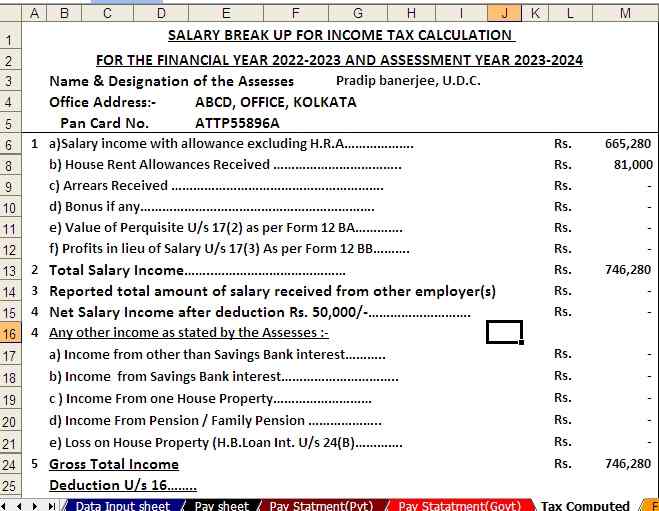
Download All in One Automated Income Tax Calculator for Government and Non-Government Employees (Individual) for Financial Year 2022-23 under New and Old Tax Regime U/s 115BAC

 Download All in One Automated Income Tax Calculator for Government and Non-Government

 Employees | Include a new section 115 BAC in the 2020 budget for the fiscal year 2022-23. This

 section 115BAC contains an option that allows you to continue the old tax regime with any income tax

 exemption as of the financial year 2021-22 and opt for the new tax regime apart from any income tax

 exemption as of the last fiscal year. Current. 2019-20 as clearly indicated in Budget 2020 U/s 115BAC.

According to the budget, a new U/s tax label has been specified under 115BAC which was introduced in the 2020 Budget.

Download All in One Automated Income Tax Calculator

 At the same time, it is also clear that according to Article 115BAC (New Tax Regime) there is no exemption for the elderly in the new tax plan.

Download Automated IncomeTax Preparation Excel-Based Software All in One for the Government andNon-Government (Private) Employees for the Financial Year 2021-22 and Assessment Year 2022-23 U/s 115BAC


Download All in One Automated Income Tax Calculator

Download All in One Automated Income Tax Calculator

Download All in One Automated Income Tax Calculator
Download All in one Income tax calculator

Feature of this Excel Utility:-


1) This Excel Utility Prepare Your Income Tax as per your option U/s 115BAC perfectly.


2) This Excel Utility has the all amended Income Tax Section as per Budget 2021


3) Automated Income Tax Arrears Relief Calculator U/s 89(1) with Form 10E from the F.Y.2000-01 to F.Y.2021-22 (Updated Version)


4) Automated Calculation Income Tax House Rent Exemption U/s 10(13A)


5) Individual Salary Structure as per the Govt and Private Concern’s Salary Pattern


6) Individual Salary Sheet


7) Individual Tax Computed Sheet


8) Automated Income Tax Revised Form 16 Part A&B for the F.Y.2021-22


9) Automated Income Tax Revised Form 16 Part B for the F.Y.2021-22


10) Automatic Convert the amount into the in-words without any Excel Formula


Saturday, 10 December 2022

Section 80DDB | With Auto fill Income Tax Preparation Software All in One in Excel for the Government and Non-Government Employees for the F.Y.2022-23

 Section 80DDB | Who can claim deductions under Section 80DDB?


Section 80DDB is Income Tax Rules 11DD. Under the Income Tax Act, of 1961, taxpayers can claim deductions for certain specified benefits for themselves or their dependents. This type of exemption is covered under Chapter VIA of the Income Tax Act, 1961. Individuals and HUFs who are residents of India can claim an exemption under this section. In other words, this means that a tax deduction can be claimed, if the relevant entity resided in the country during that tax year and the medical-related expenses are incurred for themselves or a family member, such as a spouse, parent, or dependent brother or sister.


How many deductions can be claimed under section80DDB?


Deductions corresponding to the following amounts can be claimed under section 80DDB:

For the financial year 2021-22 (the review year 2022-23)

• A person is eligible for a tax of Rupees 40,000/-(Forty Thousand) or the amount actually paid, whichever is less.

• Senior citizens, above 60 years of age, are eligible for a tax deduction of Rupees 60,000/-(Sixty Thousand) or the amount actually paid, whichever is less.

From the fiscal year 2022-23 (the tax year 2023-24)


• A Person is eligible for a tax of Rupees 40,000/-(Forty Thousand) or the actual medical expenses, whichever is less.

• Senior citizens between 60 and 80 years of age can claim tax exemption of Rupees 60,000/-(Sixty Thousand) or the actual amount spent on health care, whichever is less.


• Super seniors, above 80 years of age, are eligible for tax exemption of Rupees 80,000/-(Eighty Thousand) or the actual medical expenses, whichever is less.

From the financial year 2018-19 (The assessment year 2019-20)


• A Person is eligible for a tax of Rupees 40,000/-(Forty Thousand) or the amount actually paid, whichever is less.

• Senior citizens, above 60 years of age, are eligible for a tax deduction of Rupees 100,000/-(One Lakh) or the amount actually paid, whichever is less.


Diseases or medical conditions specified in section 80DDB


According to the Income Tax Department, the following diseases or circumstances may require tax exemption under Section 80DDB:


(1) Neurological disease, whose disability level is 40% and greater -.

• Dementia

• Dystonia Musculorum Deforms

• Aphasia

• Motor neuron diseases

• Ataxia

• chorée

• Hemiballism

• Parkinson’s disease

(2) Malignant cancers

(3) Entirely acquired immunodeficiency syndrome (AIDS).

(4) Chronic renal failure

(5) Hematologic disorders

Haemophilia

Thalassemia of the body


Papers are required for claiming deductions under Section 80DDB


To claim deductions under section 80DDB of the Income Tax Act, 1961, the assessee has to furnish evidence that medical treatment has actually been provided. It is mandatory to obtain a certificate from the prescribed authority, who has benefited from the medical treatment if a person wants to claim a deduction under this section.

Download Automated Income Tax Preparation Excel-Based Software All in One for the Government & Non-Government (Private) Employees for the F.Y.2022-23 and A.Y.2023-24


Section 80DDB

Section 80DDB

Section 80DDB

Annexure-I

Feature of this Excel Utility:-


1) This Excel utility prepares and calculates your income tax as per the New Section 115 BAC (New and Old Tax Regime)


2) This Excel Utility has an option where you can choose your option as a New or Old Tax Regime


3) This Excel Utility has a unique Salary Structure for Government and Non-Government Employees Salary Structure.


4) Automated Income Tax Arrears Relief Calculator U/s 89(1) with Form 10E from the F.Y.2000-01 to F.Y.2022-23 (Update Version)


5) Automated Income Tax Revised Form 16 Part A&B for the F.Y.2022-23


6) Automated Income Tax Revised Form 16 Part B for the F.Y.2022-23

Tuesday, 20 September 2022

Income Tax Preparation Software in Excel All in One for the Non-Govt Employees for the F.Y.2022-23

 Income Tax Preparation Software in Excel All in One for the Non-Govt Employees for the F.Y.2022-23


Income tax tables and rates remain unchanged in the fiscal year 2022-2023. No changes to the Budget for Individual Taxpayers for 2022 have been announced. Taxpayers will be able to pay taxes under the old or new tax regime. Under the new Tax Regime, tax is levied on taxpayers at preferential rates, but significant tax deductions and exemptions are not allowed. However, income tax deductions and exemptions are available under the old tax system, but the tax rate is high. Individuals need to evaluate their tax liability under both tax systems in order to determine the ideal tax system for them. The old tax system can be beneficial for those interested in using most of the deductions and exemptions. Whereas, the new tax system could be ideal for middle-income groups with small, non-tax-oriented investments.


Budget 2022: key takeaways

The tax credit of up to Rs 12,500 under Section 87A is still available for individuals with taxable income up to Rs 5 lakh per annum. This means that individuals with an income of up to Rs 5 lacs will not incur any tax liability in the 2022-23 fiscal year and 2023-2024 valuation. A standard deduction of Rs 50,000 is also available under the old tax regime. Income tax deductions under sections 80C-80U are available under the old system for employees.


Employees can significantly reduce their tax liability by taking advantage of tax deductions under the old tax system for the fiscal year 2022-23. In fact, individuals with an income of up to Rs 13 lakh can qualify for full tax exemption by taking advantage of all eligible deductions for the 2022-23 financial year.


Income tax deduction and exemption up to Rs 1,50,000 is available for individuals under Section 80C. Section 80CCC and 80CCD (1) are included in Section 80C with an aggregate deductible ceiling of INR 1,50,000/-. Investments that qualify for deduction and exemption under Section 80C include investments in the Public Reserve Fund (PPF), the National Savings Certificate (NSC), the Equity Savings Scheme (mutual funds), Life Insurance and etc.


State Reserve Fund: One of the most popular small savings schemes among individuals. PPF offers guaranteed returns along with tax incentives. Interest is reported quarterly and interest accrues annually. Investments are provided with a fixed period of 15 years.

ELSS Funds: The equity savings scheme has the shortest lock-up period of 3 years. The investment is deductible under section 80C. Investments in mutual funds can bring higher returns than debt instruments. However, investments in the capital market are subject to volatility. Therefore, investors need to make an informed decision.


Best Equity Savings Scheme for Investment: EF 2022-23

National Savings Certificate (NSC): NSC has a 5-year blocking period. Investments are eligible for tax deductions. However, interest earned is taxable. Investment interest is announced quarterly.


Life insurance plans. Premiums paid on life insurance policies are also deductible under section 80C. The premium paid by self, spouse, dependent children and any member of an undivided Hindu family is eligible for a deduction. The post-maturity benefit is tax-free in most cases.


Senior Savings Scheme (SCSS): This scheme is designed specifically for seniors and offers the highest returns among small savings schemes. The duration of the program is 5 years with the possibility of extension up to 8 years. Under this scheme, persons over 60 years of age can make deposits.


Sukanya Samriddhi Yojana (SSY): The scheme aims at the welfare of the girl. A parent or guardian of a girl under the age of 10 is eligible to join the program. The regime applies to a maximum of 2 girls (3 in the case of twins). The maximum deduction under this scheme is Rs 1,50,000.


Income Tax Tariffs and Rates for Fiscal Year 2022-23

The mortgage principal repayment is also deductible along with the registration fee and stamp duty paid on the property. However, the allowance is capped at a maximum deduction limit of INR 150,000/-. Provided that the Individual does not transfer the property before the expiration of 5 years from the Fiscal year in which it was acquired. A registration fee and stamp duty deduction are also available for individuals who have not applied for a mortgage.


Income tax deductions U/S 80 CCD (1b)

Deposit up to Rs 50,000 - eligible for deduction under section. The deduction is greater than the available U.S. Section 80C deduction for deposits made in the National Pension Scheme (NPS) and Atal Pension Yojana (APY).

Individuals can invest in these pension schemes to qualify for tax deductions up to a maximum of Rs 50,000/-.

Download Automated Income Tax Preparation Excel-Based Software All in One for the Non-Government (Private) Employees for the Financial Year 2021-22 and Assessment Year 2022-23 U/s 115BAC


Income Tax Preparation Software in Excel

Income Tax Preparation Software in Excel

Feature of this Excel Utility:-

1) This Excel Utility Prepare Your Income Tax as per your option U/s 115BAC perfectly.


2) This Excel Utility has the all amended Income Tax Section as per Budget 2021


3) Automated Income Tax Form 12 BA


4) Automated Calculation Income Tax House Rent Exemption U/s 10(13A)


5) Individual Salary Structure as per the Non-Govt(Private) Concern’s Salary Pattern


6) Individual Salary Sheet


7) Individual Tax Computed Sheet


8) Automated Income Tax Revised Form 16 Part A&B for the F.Y.2021-22


9) Automated Income Tax Revised Form 16 Part B for the F.Y.2021-22


10) Automatic Convert the amount in to the in-words without any Excel Formula

Thursday, 15 September 2022

Exemption from House for Rent U/s 10(13A)| With All in One Income Tax Preparation Software in Excel for Government and Non Government Employees for F.Y.2022-23

 Exemption from House for Rent U/s10(13A)| Often, people have to move to another city to work. In

 such cases, they may pay rent for their stay. Organizations often compensate employees for this cost by

 paying them rent instead of their basic salary. This is usually part of the salary structure. However,

 an HRA qualifies for income tax exemption and can be a great way to reduce your taxable income.


1. What is HRA or Housing Rent Allowance?


House Rent Allowances is the amount paid by an employer to an employee in compensation for the rent paid to occupy the workplace. Although a deduction is allowed for house rent allowance under Section 10(13A) of the Income Tax Act, CRT may be taxed in whole or in part. The calculation of HRA deduction depends on your salary, the HRA you have earned, the actual rent you pay, and where you work and live. Self-employed individuals can even claim HRA tax benefits.


2. HRA calculation method


The HRA calculation is based on several factors, including your salary, the HRA you get from your employer, the actual rent you pay, and whether you live in a metro or non-metro city. However, when calculating the CRT tax, the exemption rate will be the lower of the following:


HRA paid by your employer


Actual rent paid for accommodation less 10% of basic salary


50% of basic pay plus D.A. if you live in a metro city (Mumbai, Delhi, Kolkata, or Chennai) or 40% of basic salary plus dearness allowance if you live in a non-metro city.


To calculate house rent allowance or HRA policy is to calculate the above three factors and claim the lowest one as HRA deduction under Section 10(13A) of the ITA.


3. Tax Benefits of HRA


The HRA exclusion under Section 10(13A) of the ITA has the following benefits:


The main advantage of an HRA refund is that it reduces your taxable income.


You can claim an HRA deduction in your income tax file even if you live with your parents, as long as you show proof of rent payment.

Download Automated Income Tax House Rent Exemption Calculator U/s 10(13A)in Excel


Exemption from House for Rent U/s 10(13A)

4. Important Points to Remember While Applying for HRA Deduction


Any HRA paid to you cannot be claimed as an exemption. Only the lesser of the annual rent actually payable less 10% of basic salary, HRA paid by the employer and 40%/50% of salary depending on where you live can be claimed.


You can claim HRA deduction even if you live with your parents, as long as you show proof of rent payment, such as rent receipts or bank transfers. However, your parents will need to show this as income when filing their returns.


Rent paid by a spouse does not qualify for HRA deduction.


If the annual rent paid exceeds Rs 1,00,000, the PAN of the landlord will have to apply for an HRA exemption. If they do not have PAN, a signed document is required.


5. How to claim a deduction if you don't get HRA


Self-employed and salaried individuals who are not eligible for the HRA cannot claim a house rent allowance deduction under Section 10(13A) of the ITA. However, they can avail of rent exemption under Section 80GG of the Income Tax Act.


Under section 80GG, an individual can claim a minimum of the following in lieu of the house rent he or she pays:

5,000 per month ie. 60,000 per annum


25% of gross turnover


Actual rent paid minus 10% of gross income 


In understanding the difference between what is HRA and the deduction claimed under section 80GG, here are some points to keep in mind:


The deduction under section 80GG is available only to those who do not receive HRA.


This includes members of Hindu Undivided Families, self-employed persons, and salaried individuals who do not receive HRA from their employer.


The maximum deduction allowed under section 80GG is Rs 60,000.


You cannot claim a deduction under both Section 10(13A) and Section 80GG


According to section 10(13A), an individual, spouse or minor child cannot own property in the city of residence to claim the benefit.


Individuals wishing to apply for this exclusion will need to submit a Form 10-BA showing that they meet all of the conditions listed above.


6. Documents Required to Apply for HRA Tax Exemption


To claim an HRA tax exemption, an individual will have to submit certain documentary proofs.


This includes rent receipts showing the rental income used to calculate the HRA deduction or a rental agreement with a specified equivalent rental rate.


Additionally, if the rent exceeds Rs 1,00,000/- per annum, then a copy of the landlord's PAN card or a declaration form signed by them is required. For rent paid to family members or parents, the same proof will be required to calculate HRA tax.

Download Automated Income Tax Preparation Excel-Based Software All in One for the Government & Non-Government (Private) Employees for the F.Y.2022-23 and A.Y.2023-24

Exemption from House for Rent U/s 10(13A)
 
Exemption from House for Rent U/s 10(13A)

Exemption from House for Rent U/s 10(13A)

Feature of this Excel Utility:-


1) This Excel utility prepares and calculates your income tax as per the New Section 115 BAC (New and Old Tax Regime)


2) This Excel Utility has an option where you can choose your option as New or Old Tax Regime


3) This Excel Utility has a unique Salary Structure for Government and Non-Government employees Salary Structure.


4) Automated Income Tax Arrears Relief Calculator U/s 89(1) with Form 10E from the F.Y.2000-01 to F.Y.2022-23 (Update Version)


5) Automated Income Tax Revised Form 16 Part A&B for the F.Y.2022-23


6) Automated Income Tax Revised Form 16 Part B for the F.Y.2022-23

Monday, 12 September 2022

Income Preparation Software in Excel for the Gov and Non-Govt employees for the F.Y.2022-23 with Exemption Chapter VI A as per the Income Tax Act

 Chapter VI A of the Income Tax Act contains several subsections of Section 80 that allow a valuer to

 claim deductions from total gross income due to various tax savings investments, allowable expenses,

 donations, etc. Such deductions enable a valuer to recover the amount due to reducing tax.


Chapter VI A of the Income Tax Act contains the following articles:

80C: Deduction related to the life insurance premium, deferred annuity, contributions to the pension fund (PF), subscription of certain stocks or bonds, etc. The deduction limit is Rs 1.5 lakh along with section 80CCC and section 80CCD (1).

80CCC: Deduction for a premium from some pension funds. The exemption limit is Rs 1.5 lakh including section 80C and section 80CCD (1).


80CCD (1): Withholding as Contribution to Central Administrations Pension Plan - in the case of an employee, 10 % of salary (Base + DA) and in any other case 20 % of his total gross income in an exercise will be tax-free to be. The Maximum limit is Rs 1.5 lakh Including 80C and 80CCC.


80CCD (1B): Deduction of up to Rs 50,000 related to the contribution to the Central Government Pension Scheme (NPS).


80CCD (2): Deduction in connection with the employer's contribution to the pension scheme of the Central Government. The tax benefit is granted on the employer's contribution of 14 %, where that premium is paid by the central government and where the premium is paid by another employer, the tax benefit of 10 % is granted.


80D: Deduction from the health insurance premium. The premium paid up to Rs 25,000 is eligible for deduction for persons other than the elderly. For seniors, the limit is Rs 50,000 and the general u/s 80D limit is Rs 1 lakh.


80DD: Deduction for alimony, including medical care of a dependent who is a person with a disability. The maximum exemption limit is Rs 75,000.


80DDB: Deduction related to the cost of up to Rs 40,000 for the medical treatment of a specific disease by a neurologist, oncologist, urologist, haematologist, immunologist or another specialist, as prescribed.


80E: Deduction for interest on the loan granted for higher education with no upper limit.


80EE: Interest deduction up to Rs 50,000 on the loan taken out for owning a residential house.


80EEA: Interest deduction of up to Rs 1.5 lakh on the loan taken out for a particular home property (on affordable housing).


80EEB: Deduction for interest up to Rs 1.5 lakh on the loan taken out for the purchase of an electric vehicle.


80G: Donations to certain funds, charities, etc. Depending on the nature of the donee, the limit varies from 100 % of the total donation to 50 %of the total donation or 50 % of the donation with a ceiling of 10 % of the total donation. Gross Income.


80GG: Deductions from rent paid by non-salaried subjects who are not receiving HRA benefits. The deduction limit is Rs 5,000 per month or 25 % of total income in a year, whichever is lower.


80TTA: Deductions for interest on savings accounts up to Rs 10,000 in the case of experts other than senior residents.


80TTB: Deduction of interest on deposits up to Rs 50,000 in case of older residents.


80U: Deduction for a person with a disability. Depending on the type and size of the maximum disability allowance allowed in this section is Rs 1.25 lakh.

Download Automated Income Tax Preparation Excel-Based Software All in One for the Government & Non-Government (Private) Employees for the F.Y.2022-23 and A.Y.2023-24

Income Preparation Software in Excel
 
Income Preparation Software in Excel

Income Preparation Software in Excel

Feature of this Excel Utility:-


1) This Excel utility prepares and calculates your income tax as per the New Section 115 BAC (New and Old Tax Regime)


2) This Excel Utility has an option where you can choose your option as New or Old Tax Regime


3) This Excel Utility has a unique Salary Structure for Government and Non-Government employees Salary Structure.


4) Automated Income Tax Arrears Relief Calculator U/s 89(1) with Form 10E from the F.Y.2000-01 to F.Y.2022-23 (Update Version)


5) Automated Income Tax Revised Form 16 Part A&B for the F.Y.2022-23


6) Automated Income Tax Revised Form 16 Part B for the F.Y.2022-23

Tuesday, 6 September 2022

Section 80U - Tax Exemption for Persons with Disabilities| With Automated Income Tax Arrears Relief Calculator U/s 89(1) with Form 10 E for the F.Y.2022-23

Section 80U - Check Eligibility, Amount of Deduction, How to Claim, Documents, Definitions, For

 F.Y 2022-23 (AY 2023-24), Diagnosed Disease


Section 80U Exclusion of Disability

Section 80U of income tax is deductible for those who are unable to work. This section provides a lump sum exemption for a person with a disability based on the severity of the disability, regardless of the amount of the income.

The criteria for entitled this deduction are -.

Taxpayers must be residents.

Must be at least 40% disabled for work.

The disability must also be verified by recognized medical authorities.


Exemption of tax under section 80U?


This category is allowed to be deleted

Severely handicapped person* one hundred and twenty-five thousand rupees ie. Rs. 1,25,000/-

Disabled person** seventy-five thousand rupees ie. Rs. 75,000/-


*"severely disabled person" means—

(i) a person with eighty per cent or more of one or more disabilities, as defined in clause (4) of section 56 of the Persons with Disabilities (Equal Opportunities, Protection of Rights and Full Participation) Act; 1995 (1 of 1996); either


(ii) a person with a severe disability referred to in clause (o) of section 2 of the National Autism, Cerebral Palsy, Mental Retardation and Multiple Disabilities Welfare Trust Act, 1999 (44 of 1999).


You May Also Like: Automated Income Tax Preparation Excel-Based Software for the Non-Govt Employees for the F.Y.2022-23


Section 80U

Section 80U

80U Eligible - Who can claim this deduction?

Residents who have been certified as a Disabled/Scanned Person by the Medical Authority at any time during the fiscal year will only claim this exemption for themselves. Your living situation determines whether you can qualify for this deduction. NRAs are not eligible for this deduction.


The available amount of exemption available u/s 80U?

As mentioned earlier, the amount of the deductible depends on the severity of the condition. So taxpayers with less than 80% handicap get a deduction of Rs.75,000 and highly handicapped taxpayers who are 80% or more get a deduction of Rs. 1, 25,000 in cash. A deduction is a set amount that can be deducted from taxable income. 

What disabilities are covered under Section 80U?

Section 80U has the following disabilities:

Locomotor disability: - This refers to a disability in the muscles or bones of the joints leading to severe restriction of limb movement.


Visual Impairment: - Persons with visual impairment that cannot be fully corrected by surgery or standard refractive correction. People with this disability are still able to use their eyes using other devices.


Blindness: - Blindness means complete loss of vision or where the field of view is limited to an angle of 20 degrees or worse, or vision of less than 6160 accelerates after corrective lenses.


Curing leprosy: - Persons cured of leprosy but still suffering from disability in which they have lost feeling in their legs or arms and paresis in the eyelids and eyes. It also includes the elderly or those with severe disabilities that prevent them from doing vital work.


Mental Retardation: Individuals with incomplete or stunted development of mental abilities, resulting in subnormal levels of intelligence.


Hearing loss:- Hearing loss of at least 60 decibels


Autism:- Autism spectrum disorder is associated with brain development that affects how a person perceives and interacts with others causing difficulties in social interaction and communication.


Cerebral Palsy: - CP is a group of movement disorders that occur in early childhood. Signs and symptoms vary between individuals and over time but include poor alignment, tight muscles, weak muscles, and tremors. Problems can include emotions, vision, hearing and speech.


Mental Illness: - This applies to other mental disorders

A taxpayer is considered to be not severely disabled if he or she has a disability of 40% or more but less than 80%. However, if the taxpayer has a disability of 80% or more, it is called a severe disability. The limit of the deduction varies depending on the severity of the disability suffered.


How do you claim deduction under section 80U?

The person claiming the deduction is liable to submit along with the ITR a copy of the certificate issued by the medical authority in the prescribed form. Practically no document needs to be attached to the ITR, it is advisable to keep the document handy.

Please note that a medical certificate stating the diagnosed disability must be submitted. A certificate with recognized medical authority should be prepared in the prescribed format contained in Form 10 -IA Form can be downloaded from the Income India website -.

Download Automated Income Tax Arrears Relief Calculator U/s 89(1) along with Form 10E from the Financial the Year 2000-01 to Financial Year 2022-23 (Up-to-date version)

Section 80U

form 10 E


Monday, 22 August 2022

Download Automated Income Tax Preparation Software in Excel. for the Non-Government (Private) Employees for the F.Y.2022-23

 Download Automated Income Tax Preparation Software in Excel | Calculation of income tax for

 employees of a private company in 2022: The annual CTC of a person working in a private company

 consists of several components. These include LTA, HRA, pension fund contributions and tips,

 entertainment reimbursements, phone bills, transportation, books and periodicals, and more. While the

 names of CTC components may vary from company to company, the applicable tax rules remain the

 same. For proper tax planning, it is important to understand the tax implications of the various

 components of the CTC.

Here we look at how Tips, Reserve Fund, Rental Housing Allowance (HRA), LTA and Refunds are taxed.


Some components of wages are fully taxable and some are completely exempt. Some components are partially exempt from income tax.


Income Tax at HRA

HRA is an important part of the CTC, providing tax credits to workers who live in rented housing. The HRA is taxable if the employee does not live off the rent.

Subject to Section 10(13A), a minimum of the following may be exempt from tax:


(i) Actual amount received


(ii) 50% of salary if you reside in metropolitan areas (ie Mumbai, Delhi, Chennai and Kolkata) and 40% of salary otherwise.


(iii) Rent above 10% of wages


Income tax refund

Companies provide various subsidies for transportation, books and periodicals, entertainment, telephone and internet, etc.

Under section 10(14) of the Income Tax Law, subsidies given to employees are tax-deductible if such expenses are actually incurred.

The transport discount is released in the amount of the costs incurred.

Telephone/mobile and internet reimbursements are also exempt from regulation 3(7)(ix) of the Income Tax Law.

Reimbursement for books and periodicals may be claimed as an exemption under Section 10(14).

The entertainment allowance is fully taxable in the case of private employees. However, this may be claimed as an exemption if hospitality expenses are incurred for the company's business purposes.

To receive tax credits for reimbursement, employees must pay initial expense invoices.

Pension fund income tax

Contributions to the Reserve Fund are deductible under section 80C of the Income Tax Act.

Income tax on tips

Bonus earned while working is fully taxable. You can take advantage of the tip tax credit when you retire if your employer is covered by the Tips Act. Under section 10(10) of the Income Tax Law, at least the following persons are exempt:

one. Actual amount received

B. 20 thousand reais

h. 15 days' salary based on the last salary withheld for each full year of service or part of it exceeding 6 months

For the calculation of remuneration, salary means base salary + charity allowance.

If the employer is not subject to the Free Payments Act, at least one of the following exceptions:

one. Actual amount received

B. RJU CAN'T. 20 00 000

h. Half of the monthly salary for each full year of service. (i.e. ½ * average wage in the afternoon.

Income tax under LTA

The following conditions must be met in order to apply for a travel allowance tax exemption:

One. The actual trip is carried out by the taxpayer

B. Only domestic trips are counted

h. The exemption is granted to the employee alone or together with the family, including the employee's spouse, children, dependent parents, and siblings. However, the exemption does not apply to more than 2 children born after October 1, 1998.

Download Automated IncomeTax Preparation Excel-Based Software All in One for the Government andNon-Government (Private) Employees for the Financial Year 2022-23 and Assessment Year 2023-24 U/s 115BAC


Download Automated Income Tax Preparation Software in Excel

Download Automated Income Tax Preparation Software in Excel

form 12 BA

Feature of this Excel Utility:-


1) This Excel Utility Prepare Your Income Tax as per your option U/s 115BAC perfectly.


2) This Excel Utility has the all amended Income Tax Section as per Budget 2022


3) Automated Calculation Income Tax House Rent Exemption U/s 10(13A)


4) Individual Salary Structure as per the Private Concern’s Salary Pattern


5) Individual Salary Sheet


6) Individual Tax Computed Sheet


6) Automated Income Tax Revised Form 16 Part A&B for the F.Y.2022-23


7) Automated Income Tax Revised Form 16 Part B for the F.Y.2022-23

Tuesday, 9 August 2022

Download Automated All in One Salary TDS for Government and Non-Government Employees for F.Y. 2022-23 and A.Y.2023-24 with income tax benefits on joint home loan

 What is a joint home loan?

A home loan where there is more than one borrower is called a joint home loan. Two friends cannot be co-borrowers. In fact, banks sometimes refrain from lending to siblings unless they co-own the property. This also happens in the case where the loan is made with the parents as co-borrowers. It is only in the case of spouses that banks do not require co-ownership of the said property from the co-borrowers.


Having a joint home loan is advantageous when both co-borrowers are taxpayers. But keep in mind that to claim income tax benefits on joint home loans, all co-borrowers must be the co-owners. Tax benefits can be claimed in the same proportion as the loan taken by the co-owners.


A co-owner who is not a co-borrower is not entitled to income tax benefits. Likewise, a co-borrower who is not a co-owner cannot claim tax benefits. Below are some examples that will make this concept clear.

Fixed amount - Rs 75 lakhs

Loan amount - Rs 60 lakh

EMI for 20 years @ 10% p.a. (reducing) – Rs 57,901/- p.m


Case 1 – Husband (H) and Wife (W), both workers and taxpayers. H buys an apartment in his own name and to manage the EMI burden takes out a home loan with W as co-borrower. In this case, even though W is the co-borrower and contributes to the EMI, she would still not be eligible to claim any u/s 80C or section 24 tax benefit. i.e. in all years, only H can claim up to Rs 1 .50 lakh interest and 100% principal or Rs 1 lakh, whichever is less.


Case 2 – H and W both purchased a house with 50:50 co-ownership and also jointly took out home loans in the same proportion. In that case, H and W can claim Section 80C and Section 24 income tax benefits in equal proportion. i.e. the full payment of interest and principal will be split evenly on H&W and both can separately claim Rs 1.50 lakh u/s 24 and Rs 1 lakh or 50% of principal, whichever is less

Case 3 – H and W acquire a house with a co-ownership of 75:25 and also take out a joint home loan at the ratio of 50:50. In that case, both H and W can claim Section 80C and Section 24 income tax benefits in proportion to loans. that is, the interest and principal payment will be split 50:50 and both H&W can claim income tax benefit only in that proportion, up to the maximum allowable limit.


Please note that in all of the above cases the tax benefits that have been discussed are for the self-occupied house. In the case of a lease or lease on the house, no principal payment, but 100% of interest payment, may be claimed under section 24 by both co-owners in proportion to their loans.


Advantages of having a common home loan

1. A big advantage is the income tax benefit that is shared between the co-owners.


2. The second advantage is the increased chances of getting the loan and also the increased eligibility of the loan.


Disadvantages of having a regular home loan

1. The autonomous property is one that is occupied by the owner for his own housing, and if there is any other property acquired, it will be treated as “Considered leased” and taxed accordingly. Thus, in the case of a condominium, if any of the condominium owners acquire some other property in the same city, they will be treated as “considered to leave”.


2. If any of the co-borrowers has bad credit behaviour due to which the home loan repayment is erratic, this will affect the other co-borrower's credit score as well.


3. If, due to any dispute, any of the co-borrowers refuses to repay the loan, please be advised that, in accordance with the loan schedule, the liability to repay the loan rests with each co-borrower. borrower. This means that all co-borrowers are required to pay as much as all repayments. A creditor can also sue both co-applicants to recover the debts.


4. We are all emotional beings. Under the lure of gaining access to high credit eligibility that can help with the purchase of a large home, we tend to forget how the EMI load will affect other goals.


Although banks grant loans to spouses without the obligation of co-ownership, it is advisable for both spouses to have some property. Before becoming a co-applicant, make sure you own some percentage of ownership of the property. Also, if you are a co-borrower, you may be able to draw up and sign an agreement with your spouse about the division of responsibility. This is to avoid any dispute in the future.

Download Automated Income Tax Preparation Excel-Based Software All in One for the Government & Non-Government (Private) Employees for the F.Y.2022-23 and A.Y.2023-24


Download Automated All in One Salary TDS

Download Automated All in One Salary TDS

Download Automated All in One Salary TDS

Feature of this Excel Utility:-


1) This Excel utility prepares and calculates your income tax as per the New Section 115 BAC (New and Old Tax Regime)


2) This Excel Utility has an option where you can choose your option as New or Old Tax Regime


3) This Excel Utility has a unique Salary Structure for Government and Non-Government employees Salary Structure.


4) Automated Income Tax Arrears Relief Calculator U/s 89(1) with Form 10E from the F.Y.2000-01 to F.Y.2022-23 (Update Version)


5) Automated Income Tax Revised Form 16 Part A&B for the F.Y.2022-23


6) Automated Income Tax Revised Form 16 Part B for the F.Y.2022-23

Monday, 8 August 2022

Know you’re Tax Burden for the F.Y.2022-23 and A.Y.2023-24 by the Excel Based Automated Tax Calculator All in One for the Govt and Non-Govt Employees for the F.Y.2022-23


Know you’re Tax Burden for the F.Y.2022-23 and A.Y.2023-24 | As the Financial Year 2021-22 has already gone and the New Financial Year 2022-23 has started from the 1st April 2022 which will end on the month of 31st March 2023. So we called the Financial Year 2022-23 and Assessment Year 2023-24.


Now it is indispensable as well as necessary to calculate your Income Tax liability for the Financial Year 2022-23 as per the Finance Budget 2022. The New and Old Tax Regime U/s 115 has continued for this present financial year. You can change your opinion from Old to New or New to Old Tax Regime this year. Hope all of the Tax Payers are well known about this New and Old Tax Regime U/s 115 BAC.


Know you’re Tax Burden for the F.Y.2022-23

However, we prepare an Excel Based Software for calculating your Income Tax liability for the Financial Year 2022-23 and Assessment Year 2023-24 as per the Finance Budget 2022. This Excel Based software can use by both Government and Private Employees or Concerned also. This Excel Utility is easy to generate just like an Excel File. No need for any calculation of tax which will calculate automatically as per the Income Tax Law. No need to calculate for House Rent Exemption U/s 10(13A as the software can calculate it automatically.


Most of the advantage of this Excel Software All in One is that the Salary Arrears Received from the previous years, you can calculate the Arrears Relief by this software as the Automated Income Tax Arrears Relief Calculator has built in this software U/s 89(1) along with Form 10 E.


Download Automated Income Tax Preparation Excel-Based Software All in One for the Government & Non-Government (Private) Employees for the F.Y.2022-23 and A.Y.2023-24

Know you’re Tax Burden for the F.Y.2022-23 and A.Y.2023-24
 
Know you’re Tax Burden for the F.Y.2022-23 and A.Y.2023-24

Income Tax Form 10 E

Feature of this Excel Utility:-


1) This Excel utility prepares and calculates your income tax as per the New Section 115 BAC (New and Old Tax Regime)


2) This Excel Utility has an option where you can choose your option as New or Old Tax Regime


3) This Excel Utility has a unique Salary Structure for Government and Non-Government employees Salary Structure.


4) Automated Income Tax Arrears Relief Calculator U/s 89(1) with Form 10E from the F.Y.2000-01 to F.Y.2022-23 (Update Version)


5) Automated Income Tax Revised Form 16 Part A&B for the F.Y.2022-23


6) Automated Income Tax Revised Form 16 Part B for the F.Y.2022-23