Showing posts with label Income Tax Section 80CCD(1B). Show all posts

Wednesday, 27 July 2022

Section 80 CCD(IB) Deductions| With Automated Income Tax Preparation Software All in One for the Government and Non-Government Employees for the F.Y.2022-23

 Section 80CCD(1B) Deduction: National Pension Scheme (NPS) tax credits

The income tax law prescribes various forms of deductions that help reduce your tax liability. There are a number of prescribed investments and expenses that you pay from your income that are allowed as investments or deductible expenses. Since these investments and expenses are deducted from your income, your taxable income is reduced. As your taxable income decreases, you pay less taxes.


What is Section 80 CCD(1B)?

In terms of deductions, some of the most popular deductions are found in Chapter VIA of the Income Tax Act. This chapter contains Section 80 deductions. Section 80C is a very popular section that allows you to deduct up to INR 1.5 Lakh for various types of investments and expenses. There is another section, Section 80 CCD (1B), which allows an additional deduction of INR 50,000 in addition to the deduction available in Section 80C for INR 1.5 lakh. A deduction under Section 80 CCD (1B) is allowed if you invest in the National Pension Scheme (NPS) offered by the Government of India.

Do you know what NPS investing is? Let's figure it out soon

Download and Prepare at a time 50 Employees Form 16 Part B for the Financial Year 2021-22

What is an NPS scheme?

The National Pension Scheme is a public investment scheme that helps plan for retirement. You can invest in the scheme while you are working, and then the scheme will create housing for your pension. The corpus can then be used to provide a regular income in the form of annuities.


Eligibility to invest in the NPS scheme

The investor must be between 18 and 60 years of age. However, in the case of an NRI, if the NRI's nationality changes after the NRI invests in the scheme, the scheme will be terminated.


Invest in NPS

Investments in NPS can be made through a financial institution acting as a Point of Presence (POP). Almost all banks and non-bank financial companies are authorized to act as POPs. POP has specialized agencies that collect NPS deposits from investors. These agencies are called Point of Presence Service Providers or POP-SPs. The POP-SP list can be found online at the scheme's official website https://www.npscra.nsdl.co.in/pop-sp.php - no application form, ID, or proof of age. and proof of residence.


Section 80 CCD(IB) Deductions


Section 80CCD(1B) Deduction: National Pension Scheme (NPS) tax credits

The income tax law prescribes various forms of deductions that help reduce your tax liability. There are a number of prescribed investments and expenses that you pay from your income that are allowed as investments or deductible expenses. Since these investments and expenses are deducted from your income, your taxable income is reduced. As your taxable income decreases, you pay less taxes.

Download and Prepare at a time 50 Employees Form 16 Part A&B for the Financial Year 2021-22


What is Section 80 CCD(1B)?

In terms of deductions, some of the most popular deductions are found in Chapter VIA of the Income Tax Act. This chapter contains Section 80 deductions. Section 80C is a very popular section that allows you to deduct up to INR 1.5 million for various types of investments and expenses. There is another section, Section 80 CCD (1B), which allows an additional deduction of INR 50,000 in addition to the deduction available in Section 80C for INR 1.5 lakh. A deduction under Section 80 CCD (1B) is allowed if you invest in the National Pension Scheme (NPS) offered by the Government of India.

Do you know what NPS investing is? Let's figure it out soon


What is an NPS scheme?

The National Pension Scheme is a public investment scheme that helps plan for retirement. You can invest in the scheme while you are working, and then the scheme will create housing for your pension. The corpus can then be used to provide a regular income in the form of annuities.


Eligibility to invest in the NPS scheme

The investor must be between 18 and 60 years of age. However, in the case of an NRI, if the NRI's nationality changes after the NRI invests in the scheme, the scheme will be terminated.


Invest in NPS

Investments in NPS can be made through a financial institution acting as a Point of Presence (POP). Almost all banks and non-bank financial companies are authorized to act as POPs. POP has specialized agencies that collect NPS deposits from investors. These agencies are called Point of Presence Service Providers or POP-SPs. The POP-SP list can be found online at the scheme's official website https://www.npscra.nsdl.co.in/pop-sp.php - no application form, ID, or proof of age. and proof of residence.


Download and Prepare at a time 100 Employees Form 16 Part B for the Financial Year 2021-22


NPS account type

When you invest in the National Pension Scheme, you will have two accounts to choose from. These accounts are:

Level I account

A Tier I account is a mandatory account that you would have to invest in if you were to invest in the National Pension Scheme. The minimum investment required for this account is INR 500 at one time and INR 1000 for one year.

Tier II account

A Tier II Account is a voluntary account that you can invest in after you invest in a Tier I Account. The minimum investment amount for a Tier II Account is INR 250 at any given time. No minimum investment per year is required. A minimum deposit of INR 1,000 is required to open an account.

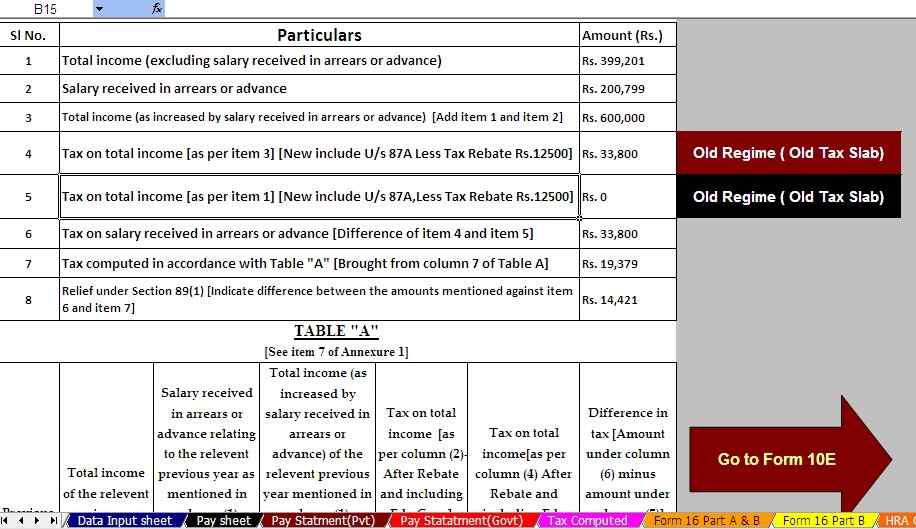
Download Automated Income Tax Preparation Excel-Based Software All in One for the Government & Non-Government (Private) Employees for the F.Y.2022-23 and A.Y.2023-24


Section 80 CCD(IB) Deductions

Section 80 CCD(IB) Deductions

Income Tax Form 10 E

Feature of this Excel Utility:-


1) This Excel utility prepares and calculates your income tax as per the New Section 115 BAC (New and Old Tax Regime)


2) This Excel Utility has an option where you can choose your option as New or Old Tax Regime


3) This Excel Utility has a unique Salary Structure for Government and Non-Government employees Salary Structure.


4) Automated Income Tax Arrears Relief Calculator U/s 89(1) with Form 10E from the F.Y.2000-01 to F.Y.2022-23 (Update Version)


5) Automated Income Tax Revised Form 16 Part A&B for the F.Y.2022-23


6) Automated Income Tax Revised Form 16 Part B for the F.Y.2022-23

Wednesday, 8 June 2022

Income tax deductions under section 80 CCD (1B)| With Automated Income tax Preparation Excel Based Software All in One for the Govt and Non-Govt Employees for the F.Y.2022-23

 Income tax deductions under section 80 CCD (1B)| Income tax is required for all citizens of India who

 are required to pay income tax in accordance with the rules and regulations of the Income Tax Act

 1961. But this does not mean that you have to pay tax on all income received by you in this financial

 area. year. There are several provisions in the Income Tax Act that allow you to claim deductions from

 certain investments and expenses.


Plan your taxes to save your income

You may carefully be planning your taxes, you can save a maximum amount on your tax liability and create an extra source of income for yourself. With the dual benefit of tax savings and income generation, these deductions provide significant benefits. From time to time, the government introduces new deductions or amendments, which you should keep a close eye on. One such deduction available to you is CCD Sec 80 (1B), which applies to contributions made to the NPS.

Download and Prepare at a time 100 Employees Form 16 Part B for the Financial Year 2021-22

Income Tax Form 16 Part B


About NPS

NPS or the National Pension System is a pension scheme available to both government employees and individuals. NPS is one of the most popular options available for people looking to set up a retirement fund along with a regular monthly income. Money deposited with NPS is invested in a variety of securities and investment opportunities, including the stock market. It is widely regarded as one of the cheapest equity investment options. Since returns are directly related to market performance, there is no guarantee of any particular value, but over time, NPS returns become one of the highest in the market.


Should you know that Two Types of NPS Accounts

Two types of NPS accounts: NPS Level 1 and NPS Level 2.

Level 1 account: has a fixed lockout period until the subscriber reaches the age of 60. Withdrawals are entitled to be subject to certain conditions. Contributions made in Tier 1 are tax-free and deductible in accordance with Section 80CCD(1) and Section 80CCD(1B). You can invest up to Rs. 2 lakh in NPS Level 1 account and claim a deduction from the total amount i.e. rupees. 1.50 lakh under section 80CCD(1) and Rs. 50,000 under section 80CCD (1B).


Level 2 Account: This is a mandatory voluntary savings account that allows subscribers to withdraw money as they wish. But a contribution made to a Tier 2 account is not eligible for a tax deduction. In order to open a Tier 2 account, you must first open a Tier 1 account. Contributing to NPS is now subject to a tax exemption (EEE) regime where the amount contributed to NPS, income received and redemption value are all tax-deductible. rid. According to the latest recommendations, you can withdraw up to 60% of the amount at maturity and must reinvest the remaining 40% to buy an annuity that will give you a regular monthly income.

Download and Prepare at a time 100 Employees Form 16 Part A&B for the Financial Year 2021-22


Income Tax Form 16 Part A and B

What is section 80CCD (1B)

Section 80CCD of the Income Tax Act deals with deductions offered to individuals who contribute to the NPS. Under section 80CCD, prior to 2015, an individual was eligible to claim a tax deduction of up to Rs. 1 lakh against contributions made to NPS. As per the 2015 budget, the government increased the maximum amount payable to the NPS to Rs. 1.50 lakh per year. In addition, a new subsection 1B was introduced which offered an additional deduction of up to Rs. 50,000/- for contributions made by individual contributors to the NPS.


Extra deduction in the amount of Rupees Fifty Thousand pursuant to section 80CCD (1B) available for valuation in excess of Rupees One Lakh and Fifty Thousand is available as a deduction under section 80CCD(1). Thus, raising the upper limit of the exemption to Rs. 2.00 lakh with Section 80CCD(1) + Section 80CCD(1B).


DID YOU KNOW?

Section 80C+ Section 80CCC+ Section 80CCD(1) For example, consider yourself an individual who invests Rs. 1 50 000 / - in accordance with Section 80C (PPF, Tax Saver FD, ELSS, etc.). Now you have decided to deposit Rs. 70,000/- per year for NPS. Now you can claim a deduction of 50,000 thousand. Total Rs. 2.00 lakh, i.e. 1.50 lakh under section 80C and Rs. 50,000 / - in accordance with section 80CCD (1B).


What to look for when claiming deductions under section 80CCD(1B)

Here are some important points regarding Section 80CCD(1B) that you should be aware of.

Additional deduction in the amount of Rs. 50,000/- is only available for contributions made to NPS Tier 1 accounts.


Level 2 accounts are not eligible to claim the deduction under section 80CCD(1B).


Section 80CCD(1B) deductions are available to both employees and the self-employed.


You need to provide documentary proof of the transaction associated with the NPS contribution.


Partial withdrawals are permitted by the NPS but subject to certain conditions.

Download and Prepare at a time 50 Employees Form 16 Part B for the Financial Year 2021-22


Income tax deductions under section 80 CCD (1B)

The normal exemption limit under section 80CCD(1B) is Rupees Fifty Thousand and is not subject to exceptions under section 80 C. As such, you may qualify for a maximum deduction of Rs. 2,00,000/-


If the defendant dies and the nominee decides to close the NPS account, the amount received by the nominee is exempt from tax.

With a partial withdrawal of funds from the account, only 25% of the contribution made is exempt from taxation.


If the assessee is an employee and decides to close the NPS account or decide not to participate in the NPS, only 40% of the total amount is tax-deductible.


The appraiser can withdraw 60% of the total amount upon reaching the age of 60 as non-taxable income. The remaining 40% is also tax-free if used to purchase an annuity plan. Section 80CCD(1B) offers you an excellent opportunity to save a significant amount on your tax liability.


This way, you can not only reduce your current tax liability but also work towards building a substantial body for retirement. Please be aware of the points above before taking any action with respect to your NPS account in connection with section 80CCD(1B).

Download and Prepare at a time 50 Employees Form 16 Part A&B for the Financial Year 2021-22


Income tax deductions under section 80 CCD (1B)

Benefits for existing NPS subscribers

Existing NPS subscribers may also benefit from the deduction under section 80CCD (1B) in addition to the deduction of Rs 1.5 million under section 80C. They may claim an additional deduction of Rs 50,000 from their contribution in accordance with Section 80CCD (IB). They can split their NPS contribution and claim partly at 80C and the rest at 80CCD (1B), making the most of the 2 lakh tax deduction. Check out NPS tax credits:


Note. From April 1, 2019, the central government contribution to the NPS for its employees is increased to 14%. maximize your tax benefits.

Download Automated Income Tax Preparation Excel Based Software All in One for the Government & Non-Government (Private) Employees for the F.Y.2022-23 and A.Y.2023-24


Income tax deductions under section 80 CCD (1B)

Income tax deductions under section 80 CCD (1B)

Income tax deductions under section 80 CCD (1B)

Feature of this Excel Utility:-


1) This Excel utility prepares and calculates your income tax as per the New Section 115 BAC (New and Old Tax Regime)


2) This Excel Utility has an option where you can choose your option as New or Old Tax Regime


3) This Excel Utility has a unique Salary Structure for Government and Non-Government employees Salary Structure.


4) Automated Income Tax Arrears Relief Calculator U/s 89(1) with Form 10E from the F.Y.2000-01 to F.Y.2022-23 (Update Version)


5) Automated Income Tax Revised Form 16 Part A&B for the F.Y.2022-23


6) Automated Income Tax Revised Form 16 Part B for the F.Y.2022-23

Monday, 15 February 2021

Deductions Allowable under Chapter VI A | With Automated Income Tax Revised Form 16 for the F.Y.2020-21


Income Tax Revised form 16 part b

Deductions Allowable under ChapterVI A | the impact of Deductions available under various sections of the Income Tax Act isn't the same for all. It relies on applicable tax rates as per the total taxable income and status of assessees. An assessee, whose income is taxable at higher rates, will have more tax savings for example more impact on his/her tax liability than the assessee whose income is taxable at lower rates. You may utilize the Maximize Tax Savings device to check the impact of various available deductions on your tax liability.

You may also, Like- Automated Income Tax Revised Form 16 Part A&B and Part B for the F.Y.2020-21 as per New and Old Tax Regime[This Excel Utility prepare One by One Form 16 Part A&B and Part B]


Deductions Allowable under Chapter VI A


Important:


On the off chance that Section 115BAC selects (for example New Income Tax Rates pick), the lone deduction under Section, 80CCD(2) is available, if applicable.


In the event that Section 115BAC doesn't select (for example Existing Income Tax Rates have picked), all deductions appeared on this page are available, if applicable.


Section 80C: Deduction for interests in determining schemes, saving instruments and so forth


Exemption : Up to 1,50,000 (Subject to overall furthest reaches of Rs. 1,50,000 under Section 80C, 80CCC and 80CCD) Available to: Individual and HUF

You may also, Like- AutomatedIncome Tax Revised Form 16 Part B for the F.Y.2020-21 as per New and Old Tax Regime[This Excel Utility prepare One by One Form 16 Part B]


Available to:


Section 80CCC: Deduction for contribution to certain predetermined Annuity Assets


Exemption: Up to Rs. 1,50,000 (Subject to overall furthest reaches of Rs. 1,50,000 under Section 80C, 80CCC and 80CCD(1))


Available to:    Individual


Details: Contribution to certain predetermined Annuity Assets of LIC/another insurer (Subject to certain conditions).


Section 80CCD (1): Deduction for assessee's contributions to the annuity scheme of Central Government


Exemption: 10% of salary in case of representatives


10% of gross total income in case of others


(Subject to overall furthest reaches of Rs. 1,50,000 under Section 80C, 80CCC and 80CCD(1))

You may also, Like- Automated Income Tax Revised Form 16 Part A &B for the F.Y.2020-21 as per New and Old Tax Regime[This Excel Utility can prepare at a time 50 Employees Form 16 Part A&B]


Available to: Individual


Section 80CCD (1B): Deduction for the store under a benefits scheme told by Central Government (NPS) up to Rs. 50,000. The exemptions in addition to deduction of Rs. 1,50,000 under Section 80C, 80CCC and 80CCD(1)


Available to: Individual


Section 80CCD (2): Deduction for employer's contributions to benefits scheme told by Central Government


Exemption: (a) fourteen per penny., where such contribution is made by the Central Government (New)


(b) 10% where such contribution is made by any other employer


Available to: Individual


Section 80D: Deduction for Amount put resources into Health Insurance


Section 80DD: Deduction for expenditure incurred for the medical treatment of the award


Section 80DDB: Deduction for expenditure incurred for medical treatment of indicated diseases


Section 80E: Exemption from Interest paid on Educational Loan


Section 80EE: Exemption from Interest on loan for residential house property, sanctioned during F.Y 2016-17


Section 80EEA: Exemption from Interest on loan for acquiring residential house property, sanctioned during F.Y 2019-20


80G: Deduction for donations to certain assets, charitable foundations, and so forth


Section 80GG: Exemption allowed for Rent paid for residential accommodation


Exemption: Least of the accompanying shall be excluded from tax: a) Rent paid in the abundance of 10% of total income*;


b) 25% of the Total Income; or


c) Rs. 5,000 per month.


Total Income = Gross total income less long haul capital gains, short-term capital gains under section 111A, deductions under sections 80C to 80U (other than 80GG) and income under section 115A

You may also, Like- Automated Income Tax Revised Form 16 Part A&B for the F.Y.2020-21 as per New and Old Tax Regime[This Excel Utility can prepare at a time 100 Employees Form 16 Part A&B]


Available to: Individual not receiving HRA


Details: Rent paid for furnished/unfurnished residential accommodation (Subject to certain conditions)


Section 80 TTA: Exemption from Interest on Savings Bank/Post Office  accounts


Exemption: 100% of the amount of such income subject to a maximum of Rs. 10,000


Available to: Individual and HUF (w.e.f. 01.04.2018 not available to Senior/Very Senior Residents)


Details: Interest in stores in saving account with a banking company, a mail centre, co-operative society engaged in the banking industry, and so on (Subject to certain conditions)


Section 80 TTB: Deduction for Interest on stores with Mail depots, Banks, Co-operative Banks (w.e.f. 01.04.2018)


Section 80U: Deduction for Persons with Disability


Section 16(ia): Standard Deduction


Exemption: Rs. 40,000 in lieu of Transport Allowance and Reimbursement of Misc. Medical Expenditure. Increased to Rs. 50,000/ - for A.Y 2020-21.


Available to: Salaried Tax Payers w.e.f. 01.04.2018


In case of any uncertainty/clarification, please visit the official site of Income Tax Department.

Download Automated Income Tax Revised Form 16 Part B for the F.Y.2020-21 as per New and Old Tax Regime[This Excel Utility can prepare at a time 50 Employees Form 16 Part B]

Income Tax Form 16

Income Tax form 16 Part B

Saturday, 28 July 2018

Prepare at a time 100 employees Master of Form 16 Part A&B for Financial Year 2017-18 Income Tax Section 80CCD(1) + 80CCD(2) and 80CCD(1B) as per the CBDT Circular No. 20/2015,

                                                                                     CIRCULAR NO: 20/2015

                                          F.No. 275/192/2015-IT(B)
                                              Government of India
                                              Ministry of Finance
                                           Department of Revenue
                                        Central Board of Direct Taxes

                                                                                                            North Block, New Delhi

                                                                                                           Dated the 2nd December 2015

SUBJECT: INCOME-TAX DEDUCTION FROM SALARIES DURING THE FINANCIAL YEAR 2015-16 UNDER SECTION 192 OF THE INCOME-TAX ACT, 1961.
                                                               *****
Reference is invited to Circular No.17/2014 dated 10.12.2014 whereby the rates of deduction of income-tax from the payment of income under the head "Salaries" under Section 192 of the Income-tax Act, 1961 (hereinafter ‘the Act’), during the financial year 2014-15, were intimated. The present Circular contains the rates of deduction of income-tax from the payment of income chargeable under the head "Salaries" during the financial year 2015-16 and explains certain related provisions of the Act and Income-tax Rules, 1962 (hereinafter the Rules). The relevant Acts, Rules, Forms, and Notifications are available at the website of the Income Tax Department- www.incometaxindia.gov.in.

Download and Prepare at a time 100 employees Form 16 Part-A&B for F.Y.2017-18 [This Excel Utility have all the amended section of Income Tax as per Finance Budget 2017-18]


5.5.3 Deduction in respect of contribution to pension scheme of Central Government (Section 80CCD):

Section 80CCD(1) allows an employee, being an individual employed by the Central Government on or after 01.01.2004 or being an individual employed by any other employer, or any other assessee being an individual, a deduction of an amount paid or deposited out of his income chargeable to tax under a pension scheme as notified vide Notification F. N. 5/7/2003- ECB&PR dated 22.12.2003 National Pension System-NPS or as may be notified by the Central Government. However, the deduction shall not exceed an amount equal to 10% of his salary (includes Dearness Allowance but excludes all other allowance and perquisites).

As per section 80CCD(1B), an assessee referred to in 80CCD(1) shall be allowed a deduction in computation of his income, of the whole of the amount paid or deposited in the previous year in his account under the pension scheme notified or as may be notified by the Central Government, which shall not exceed Rs. 50,000. The deduction of Rs. 50,000 shall be allowed whether or not any deduction is allowed under sub-section(1). However, the same amount cannot be claimed both under sub-section (1) and sub-section (1B) of section 80CCD.

As per Section 80CCD(2), where any contribution in the said pension scheme is made by the Central Government or any other employer then the employee shall be allowed a deduction from his total income of the whole amount contributed by the Central Government or any other employer subject to limit of 10% of his salary of the previous year.

If any amount is standing to the credit of the employee in the pension scheme referred above and deduction has been allowed as stated above, and the employee or his nominee receives this amount together with the amount accrued thereon, due to the reason of

(i) Closure or opting out of the pension scheme or
(ii) Pension received from the annuity plan purchased and taken on such closure or opting out

then the amount so received during the FYs shall be the income of the employee or his nominee for that Financial Year and accordingly will be charged to tax.
Where any amount paid or deposited by the employee has been taken into account for the purposes of this section, a deduction with reference to such amount shall not be allowed under section 80C.

Further, it has been specified that w.e.f 01.04.09 any amount received by the employee from the New Pension Scheme shall be deemed not to have been received in the previous year if such amount is used for purchasing an annuity plan in the same previous year.

It is emphasized that as per the section 80CCE the aggregate amount of deduction under sections 80C, 80CCC and Section 80CCD(1) shall not exceed Rs.1,50,000/-. The deduction allowed under section 80 CCD(1B) is an additional deduction in respect of any amount paid in the NPS up to Rs. 50,000/-. However, the contribution made by the Central Government or any other employer to a pension scheme u/s 80CCD(2) shall be excluded from the limit of Rs.1,50,000/- provided under this section.

5.5.3 Deduction in respect of contribution to pension scheme of Central Government (Section 80CCD):

Section 80CCD(1) allows an employee, being an individual employed by the Central Government on or after 01.01.2004 or being an individual employed by any other employer, or any other assessee being an individual, a deduction of an amount paid or deposited out of his income chargeable to tax under a pension scheme as notified vide Notification F. N. 5/7/2003- ECB&PR dated 22.12.2003 National Pension System-NPS or as may be notified by the Central Government. However, the deduction shall not exceed an amount equal to 10% of his salary (includes Dearness Allowance but excludes all other allowance and perquisites).

As per section 80CCD(1B), an assessee referred to in 80CCD(1) shall be allowed a deduction in computation of his income, of the whole of the amount paid or deposited in the previous year in his account under the pension scheme notified or as may be notified by the Central Government, which shall not exceed Rs. 50,000. The deduction of Rs. 50,000 shall be allowed whether or not any deduction is allowed under sub-section(1). However, the same amount cannot be claimed both under sub-section (1) and sub-section (1B) of section 80CCD.

As per Section 80CCD(2), where any contribution in the said pension scheme is made by the Central Government or any other employer then the employee shall be allowed a deduction from his total income of the whole amount contributed by the Central Government or any other employer subject to limit of 10% of his salary of the previous year.

If any amount is standing to the credit of the employee in the pension scheme referred above and deduction has been allowed as stated above, and the employee or his nominee receives this amount together with the amount accrued thereon, due to the reason of

(i) Closure or opting out of the pension scheme or
(ii) Pension received from the annuity plan purchased and taken on such closure or opting out

then the amount so received during the FYs shall be the income of the employee or his nominee for that Financial Year and accordingly will be charged to tax.

Where any amount paid or deposited by the employee has been taken into account for the purposes of this section, a deduction with reference to such amount shall not be allowed under section 80C.

Further, it has been specified that w.e.f 01.04.09 any amount received by the employee from the New Pension Scheme shall be deemed not to have been received in the previous year if such amount is used for purchasing an annuity plan in the same previous year.

It is emphasized that as per the section 80CCE the aggregate amount of deduction under sections 80C, 80CCC and Section 80CCD(1) shall not exceed Rs.1,50,000/-. The deduction allowed under section 80 CCD(1B) is an additional deduction in respect of any amount paid in the NPS up to Rs. 50,000/-. However, the contribution made by the Central Government or any other employer to a pension scheme u/s 80CCD(2) shall be excluded from the limit of Rs.1,50,000/- provided under this section.

Saturday, 21 July 2018

Prepare at a time 100 employees Master of Form 16 Part A&B for Financial Year 2017-18 Income Tax Section 80CCD(1) + 80CCD(2) and 80CCD(1B) as per the CBDT Circular No. 20/2015,

                                                                                     CIRCULAR NO: 20/2015

                                          F.No. 275/192/2015-IT(B)
                                              Government of India
                                              Ministry of Finance
                                           Department of Revenue
                                        Central Board of Direct Taxes

                                                                                                            North Block, New Delhi

                                                                                                           Dated the 2nd December 2015

SUBJECT: INCOME-TAX DEDUCTION FROM SALARIES DURING THE FINANCIAL YEAR 2015-16 UNDER SECTION 192 OF THE INCOME-TAX ACT, 1961.
                                                               *****
Reference is invited to Circular No.17/2014 dated 10.12.2014 whereby the rates of deduction of income-tax from the payment of income under the head "Salaries" under Section 192 of the Income-tax Act, 1961 (hereinafter ‘the Act’), during the financial year 2014-15, were intimated. The present Circular contains the rates of deduction of income-tax from the payment of income chargeable under the head "Salaries" during the financial year 2015-16 and explains certain related provisions of the Act and Income-tax Rules, 1962 (hereinafter the Rules). The relevant Acts, Rules, Forms, and Notifications are available at the website of the Income Tax Department- www.incometaxindia.gov.in.

Download and Prepare at a time 100 employees Form 16 Part-A&B for F.Y.2017-18 [This Excel Utility have all the amended section of Income Tax as per Finance Budget 2017-18]


5.5.3 Deduction in respect of contribution to pension scheme of Central Government (Section 80CCD):

Section 80CCD(1) allows an employee, being an individual employed by the Central Government on or after 01.01.2004 or being an individual employed by any other employer, or any other assessee being an individual, a deduction of an amount paid or deposited out of his income chargeable to tax under a pension scheme as notified vide Notification F. N. 5/7/2003- ECB&PR dated 22.12.2003 National Pension System-NPS or as may be notified by the Central Government. However, the deduction shall not exceed an amount equal to 10% of his salary (includes Dearness Allowance but excludes all other allowance and perquisites).

As per section 80CCD(1B), an assessee referred to in 80CCD(1) shall be allowed a deduction in computation of his income, of the whole of the amount paid or deposited in the previous year in his account under the pension scheme notified or as may be notified by the Central Government, which shall not exceed Rs. 50,000. The deduction of Rs. 50,000 shall be allowed whether or not any deduction is allowed under sub-section(1). However, the same amount cannot be claimed both under sub-section (1) and sub-section (1B) of section 80CCD.

As per Section 80CCD(2), where any contribution in the said pension scheme is made by the Central Government or any other employer then the employee shall be allowed a deduction from his total income of the whole amount contributed by the Central Government or any other employer subject to limit of 10% of his salary of the previous year.

If any amount is standing to the credit of the employee in the pension scheme referred above and deduction has been allowed as stated above, and the employee or his nominee receives this amount together with the amount accrued thereon, due to the reason of

(i) Closure or opting out of the pension scheme or
(ii) Pension received from the annuity plan purchased and taken on such closure or opting out

then the amount so received during the FYs shall be the income of the employee or his nominee for that Financial Year and accordingly will be charged to tax.
Where any amount paid or deposited by the employee has been taken into account for the purposes of this section, a deduction with reference to such amount shall not be allowed under section 80C.

Further, it has been specified that w.e.f 01.04.09 any amount received by the employee from the New Pension Scheme shall be deemed not to have been received in the previous year if such amount is used for purchasing an annuity plan in the same previous year.

It is emphasized that as per the section 80CCE the aggregate amount of deduction under sections 80C, 80CCC and Section 80CCD(1) shall not exceed Rs.1,50,000/-. The deduction allowed under section 80 CCD(1B) is an additional deduction in respect of any amount paid in the NPS up to Rs. 50,000/-. However, the contribution made by the Central Government or any other employer to a pension scheme u/s 80CCD(2) shall be excluded from the limit of Rs.1,50,000/- provided under this section.

5.5.3 Deduction in respect of contribution to pension scheme of Central Government (Section 80CCD):

Section 80CCD(1) allows an employee, being an individual employed by the Central Government on or after 01.01.2004 or being an individual employed by any other employer, or any other assessee being an individual, a deduction of an amount paid or deposited out of his income chargeable to tax under a pension scheme as notified vide Notification F. N. 5/7/2003- ECB&PR dated 22.12.2003 National Pension System-NPS or as may be notified by the Central Government. However, the deduction shall not exceed an amount equal to 10% of his salary (includes Dearness Allowance but excludes all other allowance and perquisites).

As per section 80CCD(1B), an assessee referred to in 80CCD(1) shall be allowed a deduction in computation of his income, of the whole of the amount paid or deposited in the previous year in his account under the pension scheme notified or as may be notified by the Central Government, which shall not exceed Rs. 50,000. The deduction of Rs. 50,000 shall be allowed whether or not any deduction is allowed under sub-section(1). However, the same amount cannot be claimed both under sub-section (1) and sub-section (1B) of section 80CCD.

As per Section 80CCD(2), where any contribution in the said pension scheme is made by the Central Government or any other employer then the employee shall be allowed a deduction from his total income of the whole amount contributed by the Central Government or any other employer subject to limit of 10% of his salary of the previous year.

If any amount is standing to the credit of the employee in the pension scheme referred above and deduction has been allowed as stated above, and the employee or his nominee receives this amount together with the amount accrued thereon, due to the reason of

(i) Closure or opting out of the pension scheme or
(ii) Pension received from the annuity plan purchased and taken on such closure or opting out

then the amount so received during the FYs shall be the income of the employee or his nominee for that Financial Year and accordingly will be charged to tax.

Where any amount paid or deposited by the employee has been taken into account for the purposes of this section, a deduction with reference to such amount shall not be allowed under section 80C.

Further, it has been specified that w.e.f 01.04.09 any amount received by the employee from the New Pension Scheme shall be deemed not to have been received in the previous year if such amount is used for purchasing an annuity plan in the same previous year.

It is emphasized that as per the section 80CCE the aggregate amount of deduction under sections 80C, 80CCC and Section 80CCD(1) shall not exceed Rs.1,50,000/-. The deduction allowed under section 80 CCD(1B) is an additional deduction in respect of any amount paid in the NPS up to Rs. 50,000/-. However, the contribution made by the Central Government or any other employer to a pension scheme u/s 80CCD(2) shall be excluded from the limit of Rs.1,50,000/- provided under this section.