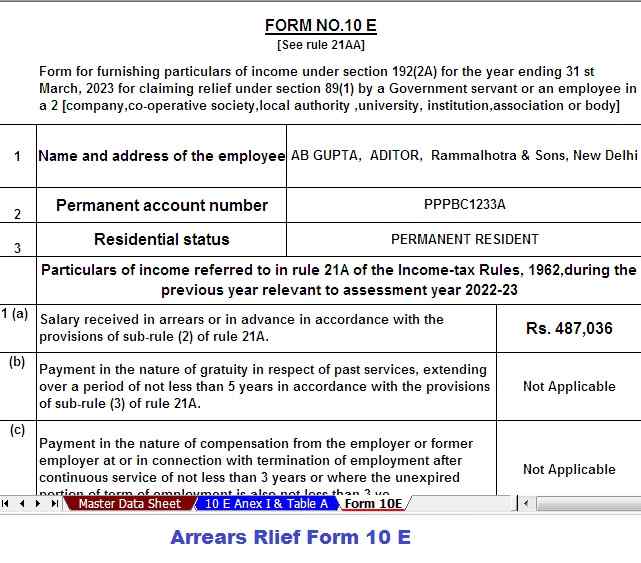
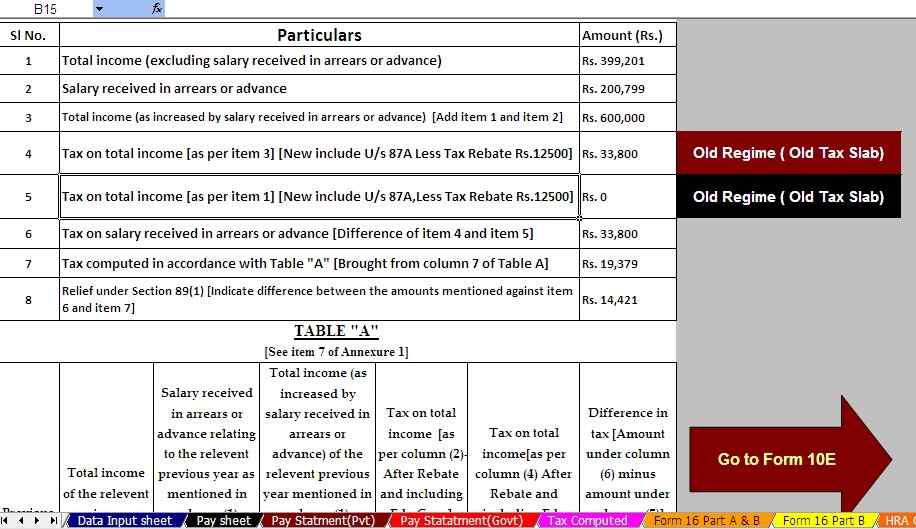
Showing posts with label Arrears Relief Calculator U/s 89(1). Show all posts

Sunday, 4 December 2022

Arrears Salary Relief Calculator A.Y 2023-24 for claiming relief u/s 89(1) in Excel

 Arrears Salary Relief Calculator A.Y 2023-24 for claiming relief u/s 89(1) in Excel|A.Y 2023-24 (F.Y

 2022-23) Calculator of arrears of pay for claiming deduction under section 89(1) of the Income Tax

 Act 1961-Download


In accordance with Section 89(1) of the Income Tax Act, a reduction in income tax was granted in 1961 when an employee receives an overdue or prepaid salary during the financial year. UnderRule 21AA of the Income Tax Rules, 1962, Form 10-E is filed for claiming the deduction.


According to the Act, if the employee is a government employee or is an employee of a society, cooperative, local government, university, institution, or body association, to claim exemption, the employee can submit his Form 10E her his responsible employer of payment of compensation as provided in Article 192, first paragraph, of the Income Tax Act, 1961


In all other cases, the valuer requesting the exemption requests it on Form 10E from his tax advisor. Relief under Section 89, paragraph 1, is allowed in the assessment year in which the employee receives arrears or advances.


Especially in the public sector, pay revisions have become more common. Since independence, six pay committees have been formed by the government so far. The retroactive recommendations of the committee have all resulted in salary delays. The rationale behind granting this exemption under section 89 is that as a result of payment of arrears or advances received by him in a particular financial year, the income of the employee for that financial year increases due to the amount of arrears or advances . . . . As a result, the employee's income is taxed at a higher rate than the income would have been taxed if no such advances or expenses had been incurred.


The steps involved in calculating the Article 89(1) exemption are essentially as follows:


First, expand the amount of arrears or advances received to the specific relevant financial year and recalculate the income tax for each year if the arrears were incurred in the same relevant financial year.


Then calculate the income tax for each of the fiscal years irrespective of arrears or advances received.


Third - removal of total income tax arrived at the 2nd stage of stage-1.


Fourth, you calculate the income tax for the financial year incurred by the arrears, including arrears/advances.


Fifth: compute the income tax for the financial year in which the arrears were collected, less arrears/advances.


Income tax of the sixth deduction reached stage 5 of income tax reached stage-4


Sixth - deduction of income tax reached stage-3 of income tax reached stage-6


The amount so entered is the amount of the deduction under section 89 (1).

DownloadAutomated Income Tax Arrears Relief Calculator U/s 89(1) along with Form 10E from the Financial Year 2000-01 to Financial Year 2022-23 (Up-to-date Version)

Arrears Salary Relief Calculator A.Y 2023-24

Arrears Salary Relief Calculator A.Y 2023-24


Thursday, 15 September 2022

Income Tax deduction under chapter VI-A | With Automated Income Tax Preparation Software in Excel for the Govt and Non-Govt Employees for the F.Y.2022-23

 Income Tax deduction under chapter VI-A|  Chapter VIA of the Income Tax Act contains several

 subsections of section 80 that allow the liquidator to claim deductions from the total gross income.


Chapter VIA of the Income Tax Law contains several subsections of section 80 which allow the liquidator to claim deductions from the total gross income from various investments to save taxes, eligible expenses, donations, etc. to reduce the tax payable.

Chapter VI A of the Income Tax Law has the following sections:


80C: Deduction in respect of life insurance premium, deferred annuities, pension fund (PF) contributions, subscriptions to certain shares or debentures, etc. The deduction limit is Rs 1.5 lakh including section 80CCC and section 80CCD(1 ).


80CCC: Deductible for contributions to certain pension funds. The deduction limit is Rs 1.5 lakh Including section 80C and section 80CCD(1).


80CCD(1): Deduction relating to the contribution to the Central Administration Pension Scheme - in the case of an employed person, 10 percent of wages (base + DA) and in any other case, 20 percent of your total gross income in the tax year will be exempt from taxes. The general limit is 1.5 lakh along with 80C and 80CCC.


80CCD(1B): Deductible up to Rs 50,000 against contributions to the Central Government Pension Scheme (NPS).


80CCD(2): A deduction relating to an employer's contribution to a Central Administration pension plan. A tax credit is available on an employer contribution of 14 percent when the central government contributes, and a tax credit of 10 percent when a contribution is made by any other employer.

 Download Automated Income Tax Revised Form 16 Part B for the Financial Year 2021-22 in Excel

form 16


80D: Deduction of health insurance premiums. Premium paid up to Rs 25,000 is eligible for deduction for individuals other than senior citizens. For the elderly, the limit is 50,000 rupees and the total limit of u/s 80D is 1 lakh rupees.


80DD: Deduction for maintenance, including treatment, of a disabled dependent. The limit in this section is Rs 75,000.


80DDB: Deduction for expenses up to Rs 40,000 for the treatment of a certain disease by a neurologist, oncologist, urologist, haematologist, immunologist or another specialist as prescribed.


80E: Graduate student loan interest deduction with no cap.


80EE: Interest deduction up to Rs 50,000 on residential property loan.


80EEA: Interest deduction up to 1.5 lakh on a loan taken out to purchase the certain residential property (affordable housing).


80EEB: Interest deduction of up to 1.5 lakh on a loan taken out to purchase an electric car.


80G: Donations to certain foundations, charities, etc. Depending on the nature of the donor, the limit ranges from 100 percent of the total donation to 50 percent of the total donation, or 50 percent of the donation, with a limit of 10 percent of gross income.


80GG: Deductions on income paid by self-employed individuals who do not receive HRA benefits. The deduction limit is Rs 5,000 per month or 25 percent of gross income per year, whichever is less.


80GGA: Full deductions for certain research or rural development grants.


80GGC: General deductions for donations to political parties provided such donations are not monetary donations.


80TTA: Deductions related to interest on savings accounts up to Rs 10,000 in the case of taxable persons other than senior citizens.


80TTB: Deductions related to interest on deposits up to Rs 50,000 in the case of senior residents.


80U: Disability deduction. Depending on the type and degree of disability, the maximum deduction allowed under this section is Rs 1.25 lakh.


Download Automated Income Tax Preparation Excel-Based Software All in One for the Government & Non-Government (Private) Employees for the F.Y.2022-23 and A.Y.2023-24

Income Tax deduction under chapter VI-A

Income Tax deduction under chapter VI-A

Feature of this Excel Utility:-


1) This Excel utility prepares and calculates your income tax as per the New Section 115 BAC (New and Old Tax Regime)


2) This Excel Utility has an option where you can choose your option as New or Old Tax Regime


3) This Excel Utility has a unique Salary Structure for Government and Non-Government employees Salary Structure.

Wednesday, 27 July 2022

Section 80 CCD(IB) Deductions| With Automated Income Tax Preparation Software All in One for the Government and Non-Government Employees for the F.Y.2022-23

 Section 80CCD(1B) Deduction: National Pension Scheme (NPS) tax credits

The income tax law prescribes various forms of deductions that help reduce your tax liability. There are a number of prescribed investments and expenses that you pay from your income that are allowed as investments or deductible expenses. Since these investments and expenses are deducted from your income, your taxable income is reduced. As your taxable income decreases, you pay less taxes.


What is Section 80 CCD(1B)?

In terms of deductions, some of the most popular deductions are found in Chapter VIA of the Income Tax Act. This chapter contains Section 80 deductions. Section 80C is a very popular section that allows you to deduct up to INR 1.5 Lakh for various types of investments and expenses. There is another section, Section 80 CCD (1B), which allows an additional deduction of INR 50,000 in addition to the deduction available in Section 80C for INR 1.5 lakh. A deduction under Section 80 CCD (1B) is allowed if you invest in the National Pension Scheme (NPS) offered by the Government of India.

Do you know what NPS investing is? Let's figure it out soon

Download and Prepare at a time 50 Employees Form 16 Part B for the Financial Year 2021-22

What is an NPS scheme?

The National Pension Scheme is a public investment scheme that helps plan for retirement. You can invest in the scheme while you are working, and then the scheme will create housing for your pension. The corpus can then be used to provide a regular income in the form of annuities.


Eligibility to invest in the NPS scheme

The investor must be between 18 and 60 years of age. However, in the case of an NRI, if the NRI's nationality changes after the NRI invests in the scheme, the scheme will be terminated.


Invest in NPS

Investments in NPS can be made through a financial institution acting as a Point of Presence (POP). Almost all banks and non-bank financial companies are authorized to act as POPs. POP has specialized agencies that collect NPS deposits from investors. These agencies are called Point of Presence Service Providers or POP-SPs. The POP-SP list can be found online at the scheme's official website https://www.npscra.nsdl.co.in/pop-sp.php - no application form, ID, or proof of age. and proof of residence.


Section 80 CCD(IB) Deductions


Section 80CCD(1B) Deduction: National Pension Scheme (NPS) tax credits

The income tax law prescribes various forms of deductions that help reduce your tax liability. There are a number of prescribed investments and expenses that you pay from your income that are allowed as investments or deductible expenses. Since these investments and expenses are deducted from your income, your taxable income is reduced. As your taxable income decreases, you pay less taxes.

Download and Prepare at a time 50 Employees Form 16 Part A&B for the Financial Year 2021-22


What is Section 80 CCD(1B)?

In terms of deductions, some of the most popular deductions are found in Chapter VIA of the Income Tax Act. This chapter contains Section 80 deductions. Section 80C is a very popular section that allows you to deduct up to INR 1.5 million for various types of investments and expenses. There is another section, Section 80 CCD (1B), which allows an additional deduction of INR 50,000 in addition to the deduction available in Section 80C for INR 1.5 lakh. A deduction under Section 80 CCD (1B) is allowed if you invest in the National Pension Scheme (NPS) offered by the Government of India.

Do you know what NPS investing is? Let's figure it out soon


What is an NPS scheme?

The National Pension Scheme is a public investment scheme that helps plan for retirement. You can invest in the scheme while you are working, and then the scheme will create housing for your pension. The corpus can then be used to provide a regular income in the form of annuities.


Eligibility to invest in the NPS scheme

The investor must be between 18 and 60 years of age. However, in the case of an NRI, if the NRI's nationality changes after the NRI invests in the scheme, the scheme will be terminated.


Invest in NPS

Investments in NPS can be made through a financial institution acting as a Point of Presence (POP). Almost all banks and non-bank financial companies are authorized to act as POPs. POP has specialized agencies that collect NPS deposits from investors. These agencies are called Point of Presence Service Providers or POP-SPs. The POP-SP list can be found online at the scheme's official website https://www.npscra.nsdl.co.in/pop-sp.php - no application form, ID, or proof of age. and proof of residence.


Download and Prepare at a time 100 Employees Form 16 Part B for the Financial Year 2021-22


NPS account type

When you invest in the National Pension Scheme, you will have two accounts to choose from. These accounts are:

Level I account

A Tier I account is a mandatory account that you would have to invest in if you were to invest in the National Pension Scheme. The minimum investment required for this account is INR 500 at one time and INR 1000 for one year.

Tier II account

A Tier II Account is a voluntary account that you can invest in after you invest in a Tier I Account. The minimum investment amount for a Tier II Account is INR 250 at any given time. No minimum investment per year is required. A minimum deposit of INR 1,000 is required to open an account.

Download Automated Income Tax Preparation Excel-Based Software All in One for the Government & Non-Government (Private) Employees for the F.Y.2022-23 and A.Y.2023-24


Section 80 CCD(IB) Deductions

Section 80 CCD(IB) Deductions

Income Tax Form 10 E

Feature of this Excel Utility:-


1) This Excel utility prepares and calculates your income tax as per the New Section 115 BAC (New and Old Tax Regime)


2) This Excel Utility has an option where you can choose your option as New or Old Tax Regime


3) This Excel Utility has a unique Salary Structure for Government and Non-Government employees Salary Structure.


4) Automated Income Tax Arrears Relief Calculator U/s 89(1) with Form 10E from the F.Y.2000-01 to F.Y.2022-23 (Update Version)


5) Automated Income Tax Revised Form 16 Part A&B for the F.Y.2022-23


6) Automated Income Tax Revised Form 16 Part B for the F.Y.2022-23

Thursday, 10 February 2022

Section 80U - Tax Deduction for Persons with Disabilities | With Automatic Income Tax Arrears Relief Calculator U/s 89(1) with Form 10 E + Automatic Form 16 for the F.Y.2021-22

 Section 80U - Tax Deduction for Persons with Disabilities| There are certain sections of the income tax

 laws of India which offer tax benefits to individuals if they or any member of their family suffers from

 certain disabilities. 

Section 80U tax deduction for persons with disabiulities

Section 80U provides tax benefits if an individual has a disability, while Section 80DD provides tax benefits if a dependent family member of an individual taxpayer has a disability. This article about on discussing the tax benefits in section 80U.

Download and prepare at a time 50 Employees Form 16 Part B for the Financial Year 2021-22 with the new and old tax regime 

Section 80U tax deduction for persons with disabiulities

Section 80U tax deduction for persons with disabiulities

Who can claim the deduction under section 80U

A resident person who has been certified as a person with a disability by a medical authority can claim tax benefits under section 80U. A disabled person is defined as having at least 40% of the disability ascertained by the health authorities.


Given below the purposes of this section,

blindness

low vision

freedom from leprosy

hearing problems

locomotor disability

mental delay

mental disease


This section also provides a definition of major disability which refers to a condition in which the disability is 80% or more. Major disabilities along with multiple disabilities, autism, and cerebral palsy.


Amount of deduction less than 80U

Deduction of Rs. 75,000 is allowed for the disabled and Rs. Deduction of 1.25.000 for people with severe disabilities.


Section 80U. Requirements for requesting the deduction pursuant to art

No documents are required in Form 10-IA other than a certificate of disability issued by a recognized medical authority. There is no need to submit an invoice for the cost of continued treatment or other similar expenses.

Download and prepare at a time 100 Employees Form 16 Part B for the Financial Year 2021-22 with the new and old tax regime 

Section 80U tax deduction for persons with disabiulities

To submit the application referred to in this section, it is necessary to submit a medical certificate certifying the disability together with the tax return referred to in Article 139 of the relevant AA. In the event that the certificate of assessment of invalidity has expired, it is still possible to request this deduction in the year of the expiry of the certificate. However, a new certificate will be required from next year to apply for Section 80U benefits.


Certificates can be obtained from official physicians who may be neurologists with a Doctor of Medicine (MD) degree in neurology (in the case of children, a pediatric neurologist with an equivalent degree) or civil surgeons in a government hospital or medical executive. ,


Note: If the invalidity is temporary and requires re-evaluation after a certain period, the validity of the certificate starts from the year of assessment relating to the year in which it was issued and during the assessment year relating to the financial year. in which the certificate expires.


Difference between section 80U and section 80DD

Section 80DD provides for the tax deduction for family members and relatives of the disabled taxpayer, while section 80U provides for the tax deduction for the disabled person.


Article 80DD is applicable when a taxpayer deposits a specific amount as an insurance premium for the assistance of their disabled employee. Under section 80DD, the deduction limit is the same as section 80U. Here, an employee refers to the assessor's siblings, parents, spouse, children, or a member of an integrated Hindu family.

Download Automatic Income Tax Arrears Relief Calculator U/s89 (1) with Form 10 E from the F.Y.2000-01 to F.Y.2021-22 (Updated Version)

Master Data Sheet
Annexure-I

Friday, 7 January 2022

Download Automated Income Tax Salary Arrears Relief Calculator U/s 89(1) with Form 10 E from the F.Y.2000-01 to F.Y.2021-22 (Updated Version)


Section 89 comes into play when salary / annuity or other parts are paid late or early. As outlined in Section 89, on the off chance that you simply receive financially or prepaid salary during a budget year due to which your total income for the year expands, which then builds up your taxable income, you will secure it. relief under Section 89. You should fill out Form 10E with these subtleties and then send it to your current manager to ensure relief. The 10E structure must be submitted online and no duplicate is required to be attached to the tax return.

This is how relief u / s 89 is decided

Step 1: ascertain the tax for the current year (counting termination and termination of education) on income by remembering the salary for arrears / advance / pay.

Step 2: Establish tax for the current year (counting the cessation and cessation of education) on income, unless wages are less than financial wages.

Step 3: Step 1 short Step 2

Step 4: Ascertain the tax for the year during which the salary (cees and cess education count) should be received on income by remembering the salary for arrears.

Step 5: Calculate the tax for the year during which the salary / salary should be obtained (counting the cessation and cessation of education) on income, save for the financially overdue salary

Step 6: Step 4 short Step 5

Phase 7: Deduction for arrears u / s 89 = Phase 3 short Phase 6 (if positive, in any case null)

Step 8: Tax Purchased Current Evaluation Year = Step 1 Short Step 7

Download Automated Excel Based Income Tax Salary Arrears Relief Calculator U/s 89(1) with Form 10E from the Financial Year 2000-01 to the Financial Year 2021-22 (Updated Version)

Download automated Income tax salary arrears relief calculator

Download automated Income tax salary arrears relief Calculator

form 10E

Wednesday, 28 April 2021

How to submit Salary Arrears Relief Calculation Form 10 E through online filling? With Automatic Income Tax Form 10 E for the F.Y.2020-21


Here are the steps on how to submit Form 10E:

1. Log in to your income tax e-filing account with a valid certificate

2. Select E-File >> Income Tax Forms

Form 10 E

Under "Form Name", select "Form No. 10 - Form Instantly for 89 years. Income Tax Form 10 E

Select the assessment year for which you need to file Form 10E

Form 10 E

1. Select the submission mode

2. Click "Continue"

3. Fill in the required details. And click "Save Draft" to save the form. 

Online filling Form 10 E

On the Form 10E tab, select the addition you want to fill out. The selected addition will then be available in an editable format. For arrears of pay, please select Attachment-1 

Form 10 E

  Addition-2 for gratuity (more than last five years but less than 15 years)


  Addition - For IIA gratuity (past service for 15 years or more)

  Attachment-3I for compensation for termination of employment

  Attachment - For Commitment of IV Pension 

Online Form 10 E

1. Hit “View & Submit" and submit form 10 E.

Relief under section 89 (1) for arrears is available in the following cases:

The advance salary was received as advance or arrears

Family pension received late as arrears

Received salary for more than 12 months in one financial year

Receive compensation from the employer as compensation for termination of employment

You may also, like- Prepare One by One Income Tax Automatic Form 16 Part A&B and Part B for the F.Y.2020-21 as per new and old tax regime  

Tax relief is an effective measure to ensure that taxpayers do not face problems with additional duties due to arrears. You will need to submit Form 10E to avoid paying additional taxes that you might otherwise pay. It should also be noted that relief is only allowed if the taxpayer's duty liability increases. No relief is provided unless liability is increased.


Also, keep in mind that if an employee receives VRS compensation, no relief will be provided under Section 89 if the taxpayer claims an exemption under section 10 (10C) for a VRS. Only one of these discounts can be claimed and the two cannot be clubbed together.


The 10th form for arrears is a simple form and does not require lots of input from your end. You must file Form 10E before filing your return. And if you fail to do so, you can expect a notice from the income tax department on the same subject.


If you wish to claim benefits under section 89 (1), submission of Form 10E is mandatory.

The steps outlined above will also help you file your Form 10E so that you do not have to worry about payments in arrears. For any problem related to arrears or reliance under section 89 (1) for tax filing, expert advice can help and assist in filing a return properly without any problems.

 You may also, like- Prepare One by One Income Tax Automatic Form 16 Part B for the F.Y.2020-21 as per new and old tax regime  

FAQs

1. Is it mandatory to file Form 10E?

Section 89 (1) will help you avoid additional taxes if you are receiving arrears of salary or pension. And for this to happen, you need to submit Form 10E. Therefore, it is mandatory to file Form 10E, only if you get the benefit of under 89 (1). 


2. How do I submit Form 10E?

You may submit Form 10E through the Income Tax e-filing website. For detailed steps on how to do this, you can refer to the steps described above. 


3. Will I be in arrears?

If you file Form 10E with proper details, you will not be charged any additional charges due to arrears. The Assessing Officer may grant a waiver. 


4) It is mandatory to attach a copy of Form 10E?

No, a copy of Form 10E does not need to be attached to the tax return. The form must be filled out and submitted online, but it is advisable to keep the document safely on record.

Download Automatic Income Tax Form 10E U/s 89(1) from the F.Y.2020-21 to F.Y.2020-21

Input Sheet from 10E
Income Tax Arrears Relief Form 10 E


Income Tax Arrears Relief Form 10 E

Friday, 28 August 2020

Download Automated Income Tax Salary Arrears Relief Calculator U/s 89(1) with Form 10 E from the F.Y.2000-01 to F.Y.2020-21 (Updated Version)


Section 89 comes in picture when salary/annuity or different parts are paid financially past due or advance. As indicated by Section 89, on the off chance that you get salary financially past due or advance in a budgetary year because of which your all-out income for the year expands, which thusly builds your taxable income, you can guarantee for relief under Section 89. You should fill up Form 10E with these subtleties and afterwards submit it to your current manager to guarantee the relief. Structure 10E must be submitted on the web and no duplicate is required to be connected with your tax return.

Here's the way relief u/s 89 is determined

Step 1: Ascertain tax for the current year (counting cess and instruction cess) on income remembering salary for arrears/advance/pay.

Step 2: Ascertain tax for the current year (counting cess and instruction cess) on income barring salary falling behind financial remunerations.

Step 3: Step 1 short Step 2

Step 4: Ascertain tax for the year in which salary should have been gotten (counting cees and instruction cess) on income remembering salary for arrears remunerations.

Step 5: Compute tax for the year in which salary/remuneration should have been gotten (counting cess and instruction cess) on income barring salary financially past due

Step 6: Step 4 short Step 5 


Step 7 : Relief u/s 89 = Step 3 short Step 6 (if positive, in any case, nil) 


Step 8: Tax paid for Current Appraisal year = Step1 short step 7


Sunday, 8 March 2020

Free Download Automated Master of Form 16 Part A&B for F.Y. 2019-20 and Automated Arrears Relief Calculator U/s 89(1) for F.Y. 2019-20 With Easy Investments to Save Tax u/s 80C

Advantages of Section 80C

You can guarantee most extreme conclusion of Rs 1.5 Lakhs u/s 80C (counting Sections 80CCC, 80CCD) by putting resources into qualified instruments. Sadly ventures and consumption permitted u/s 80C is excessively packed and that settles on the decision hard for the vast majority.

Uses Eligible for Tax Benefit

The initial step is to check all uses which are qualified for charge finding. The following is the rundown:

1. Education costs for up to 2 Children.

The costs on education costs for full time courses for limit of two child is qualified for reasoning u/s 80C. In any case, the reasoning isn't accessible for education cost to instructing classes or private educational costs. The accompanying costs are not considered as education costs – Development Fee, Transport charges, lodging charges, Mess charges, library expenses, Late fines, and so on.

Download And Prepare At a Time 100 Employees  Automated Income Tax Form 16 Part A&B (Modified Format) [This Excel Utility Prepare At a time 100 Employees Form16 Part A&B in New Format for A.Y. 2020-21]


 The main feature of this Excel Utility:-
1)   Prepare At time 100 Employees  Excel Based  Form 16 Part A&B ( Modified Format of Form 16 Part B Vide CBDT Notification No.36/2019 Dated 12/04/2019 ]
2)   All the Amended Income Tax Section have in this utility as per Budget 2019
3)   You can print individual Form 16 Part Part A&B
4)   Most easy to install just like an Excel File
5)   Easy to Fill the all column
6)   Automatic Convert the Amount to the In-Words
2. Stamp Duty for enrollment of New Home

Stamp obligation and enrollment energizes to Rs 1.5 Lakh can be asserted for conclusion u/s 80C. The installment ought to have been made in the equivalent money related year for which the expense is being paid. for example the conclusion can't be conveyed forward to one year from now. Likewise the house ought to be for the sake of assessee guaranteeing conclusion.

On the off chance that you have paid stamp obligation for new home, you most presumably would debilitate your 80C breaking point for the year and no further speculation may be required.

Mandatory Deductions

There are some mandatory findings that are qualified for tax break u/s 80C. Check on the off chance that you contribute in any of such derivations:

1. Fortunate Funds (EPF/VPF)

EPF is a necessary finding for most salaried representatives. The reasoning can be 12% of the essential compensation and dearness recompense or Rs 1,800 consistently. Take a gander at your pay explanation to realize what amount have you contributed for the year. Check just your commitment. Business' commitment isn't qualified for charge sparing speculation. You can likewise have some sum contributed through Voluntary Provident Fund (VPF), which can be up to 100% of the fundamental compensation and DA.

2. National Pension Scheme (NPS)

NPS (Tier 1) is obligatory for most Government representatives who joined after 2004. Take a gander at your pay slip to check your reasoning. Again just your commitment is legitimate derivation. Manager's commitment isn't qualified. The beneficial thing is you can utilize this commitment to guarantee extra duty conclusion up to Rs 50,000 under the recently presented Section 80CCD(1B). We have clarified this at the last passage of the post.

Repeating Deductions

There are a few reasonings which happen year on year like home advance reimbursement, protection premium and so forth.

1. Home Loan Principal Amount

Is it true that you are paying home advance? The important segment paid each year is qualified as duty reasoning. For this you can download the duty proclamation from banks' site. On the off chance that not get it from the advance supplier. This would give you a gauge of head and intrigue paid for the money related year.

2. Protection Premium

Have you purchased disaster protection items like ULIP, Endowment Plan or Term Insurance where you have to pay the premium for ensuing years? On the off chance that you need to keep putting resources into a similar you can keep on guaranteeing tax break.

3. PPF (open Provident Fund)

On the off chance that you have PPF account you ought to contribute least Rs 500 out of a monetary year. On the off chance that you don't do, a fine is exacted.

4. Sukanya Samriddhi Account (SSA)

Least store of Rs 1,000 should be made each year else punishment of Rs 50 is collected.

5. NPS

Do you have NPS account? A base commitment of Rs 1,000 is required each monetary year to keep the record dynamic.

For some individuals the 80C reasoning breaking point is come to at this point. In the event that not, browse the rundown beneath relying upon your hazard profile and speculation objectives:

Download And Prepare At a Time 50 Employees  Automated Income Tax Form 16 Part A&B (Modified Format) [This Excel Utility Prepare At atime 50 Employees Form 16 Part A&B in New Format for A.Y. 2020-21]

 The main feature of this Excel Utility:-
7)   Prepare At time 50 Employees  Excel Based  Form 16 Part A&B ( Modified Format of Form 16 Part B Vide CBDT Notification No.36/2019 Dated 12/04/2019 ]
8)   All the Amended Income Tax Section have in this utility as per Budget 2019
9)   You can print individual Form 16 Part Part A&B
10)                     Most easy to install just like an Excel File
11)                     Easy to Fill the all column
12)                     Automatic Convert the Amount to the In-Words
New Investment for 80C

1. Term Life Insurance

Do you have wards? Would they endure monetarily on the off chance that something transpires? Do you have enough life coverage? On the off chance that no go get a term protection first. It's imperative to decide on insurance first.

2. ELSS (Equity Linked Saving Scheme)

Prevalently known as Tax sparing Mutual Fund. These are value based common assets and outstanding amongst other venture alternatives to make riches over the long haul while sparing duty. In the event that you can process the instability of financial exchange, this is the prescribed alternative.

Lock-in Period: 3 Years
           Among the duty sparing ventures, ELSS has least lock-in time of 3 years.

           The gains on ELSS Fund is Tax Free.

           Convenient to purchase and oversee as ELSS can be purchased and recovered on the web.

           There can be significant instability in returns and you can get negative returns toward the finish of 3 years.

3. PPF (Public Provident Fund)

PPF is another mainstream charge sparing venture choice for 80C, particularly for individuals with no other opportune store.
Lock-in Period: 15 Years. Anyway fractional withdrawal is permitted from seventh year
           The premium earned on PPF is Tax Free

           After opening the PPF account, venture should be possible online consistently (for certain banks)

           Highest Safety – upheld by Govt. of India

           The lock-in is for a long time however there is halfway liquidity from seventh year on wards.

4. Senior Citizen's Saving Scheme (SCSS)
SCSS is great choice for senior residents (over 60 years old) as it gives ordinary quarterly premium salary legitimately in financial balance.

Lock-in: 5 years

           Highest Safety – upheld by Govt. of India

           The financing cost offered is most noteworthy among the little sparing plans

           The intrigue got is assessable.

           TDS would be deducted if the all out enthusiasm for a year is over Rs 10,000. Be that as it may, if qualified Form 15H can be submitted to keep away from TDS.


5. Sukanya Samriddhi Account (SSA)
SSA can be opened by guardians of young lady kid subject to specific conditions. SSA can be a decent choice for fixed salary speculation for kid. Anyway you ought to likewise put resources into ELSS or other value shared assets for objectives identified with kid.
Lock-in: Deposit to the record to be made for a long time and record develops at 21 years from date of opening

           The premium earned on SSA is Tax Free and furthermore higher than that offered to PPF

           50% withdrawal permitted when young lady turns 18 for marriage/advanced education

           Highest Safety – upheld by Govt. of India

           No arrangement of Loan or pre-developed withdrawal not at all like PPF


6. National Saving Certificate (NSC)

NSC can be purchased at present workplaces on spare expense u/s 80c. It is accessible for a long time (NSC VIII) as it were. The intrigue offered is 7.8%.

Lock-in: 5 Years

           The premium is higher than most expense sparing bank fixed stores.

           Certificates can be kept as insurance security to get advance from banks

           No Tax conclusion at source

           The intrigue gathered for NSC meets all requirements for Sec 80C reasoning in ensuing years

           Highest Safety – supported by Govt. of India

           The premium earned is assessable

           You need to visit Post office for purchasing and recovering NSC units. This can be an issue for individuals who move addresses regularly.


7. Relief from Saving Bank Fixed Deposits Interest Max Rs. 40,000/- and Sr.Citizen Rs. 50,000/- U/s 80TTA

8. NPS (National Pension Scheme)


Some of you may need to contribute necessarily to NPS. For this situation you can take finding up to Rs 50,000 under the recently presented Section 80CCD(1B). And afterward you can pick progressively proficient speculation for 80C.