Showing posts with label Form 10 E. Show all posts

Thursday, 15 September 2022

Income Tax deduction under chapter VI-A | With Automated Income Tax Preparation Software in Excel for the Govt and Non-Govt Employees for the F.Y.2022-23

 Income Tax deduction under chapter VI-A|  Chapter VIA of the Income Tax Act contains several

 subsections of section 80 that allow the liquidator to claim deductions from the total gross income.


Chapter VIA of the Income Tax Law contains several subsections of section 80 which allow the liquidator to claim deductions from the total gross income from various investments to save taxes, eligible expenses, donations, etc. to reduce the tax payable.

Chapter VI A of the Income Tax Law has the following sections:


80C: Deduction in respect of life insurance premium, deferred annuities, pension fund (PF) contributions, subscriptions to certain shares or debentures, etc. The deduction limit is Rs 1.5 lakh including section 80CCC and section 80CCD(1 ).


80CCC: Deductible for contributions to certain pension funds. The deduction limit is Rs 1.5 lakh Including section 80C and section 80CCD(1).


80CCD(1): Deduction relating to the contribution to the Central Administration Pension Scheme - in the case of an employed person, 10 percent of wages (base + DA) and in any other case, 20 percent of your total gross income in the tax year will be exempt from taxes. The general limit is 1.5 lakh along with 80C and 80CCC.


80CCD(1B): Deductible up to Rs 50,000 against contributions to the Central Government Pension Scheme (NPS).


80CCD(2): A deduction relating to an employer's contribution to a Central Administration pension plan. A tax credit is available on an employer contribution of 14 percent when the central government contributes, and a tax credit of 10 percent when a contribution is made by any other employer.

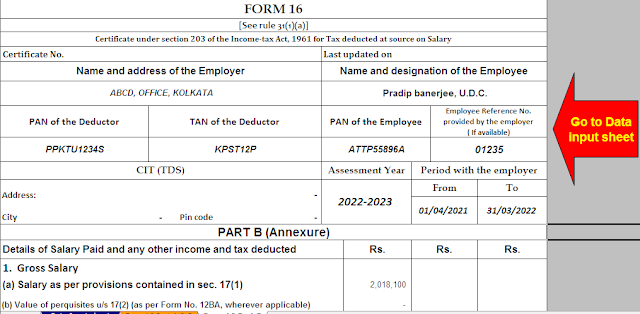
 Download Automated Income Tax Revised Form 16 Part B for the Financial Year 2021-22 in Excel

form 16


80D: Deduction of health insurance premiums. Premium paid up to Rs 25,000 is eligible for deduction for individuals other than senior citizens. For the elderly, the limit is 50,000 rupees and the total limit of u/s 80D is 1 lakh rupees.


80DD: Deduction for maintenance, including treatment, of a disabled dependent. The limit in this section is Rs 75,000.


80DDB: Deduction for expenses up to Rs 40,000 for the treatment of a certain disease by a neurologist, oncologist, urologist, haematologist, immunologist or another specialist as prescribed.


80E: Graduate student loan interest deduction with no cap.


80EE: Interest deduction up to Rs 50,000 on residential property loan.


80EEA: Interest deduction up to 1.5 lakh on a loan taken out to purchase the certain residential property (affordable housing).


80EEB: Interest deduction of up to 1.5 lakh on a loan taken out to purchase an electric car.


80G: Donations to certain foundations, charities, etc. Depending on the nature of the donor, the limit ranges from 100 percent of the total donation to 50 percent of the total donation, or 50 percent of the donation, with a limit of 10 percent of gross income.


80GG: Deductions on income paid by self-employed individuals who do not receive HRA benefits. The deduction limit is Rs 5,000 per month or 25 percent of gross income per year, whichever is less.


80GGA: Full deductions for certain research or rural development grants.


80GGC: General deductions for donations to political parties provided such donations are not monetary donations.


80TTA: Deductions related to interest on savings accounts up to Rs 10,000 in the case of taxable persons other than senior citizens.


80TTB: Deductions related to interest on deposits up to Rs 50,000 in the case of senior residents.


80U: Disability deduction. Depending on the type and degree of disability, the maximum deduction allowed under this section is Rs 1.25 lakh.


Download Automated Income Tax Preparation Excel-Based Software All in One for the Government & Non-Government (Private) Employees for the F.Y.2022-23 and A.Y.2023-24

Income Tax deduction under chapter VI-A

Income Tax deduction under chapter VI-A

Feature of this Excel Utility:-


1) This Excel utility prepares and calculates your income tax as per the New Section 115 BAC (New and Old Tax Regime)


2) This Excel Utility has an option where you can choose your option as New or Old Tax Regime


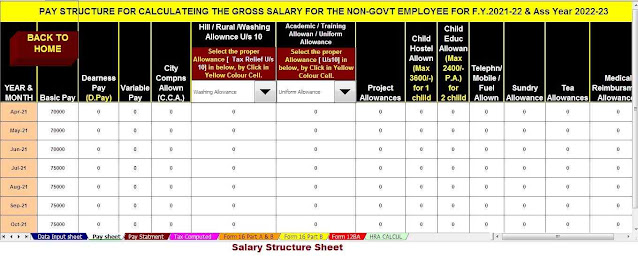
3) This Excel Utility has a unique Salary Structure for Government and Non-Government employees Salary Structure.

Thursday, 4 August 2022

Download Automatic Arrears Relief Calculator U/s 89(1) with Form 10 E for the F.Y.2022-23

 What is Section 89?

Download Automatic Arrears Relief Calculator U/s 89(1) with Form 10 E | For the purposes of the Income Tax Law, income tax is levied on the total income earned or received during the previous year by the taxable person. There are cases when past debts are paid to an employee in the current year as salary arrears. In this case, the income tax payable by the employee will in this case be higher in the current year. This may be due to a change in the flat rate applicable to the taxpayer, in connection with which his flat rate will change to a higher tax rate.


The Section 89 tax credit allows us to deal with this situation. Provides for an exemption if the employee is in a higher tax bracket at the time of receiving money for previous years.


How to calculate the tax exemption under section 89(1) for wage arrears?

Below are the detailed steps for calculating Section 89 assistance:


Step 1: We need to calculate the tax due on all income, including income owed in the year it was received.


Step 2: Calculate the tax payable on total income, excluding income owed in the year of receipt. As evidence, the employer provides the employee with an overdue document, which will indicate the additional amount received. This amount must be deducted from the total salary as stated on the worker's Form 16. The calculation of the tax would give us responsibility in case there were no delays.


Step 3: Calculate the difference between steps 1 and 2. This will be the additional payroll tax included in your total income.

Step 4: Calculate the tax payable for each previous year to which additional delays apply:


By total income, including additional debt

By total income without additional debt

Step 5: Calculate the sum of the difference between the amount calculated in step 4. This will calculate the actual tax liability for any previous years for which arrears were received in the current year.


Step 6: The amount in excess of step 3 over step 5 will be the amount of the tax exemption allowed by section 89. If there is no excess, no exemption is allowed. If the tax calculated in step 3 is less than the tax calculated in step 5, the employee does not need to apply for an exemption under section 89. 

Download Automated Excel Based Income Tax Salary Arrears Relief Calculator U/s 89(1) with Form 10E from the Financial Year 2000-01 to the Financial Year 2022-23 (Updated Version)

Download Automatic Arrears Relief Calculator U/s 89(1)

Income Tax Form 10E

Wednesday, 3 August 2022

Section 80 Income Tax Deductions|With All in One Tax Calculator for the F.Y.2022-23

 Worried about paying huge taxesevery year? Know these deductions that can reduce your tax payable.


Section 80C - Investment deductions from taxable income


Some of your investments offer more than just expected returns. You can also save on taxes. Section 80C investments are important examples of such investments. This deduction is eligible for the individual and Hindu undivided family (HUF). Deductions are available for some large investments such as:


Investments in the state pension fund (NPF)


Unit Linked Investment Plans (ULIP)


Equity Savings Schemes (ELSS)


Participation of employees in contributions to the Pension Fund


National Savings Certificates (NSCs)


Life insurance premium payment


Child education


Home loan repayment


Senior Savings Scheme (SCSS)


Maximum deduction: `1,50,000*


*The maximum deduction shown here only applies to the specific section. Also note that, in the aggregate, the maximum deduction that can be claimed under Section 80C, Section 80CC and 80CCD(1) is $1,50,000. In addition, an additional 50,000 may be claimed as a tax credit for investments in the National Pension Scheme (NPS) account pursuant to section 80CCD (1B).


Section 80 CCD - Withholding a contribution to a pension fund


It is designed to reduce the tax liability of pension plans offered by various public and private sector insurance companies. It provides a deduction to an individual who has paid or contributed an amount to any insurer's annuity plan to receive a pension (income) from a fund created by the insurer. The deduction of premium paid during the year may be claimed as a deduction from taxable income.

Maximum deduction: `1,50,000*

*The maximum deduction shown here only applies to the specific section. In addition, please note that the cumulative maximum deduction that can be claimed under Section 80C, Section 80CC and 80CCD(1) is $1,50,000.


In addition, an additional Rs.50,000 may be claimed as a tax credit for investing in an NPS account pursuant to section 80CCD (1B).


Section 80CCD. Deduction of contribution to the central government pension system.

A Section 80CCD deduction is permitted for individuals who make deposits into their retirement accounts.


The maximum deduction allowed is 10% of wages (in the case of employees) and 20% of gross income (in the case of self-employed persons) or £150,000, whichever is less. Under subsection 1B, there is an additional deduction of up to $50,000 for individual contributions to the NPS.

Maximum deduction: Rs.2,00,000*


* The maximum deduction shown here only applies to the specific section. Also note that, in the aggregate, the maximum deduction that can be claimed under Section 80C, Section 80CC and 80CCD(1) is Rs.1,50,000.


In addition, an additional Rs.50,000 may be claimed as a tax credit for investing in an NPS account pursuant to section 80CCD (1B).


Both of the sections mentioned above are related to pension plans and annuity plans. But there is a difference between them.


While Section 80CCD covers a deduction from the amount paid into an annuity plan by any insurer, Section 80CCD provides for a deduction from the amount paid into pension plans: NPS and Atal Pension Yojana.

Download Automated Income Tax Preparation Software All in One for the West Bengal Govt Employees for the F.Y.2022-23

Salary Structure

Main Feature of this Excel Utility:-

1) This Excel utility prepares and calculates your income tax as per the New Section 115 BAC (New and Old Tax Regime)


2) This Excel Utility has an option where you can choose your option as New or Old Tax Regime


3) This Excel Utility has a unique Salary Structure as per the West Bengal Govt Employee’s Salary Structure.


4) Automated Income Tax Revised Form 16 Part A&B for the F.Y.2022-23


5) Automated Income Tax Revised Form 16 Part B for the F.Y.2022-23


7) Individual Salary Sheet


Section 80D - Deduction of premium paid for health insurance

Section 80D allows a taxpayer to deduct up to $25,000 for insurance for self, spouse, and dependent children. If the insured is aged 60 or over, the deduction is available for up to EUR 30,000. An additional insurance deduction for parents (parent or both) is allowed in the amount of 25,000 (30,000 if the parents are 60 years of age or older). You can also claim a preventive health check-up to Rs.5,000 up to the limit above.

Maximum deduction: Rs.60,000


Section 80E - Deduction of Interest on an Educational Loan Taken for Higher Education

If you took out a student loan for higher education, you can claim a tax credit under Section 80E. It applies even if the loan may be to a spouse, children, or student for whom the taxpayer is legally responsible. A deduction is permitted from the amount of interest on the loan and is available for a maximum period of 8 years or until interest is paid, whichever comes first.

Download Automated Income Tax Preparation Software All in One for the Non-GovtEmployees for the F.Y.2022-23

Section 80 Income Tax Deductions


Main Feature of this Excel Utility:-

1) This Excel utility prepares and calculates your income tax as per the New Section 115 BAC (New and Old Tax Regime)


2) This Excel Utility has an option where you can choose your option as New or Old Tax Regime


3) This Excel Utility has a unique Salary Structure as per the West Non-Govt Employee’s Salary Structure.


4) Automated Income Tax Revised Form 16 Part A&B for the F.Y.2022-23


5) Automated Income Tax Revised Form 16 Part B for the F.Y.2022-23


7) Automated Income Tax Form 12 BA


You can even claim a deduction if the loan is made to fund study abroad.

Maximum deduction: no limits. The deduction is granted for 8 years.

Section 80GG - Tax deductions for paid rent for housing.


Under Section 80GG, you may claim a deduction for housing rent you paid if you did not receive Home Rent Assistance (HRA) from your wages. The taxpayer, spouse, or minor child must not have accommodation at the place of work. The taxpayer must live on rent and pay rent. In addition, the taxpayer must not have their own housing anywhere else.


The deduction under this section is available at least:

Rent paid minus 10% of the total rent

5000 per month

25% of total income

Maximum deduction: `60,000


Savings Account Interest Deduction - Section 80TTA

A deduction may be claimed under section 80TTA on interest income received from a bank savings account. Savings bank account interest must first be included in the Miscellaneous Income section when it is calculated, and the deduction may be deducted from the total interest earned or "10,000" whichever is less. Interest income on time deposits, regular deposits or interest income on corporate bonds cannot be reported under this section.

Maximum deduction: Rs.10,000

Download Automated Income Tax Preparation Excel-Based Software All in One for the Government & Non-Government (Private) Employees for the F.Y.2022-23 and A.Y.2023-24

 Section 80 Income Tax Deductions

Section 80 Income Tax Deductions

Section 80 Income Tax Deductions

Feature of this Excel Utility:-


1) This Excel utility prepares and calculates your income tax as per the New Section 115 BAC (New and Old Tax Regime)


2) This Excel Utility has an option where you can choose your option as New or Old Tax Regime


3) This Excel Utility has a unique Salary Structure for Government and Non-Government employees Salary Structure.


4) Automated Income Tax Arrears Relief Calculator U/s 89(1) with Form 10E from the F.Y.2000-01 to F.Y.2022-23 (Update Version)


5) Automated Income Tax Revised Form 16 Part A&B for the F.Y.2022-23


6) Automated Income Tax Revised Form 16 Part B for the F.Y.2022-23

Sunday, 3 July 2022

DOWNLOAD 89(1) ARREARS RELIEF CALCULATOR FROM F.Y.2000-01 TO FY 2022-23

 Download 89(1) Arrears Relief Calculator From F.Y.2000-01 to F.Y.2022-23|If you are in arrears in the

 2022-2023 tax year relating to the previous year(s), then your tax liability will be higher due to the

 arrears, but you know that you can split out your delayed income in the relevant years on a national

 basis and may avail of an exemption under section 89(1) of the Income Tax Act 1961.


The reason for providing this benefit under section 89 is that due to the payment of past due or advance wages received in a given fiscal year, the employee's income for that financial year is hiked by the amount advanced. In fact that a result, the employee's earnings are taxed at a higher rate than the rate at which his earnings would have been taxed were it not for such delays or advances.


DOWNLOAD 89(1) ARREARS RELIEF CALCULATOR

We have prepared a small Excel calculator that will be useful to calculate the write-off under section 89(1) of arrears received in the financial year 2022-23 and the debt is related to the maximum before the financial year 2000-01 through the financial year 2022-23.


How it works

This calculator shows two income tax calculations, one is a tax based on wages/debts received and the other is a tax based on qualifying years, if the tax based on the receipt is greater than the tax due based on qualifying years then section 89 exemption (1) will be available, otherwise, nothing will be available, which means there is no benefit from debt allocation in the respective years.


How to use. Note/Frequently Asked Questions on Using the Calculator


You must complete only the white column. If the arrears are in years other than those listed on the sheet, put zeros in the remaining optional years.

All white cells are optional, fill in only those that are required. Insert a zero where numbers are not needed


Fill in M ​​for men and F for women and S for Mr Citizen and N for the new article 115 tax regime (calculator does not work for very old retirees). You must choose a status each year. Make sure the status is correct


Complete total income excluding debt, including all other income and after all deductions such as section 80C, 80CC, 80D, 80G ...........80U, etc.


Complete the annual breakdown of the arrears received for the fiscal year 2022-2023 in the respective years. The total will automatically be shown in the fiscal year 2022-23.


The debt column (C-11 of the spreadsheet) in FY 2022-23 is protected and cannot be edited, if you received debt related to FY 2020-21 in FY 2022-23 itself, then you are not covered by the definition of debt and should be included in total income for 2022-2023 (Spreadsheet C-10).


The result is disregarded, if total A > total B, then relief will be taken in accordance with section 89(1), otherwise 0 will be shown. An additional form 10E will also be automatically completed with the appropriate annexe, including table-1. 

Download the Automated U/s 89 (1) Income Tax Arrearage Relief Calculator with Form 10E from FY 2000-01 to FY 2022-23(updated version)

DOWNLOAD 89(1) ARREARS RELIEF CALCULATOR

Form 10 E

Monday, 13 June 2022

Income tax arrears relief calculator u/s 89(1) downloads

     Download Automated Income Tax Arrears Relief Calculator U/s 89(1) with Form 10 E from the Financial       Year 2000-01 to the Financial Year 2022-23 

Income tax arrears relief calculator u/s 89(1) downloads

Income tax arrears relief calculator u/s 89(1) downloads

Form 10 E

Excel Form 10E - Withholding Salary A.Y 2023-24 Calculator of Benefits for Rebate under Section 89(1) Income Tax Act 1961 - Download


Under section 89(1) of the Income Tax Act 1961, an exemption from income tax was granted when an employee received late or advanced wages during a financial year. Under rule 21AA of the Income Tax Rules of 1962, Form 10-E was prescribed for benefits.


Subject to the above rule, if the worker is a government employee or an employee of a company, cooperative, municipality, university, institution, or association of bodies, he/she may, to claim compensation, file Form 10E with his/her employer, who is responsible for paying wages, as stated in subsection (1) section 192 of the Income Tax Act 1961


In all other cases, a person who is assessed as requiring an exemption must file a Form 10E application with their income tax inspector. An exemption under section 89(1) is permitted in the assessment year in which the employee received the delay or advance.


Wage reviews, especially in the public sector, have become commonplace. Since independence, the government has set up six payment commissions. Retroactive recommendations from each committee led to wage delays.


The reason for this section 89 benefit is that due to the payment of past due or advance wages received in a given fiscal year, the employee's income for that fiscal year is increased by the amount owed or advanced. As a result, the worker's earnings are taxed at a higher rate than the rate at which his earnings would have been taxed were it not for such delays or advances.

Friday, 8 April 2022

U/s 89 (1) Income Tax Exemption Calculator with Form 10E for F.Y 2022-23 (based on Budget 2022)

U/s 89 (1) Income Tax ExemptionCalculator with Form 10E |How can income tax arrears be exempted from wage arrears from the previous tax year? If we really assume you might be nervous about the tax consequences of the equivalent. Would it be okay for me to have to pay taxes on the total taxable amount? Shouldn't something be said about the previous year's tax checks etc? For taxpayers with such demands in mind, here's all you need to know.


For now, I recently found out that income tax is determined by the taxpayer's total income for a specific year. Income can be a salary, an annual family stipend, or various sources of income.


However, there may be circumstanceswhere you have received family benefits in arrears or your salary has come close during the current cash year. It may happen that a taxpayer gets a hint of her preferred status or salary early or late in any money-related year, accumulating her total income similarly as taxes payable increase. In such a case, an application can be filed and the inspection body may allow the taxpayer to be exempted.


In summary, the Income Tax Lawensures that there is value in the irregularity rates of the Income Tax, in this way, when no indication of income is related to the current year, the exemption is abandoned with the objective of that the taxable income does not increase.


To ensure that it does not interfere with the completion of additional taxes, the Income Tax Office grants you Relief U/s 89 (1). In the event that you have earned any annual salary or part of the previous year, you will not be taxed on the total amount of the current year. Basically, it prevented you from paying additional taxes by thinking about the path in which the partial delays occurred.


To take advantage of the provisions set forth in Section 89(1), you must file a Form 10E. Form 10E will be the most obvious request. The exact details of Form 10E, about how to file the amount, and why are listed below.


What is relief under section 89(1)?

Specifically when the taxpayer obtains:

1. Back wages or

2. Salary advance or

3. Arrears in family pensions


At this point, this amount is taxable in the cash year in which it was acquired.

In any case, the exemption is granted pursuant to section 89(1) to reduce additional tax inconveniences due to the deferral in obtaining such income.

How is the exemption under Section 89(1) calculated?


The following is the best approach for calculating the exemption under Section 89(1) of the Income Tax Act of 1961:

1. Calculate the tax to be paid on the total income by reviewing the arrears of the year in which they were accrued.

2. Calculate the tax to be paid on the total income regardless of the delay in the year in which they were accrued.

3. Calculation of the separation between some points in the measure of (1) and (2).

4. Tax to be paid on the total taxable income for the year to which the arrears refer, including arrears.

5. Calculate the separation between some points of the range (4) and (5).

6. The amount of the exemption is the amount of abundance (3) more than (6). No exemption will be allowed if quantity (6) is greater than the quantity in (3).


What is Form 10E?

To secure exemption under Section 89(1) for back wages earned, Form 10E is expected to be filed with the Department of Income Taxes. If the Form 10E is not filed and the exemption is granted, then the taxpayer is on track to receive a warning from the Income Tax Office for not filing the Form 10E.

Download the Automated U/s 89 (1) Income Tax Arrears Relief Calculator with Form 10E from F.Y 2000-01 to F.Y 2022-23 (updated version) 

Data input Sheet

U/s 89 (1) Income Tax Exemption Calculator with Form 10E

U/s 89 (1) Income Tax Exemption Calculator with Form 10E

Friday, 11 February 2022

Section wise income tax deductions list | With Automatic Income Tax Preparation Software in Excel for the Non-Govt Employees for F.Y.2021-22 and Automatic Income Tax Arrears Relief Calculator U/s 89(1) with Form 10 E for F.Y.2021-22


Section wise income tax deductions list | The deduction for the taxable amount is available in various sections of the Income Tax Act, 1961. The deduction must be mentioned on the relevant ITR form when filing the tax return.

Income Tax Deductions

Section 80C

The deduction in this section is only available for individuals and HUF. This section allows certain investments such as NSC, etc. to be exempt from taxation. and charges up to Rs.1,5 lakh.


Section 80CC

The deduction in this section applies to payments made to LIC or any other approved insurance company under an approved retirement plan. The pension policy should be up to Rs 1.5 lakh and should be deducted from the taxable income for the individual himself.


Section 80CCD

The deduction under this section is for the contribution to the New Pension Scheme by the assessor and the employer. The deduction is equal to the contribution, not exceeding 10% of his salary.

Download Automated Income Tax Preparation Excel Based Software All in One for the Non-Government(Private) Employees for the Financial Year 2021-22 and Assessment Year 2022-23U/s 115BAC


Section wise income tax deductions list

Section wise income tax deductions list

Feature of this Excel Utility:-


1) This Excel Utility Prepare Your Income Tax as per your option U/s 115BAC perfectly.


2) This Excel Utility has the all amended Income Tax Section as per Budget 2021


3) Automated Income Tax Form 12 BA


4) Automated Calculation Income Tax House Rent Exemption U/s 10(13A)


5) Individual Salary Structure as per the Non-Govt(Private) Concern’s Salary Pattern


6) Individual Salary Sheet


7) Individual Tax Computed Sheet


8) Automated Income Tax Revised Form 16 Part A&B for the F.Y.2021-22


9) Automated Income Tax Revised Form 16 Part B for the F.Y.2021-22


10) Automatic Convert the amount in to the in-words without any Excel Formula


The total deduction available under Sections 80C, 80CCC and 80CCD is Rs 1.5 lakh. However, the contribution to the pension scheme notified under section 80CCD is not counted in the limit of Rs 1,5 lakh.


Section 80D

This is the section that deals with the income tax deduction of insurance premiums paid. In the case of individuals, the insurance policy can be taken out for oneself, spouse, dependent children - up to Rs 15,000 and for parents (dependent or not) - up to Rs 15,000.


If the insured is a senior, an additional deduction of Rs 5,000 is applicable. In the case of HUF, any member can be insured and the normal deduction will be up to Rs 15,000 and there will be an additional deduction of Rs 5,000.

Total Rs. 2.0 lakhs can be claimed if the valuer is an individual or a HUF.


Section 80DDB

This section is for the deduction of medical expenses resulting from the treatment of diseases or illnesses specified in the rules (11DD) for the assessor, a family member or any member of the HUF.


Section 80E

This section deals with the deductions that apply to interest paid on education loans for education in India.

Download Automatic Income Tax Challan 280 in Excel for deposit the Self Assessment Tax and Advance Tax

Section wise income tax deductions list
Income Tax ITNS 280 Challan

Section 80EE

This section deals with the tax savings applicable to first homeowners. Applicable for people whose first home value is less than Rs 40 lakh and the loan is taken for which is Rs 25 lakh or less.


Section 80 TTA

This section deals with the tax savings that are applied to interest accrued in savings bank accounts, post offices or cooperatives. Individuals and HUFs can apply for the interest income deduction of up to Rs 10,000.


Section 80U

This section deals with the flat-rate deduction of income tax that applies to the handicapped, upon presentation of the certificate of disability. Up to Rs, 1.0 lakh may be non-taxable depending on the severity of the disability.


Section 24

This section deals with the interest paid on those real estate loans that are exempt from taxation. You can request a deduction of up to Rs 2,0 lakh per year and this is in addition to u / s deduction 80C, 80CCF and 80D. This is for self-occupied properties only. For the properties that have been leased, 30% of the rent received and the municipal taxes paid can benefit from the tax exemption.

Download Automated Income Tax Arrears Relief Calculator U/s 89(1) along with Form 10E from the Financial the Year 2000-01 to Financial Year 2021-22 (Up-to-date Version)

Section wise income tax deductions list

Thursday, 10 February 2022

Section 80U - Tax Deduction for Persons with Disabilities | With Automatic Income Tax Arrears Relief Calculator U/s 89(1) with Form 10 E + Automatic Form 16 for the F.Y.2021-22

 Section 80U - Tax Deduction for Persons with Disabilities| There are certain sections of the income tax

 laws of India which offer tax benefits to individuals if they or any member of their family suffers from

 certain disabilities. 

Section 80U tax deduction for persons with disabiulities

Section 80U provides tax benefits if an individual has a disability, while Section 80DD provides tax benefits if a dependent family member of an individual taxpayer has a disability. This article about on discussing the tax benefits in section 80U.

Download and prepare at a time 50 Employees Form 16 Part B for the Financial Year 2021-22 with the new and old tax regime 

Section 80U tax deduction for persons with disabiulities

Section 80U tax deduction for persons with disabiulities

Who can claim the deduction under section 80U

A resident person who has been certified as a person with a disability by a medical authority can claim tax benefits under section 80U. A disabled person is defined as having at least 40% of the disability ascertained by the health authorities.


Given below the purposes of this section,

blindness

low vision

freedom from leprosy

hearing problems

locomotor disability

mental delay

mental disease


This section also provides a definition of major disability which refers to a condition in which the disability is 80% or more. Major disabilities along with multiple disabilities, autism, and cerebral palsy.


Amount of deduction less than 80U

Deduction of Rs. 75,000 is allowed for the disabled and Rs. Deduction of 1.25.000 for people with severe disabilities.


Section 80U. Requirements for requesting the deduction pursuant to art

No documents are required in Form 10-IA other than a certificate of disability issued by a recognized medical authority. There is no need to submit an invoice for the cost of continued treatment or other similar expenses.

Download and prepare at a time 100 Employees Form 16 Part B for the Financial Year 2021-22 with the new and old tax regime 

Section 80U tax deduction for persons with disabiulities

To submit the application referred to in this section, it is necessary to submit a medical certificate certifying the disability together with the tax return referred to in Article 139 of the relevant AA. In the event that the certificate of assessment of invalidity has expired, it is still possible to request this deduction in the year of the expiry of the certificate. However, a new certificate will be required from next year to apply for Section 80U benefits.


Certificates can be obtained from official physicians who may be neurologists with a Doctor of Medicine (MD) degree in neurology (in the case of children, a pediatric neurologist with an equivalent degree) or civil surgeons in a government hospital or medical executive. ,


Note: If the invalidity is temporary and requires re-evaluation after a certain period, the validity of the certificate starts from the year of assessment relating to the year in which it was issued and during the assessment year relating to the financial year. in which the certificate expires.


Difference between section 80U and section 80DD

Section 80DD provides for the tax deduction for family members and relatives of the disabled taxpayer, while section 80U provides for the tax deduction for the disabled person.


Article 80DD is applicable when a taxpayer deposits a specific amount as an insurance premium for the assistance of their disabled employee. Under section 80DD, the deduction limit is the same as section 80U. Here, an employee refers to the assessor's siblings, parents, spouse, children, or a member of an integrated Hindu family.

Download Automatic Income Tax Arrears Relief Calculator U/s89 (1) with Form 10 E from the F.Y.2000-01 to F.Y.2021-22 (Updated Version)

Master Data Sheet
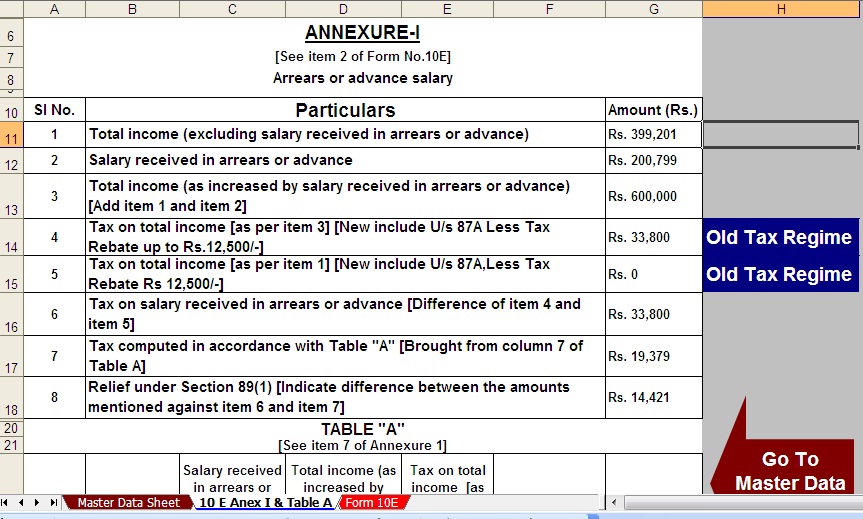
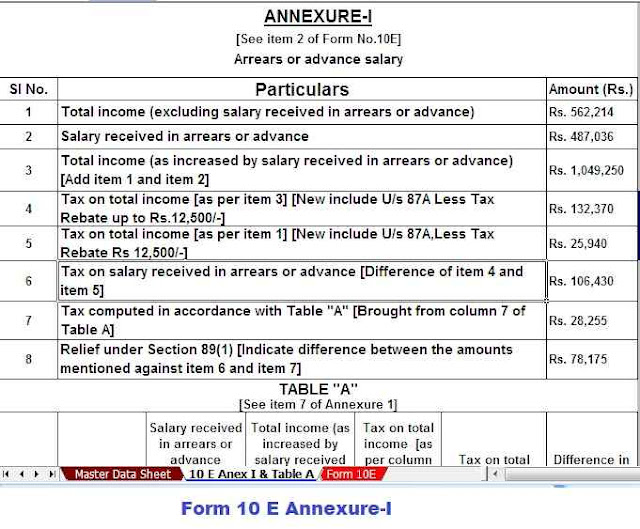
Annexure-I

Monday, 7 February 2022

Section 24 exemption from House Building Loan Interest along with Automatic Income Tax Arrears Relief Calculator U/s 89(1) with Form 10 E for the F.Y. 2021-22 and Automatic Income Tax Master of Form 16 Part B for the F.Y.2021-22

 Section 24 of the Income Tax Act deals with the interest an individual pays on a home or property loan.

 The name of this particular section is 'Domestic Property Income'. The discounts available are the loan

 interest and the standard deduction. 

section 24

There are several sections in the income tax law for obtaining the tax deduction on specific investments and expenses. One of the investments under constant legal pressure is the purchase of the residential property. The government recognizes that housing is the most important requirement as well as ownership, and many investments in your first home are tax-deductible.

Download Automatic Income Tax Arrears Relief Calculator U/s89 (1) with Form 10 E from the F.Y.2000-01 to F.Y.2021-22(Updated Version)

Section 24 exemption from house building loan interest

An important section related to a home loan in Section 24, allows you to apply for an exemption on the interest you pay on a home loan. Another section, Section 80C, allows you to apply for capital redemption tax benefits.


Section 24 is titled "Home Ownership Income Exemption". Income from home applies in the following cases:


If you are sending out, the rent received will be considered part of your income;

If you have more than 1 home, the annual net worth of the home, not including the home you live in, will count as your income.


If you only have 1 house and you live in it, the income from home ownership will be considered nil. Any rental income and the annual value of additional housing are subject to tax deduction under section 24.


Section 24. exemption Below


Here are two types of Income-tax deductions U/s 24 of the Income Tax Act:

Standard exemption: this is an exemption allowed for each taxpayer, where the amount equal to 30% of the net annual value is not covered by the tax ceiling. This does not apply if you are only occupying your home.


Interest on the loan: If you take out a mortgage to buy, build, or renovate a home, any interest you pay on the actual loan amount will be deductible from your tax payments. This category has the following 2 sub-categories, out of 2 in total.

Download and prepare at a time 50 Employees Form 16 Part B for the F.Y.2021-22 as per new and old tax regime.

 Form 16 Part B


If you take out a loan for a self-occupied property, you will have to pay  Rs. Discounts can be requested up to. 2 lakh.


If you take out a loan to buy or build a property (not a renovation), you can still request interest before actually buying or finishing its construction. You can request the deduction on interest paid before the completion of the construction or purchase, in 5 equal instalments from the year in which you bought or completed the house.


If the home is borrowed for renovations or renovations, you will not be able to apply for the tax deduction until the renovation is complete.


To get this exemption, you need to calculate the amount of interest you owe to the bank or financial institution you borrowed from, rather than the actual payment. It doesn't matter if you actually pay the lender the amount: you can get a discount on the entire amount of annual interest.


Exceptions under Section 24.


If the house is not in your possession, you can request the deduction of the entire amount of interest due without any maximum limit.


If you do not occupy the house because you live in another city for work or business reasons and you live in any other property or rental property in the city where you are employed, you can get the tax deduction only on the payment of interest. Rs. Can claim. , 2 lakh.


There is no exception to any brokerage or commission for loan or tenant arrangements.

To request the maximum deduction on the loan interest amount, the home must be purchased or completed within 3 years of the loan being granted. If the construction or purchase is not completed within 3 years, you will only have to pay Rs. Can claim. 30,000 instead of 2 lakhs.


The loan you are taking out must have a certificate of interest.


Download and prepare at a time 50 Employees Form 16 Part A&B for the F.Y.2021-22 as per new and old tax regime.

section 24 exemption from house building loan interest